
- Services
- Discovery & Intelligence Services
- Publication Support Services
- Sample Work

Publication Support Service
- Editing & Translation
-
Editing and Translation Services
- Sample Work

Editing and Translation Service
-
- Research Services
- Sample Work

Research Services
- Physician Writing
- Sample Work

Physician Writing Service
- Statistical Analyses
- Sample Work

Statistical Analyses
- Data Collection
- AI and ML Services
- Sample Work

AI and ML Services
- Medical Writing
- Sample Work
Medical Writing
- Research Impact
- Sample Work
Research Impact
- Medical & Scientific Communication
- Sample Work
Medical & Scientific Communication
- Medico Legal Services
- Educational Content
- Academic Editorial Services
- Sample Work
Academic Editorial Services
- Educational Editorial Service
-
Education Editorial Services
- Sample Work
Education Editorial Services
-
- Industries
- Subjects
- About Us
- Academy
- Insights
- Contact Us
What is Experimental Research Design? Definition, Examples, and Types of Designs
- Home
- Academy
- Experimental Design
- What is Experimental Research Design? Definition, Examples, and Types of Designs
High-Impact Journals
- Understanding Experimental Research Design
- Definition of Experimental Research Design
- Structure of an Experimental Design
- Types of Experimental Research Designs
- Comparative Overview of Experimental Designs
- Examples of Experimental Research Design
- Applications and Importance
- Challenges in Experimental Research Design
- Conclusion
Interesting topics
What is Experimental Research Design? Definition, Examples, and Types of Designs
1. Understanding Experimental Research Design
2. Definition of Experimental Research Design
3. Structure of an Experimental Design
4. Types of Experimental Research Designs
5. Comparative Overview of Experimental Designs
6. Examples of Experimental Research Design
7. Applications and Importance
8. Challenges in Experimental Research Design
9. Conclusion
One of the most powerful tools in the field of Research Methodology is experimental research design. It enables researchers to establish cause-and-effect relationships with clarity and precision. Unlike observational research design, research design in experiments involves manipulating variables to observe their direct effect. Such a research design is considered a foundation in many fields like psychology, medicine, education, and business analytics, highlighting the importance of scientific research design.[1]
1. Understanding Experimental Research Design
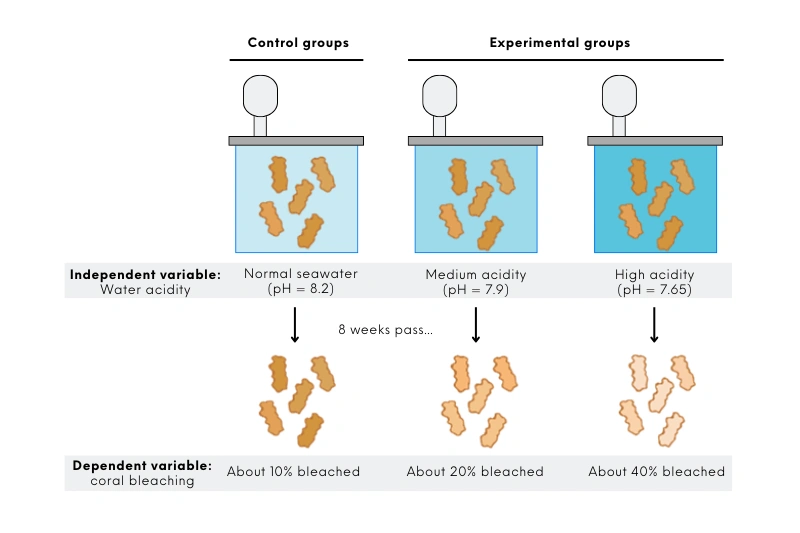
Experimental research design is a scientific technique whereby a researcher aims to manipulate one or more independent variables in a manner that controls all other factors to assess their effects on a dependent variable. The main concept of experimental research is based on control and randomisation, where a researcher aims to establish a cause-and-effect relationship by controlling all external factors using experimental research methods.
At its core, experimental research is based on three fundamental principles: manipulation, control, and randomisation. These three concepts are used in experimental research design to ensure that a researcher can effectively test a hypothesis in Behavioural Science and Clinical Research.[2]
2. Definition of Experimental Research Design
Experimental research design can be defined as a scientific approach wherein a researcher manipulates an independent variable, controls all extraneous variables, and observes the effect of this manipulation on a dependent variable. This definition reflects the essence of scientific research design. The definition points to its unique characteristic: its power to infer causality. Other research designs may establish relationships between variables; an experimental research design is able to establish if one variable directly affects another variable.
3. Structure of an Experimental Design
To understand how research design in experiments works in practice, it is helpful to examine its fundamental structure.[3]
| Component | Description |
|---|---|
| Independent Variable | The factor manipulated by the researcher |
| Dependent Variable | The outcome measured in the experiment |
| Control Group | A group that does not receive the experimental treatment |
| Experimental Group | A group that receives the treatment or intervention |
| Random Assignment | Process of assigning participants to groups without bias |
| Control Variables | Variables were kept constant to ensure validity |
This structured framework ensures that the results are reliable and reproducible, which is essential in fields such as Pharmacology and Educational Psychology and reflects strong experimental research methods.
4. Types of Experimental Research Designs
There are three categories of types of experimental research, and they differ in their level of control and precision.
- True Experimental Research Design: True experimental research design is considered the most robust and is often referred to as the gold standard. It allows researchers to establish causality by using randomisation and control groups. In this type of experimental research design, a variable is manipulated and measured. For example, a researcher wants to establish the effectiveness of a new drug. In this case, participants are randomly assigned a new drug or a placebo.
- Quasi-Experimental Research Design: he quasi-experimental research design is like true experimental research design but differs in that randomisation is not used. In this type of experimental research methods, a variable is manipulated and measured. For example, a researcher wants to establish the effectiveness of a new teaching technique in a classroom setting. [4]
- Pre-Experimental Research Design: The pre-experimental research design is considered the simplest type of research design and is not considered robust since it does not allow researchers to establish causality. In this type of research design in experiments, a variable is not properly controlled or manipulated.
5. Comparative Overview of Experimental Designs
| Design Type | Randomization | Control Group | Strength of Causality |
|---|---|---|---|
| True Experimental | Yes | Yes | High |
| Quasi-Experimental | No | Sometimes | Moderate |
| Pre-Experimental | No | No | Low |
This comparison illustrates how increasing control and randomisation enhances the reliability of findings.
6. Examples of Experimental Research Design

Experimental research examples are widely used in various industries and disciplines. In the medical sector, researchers carry out experiments in the form of randomised controlled trials to test the efficiency of a new medical treatment. In this experimental research design, the patients are divided into groups, where one group receives the medical treatment, and the other group receives a placebo.
In the education sector, researchers carry out experiments by testing the efficiency of a new educational technique by using it for one group of students, whereas the other group uses the conventional technique. By comparing the performance outcomes, the efficiency of the technique is ascertained.
The A/B testing research design is widely used in the business sector. In this research design in experiments, the efficiency of two versions of a product, advertisement, or website is compared to determine which one performs better. This is one of the most common experimental research examples used in digital platforms such as Google Analytics.
7. Applications and Importance
Experimental research design is instrumental in the development of knowledge and innovations. This is because it can establish causation, which is vital in decision-making in the fields of policymaking, healthcare, and technology development. It is through scientific research design that governments can assess their policies and that businesses can improve their products and services. [5]
In the field of scientific research, experimental research methods are vital in the testing of hypotheses and the validation of theories. This is because the results obtained can only be attributed to the observations and analysis made, and not coincidental.
8. Challenges in Experimental Research Design
However, despite the advantages, experimental research design is not without limitations. Ethical issues could pose a limitation in the manipulation of some variables, especially in medical research. In addition, practical factors could limit the research, especially if it is costly and time-consuming.
Another limitation in research design in experiments is the control of extraneous variables. In the real world, it is hard to separate the variables completely, which could impact the research results. In addition, biases could impact the research results.
Connect with us to explore how we can support you in maintaining academic integrity and enhancing the visibility of your research across the world!
Conclusion
Experimental research design is still one of the cornerstones of scientific research design and has provided a powerful framework for understanding cause-and-effect relationships. Whether in healthcare, education, business, agriculture, and many more areas of human endeavour, experimental research methods have remained powerful tools for innovation and informed action.
Experimental Research Design: Definition, Types, Examples and Applications. Our Pubrica consultants are here to guide you. [Get Expert Publishing Support] or [Schedule a Free Consultation]
References
- Miller, C. J., Smith, S. N., & Pugatch, M. (2020). Experimental and quasi-experimental designs in implementation research. Psychiatry research, 283, 112452. https://doi.org/10.1016/j.psychres
- Ranganathan P. (2019). Understanding Research Study Designs. Indian journal of critical care medicine : peer-reviewed, official publication of Indian Society of Critical Care Medicine, 23(Suppl 4), S305–S307. https://doi.org/10.5005/jp-journals-10071-23314
- Behi, R., & Nolan, M. (1996). The basic experimental design. British journal of nursing (Mark Allen Publishing), 5(9), 563–566. https://doi.org/10.12968/bjon.1996
- Capili, B., & Anastasi, J. K. (2024). An Introduction to Types of Quasi-Experimental Designs. The American journal of nursing, 124(11), 50–52. https://doi.org/10.1097/01.NAJ.000
- Yin, J., Ngiam, K. Y., & Teo, H. H. (2021). Role of Artificial Intelligence Applications in Real-Life Clinical Practice: Systematic Review. Journal of medical Internet research, 23(4), e25759. https://doi.org/10.2196/25759