
- Services
- Discovery & Intelligence Services
- Publication Support Services
- Sample Work

Publication Support Service
- Editing & Translation
-
Editing and Translation Services
- Sample Work

Editing and Translation Service
-
- Research Services
- Sample Work
Research Services
- Physician Writing
- Sample Work
Physician Writing Service
- Statistical Analyses
- Sample Work
Statistical Analyses
- Data Collection
- AI and ML Services
- Sample Work
AI and ML Services
- Medical Writing
- Sample Work
Medical Writing
- Research Impact
- Sample Work

Research Impact
- Medical & Scientific Communication
- Sample Work
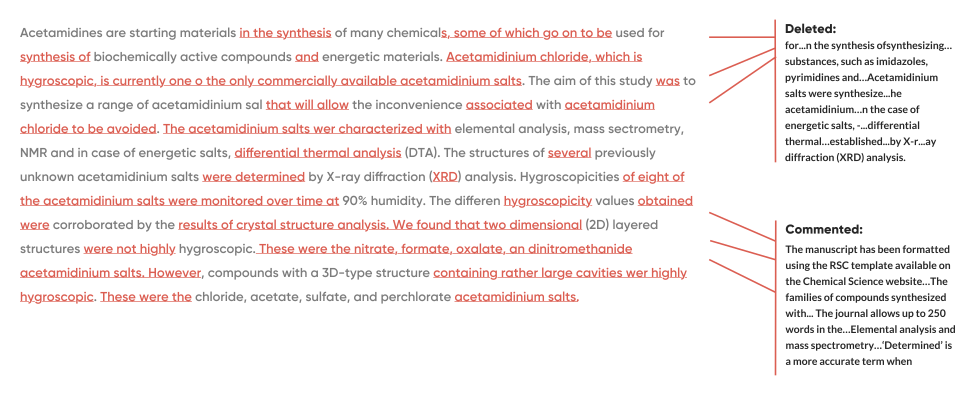
Medical & Scientific Communication
- Medico Legal Services
- Educational Content
- Academic Editorial Services
- Sample Work
Academic Editorial Services
- Educational Editorial Service
-
Education Editorial Services
- Sample Work
Education Editorial Services
-
- Industries
- Subjects
- About Us
- Academy
- Insights
- Contact Us
Biostatistics & Study Design Support: Sample Size, SAP, Survival Analysis & Regression
High-Impact Journals
- Why Biostatistics Matters in Study Design
- Sample Size and Power Calculation
- Statistical Analysis Plan (SAP)
- Survival Analysis for Time-to-Event Outcomes
- Regression Analysis in Clinical Research
- Current Trends in Biostatistical Study Design
- Common Statistical Challenges
- Integrated Biostatistical Workflow
- Practices for Reliable Statistical Analysis
- Conclusion
Interesting topics
Biostatistics & Study Design Support: Sample Size, SAP, Survival Analysis & Regression
Biostatistics is the basis for the design of studies, the analysis of clinical data, and the interpretation of results. Designing a good study involves more than simply choosing the statistical method to use after collecting the data. It includes sample size calculations, statistical analyses, survival analyses, regressions, missing data plans, and sensitivity analyses before even starting a study. Researchers may also seek biostatistics support services, study design consulting, and biostatistician for researchers to ensure appropriate statistical planning from the beginning.
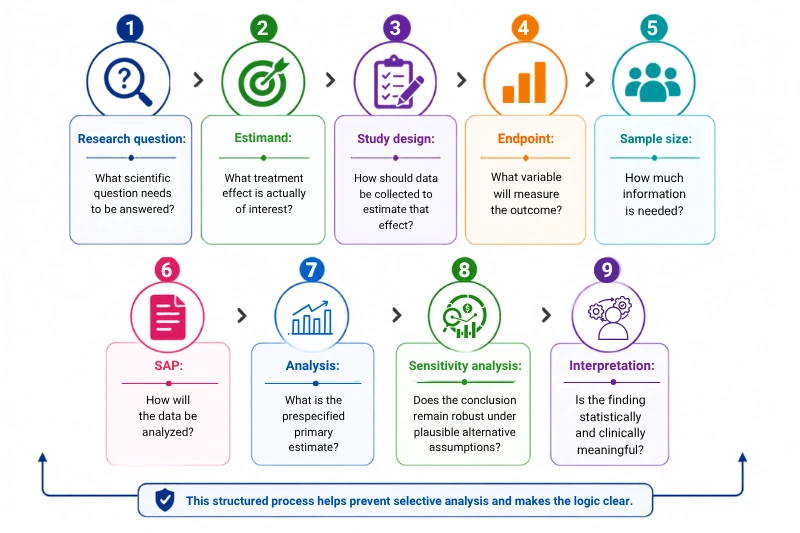
In clinical and biomedical research, statistical planning increasingly emphasizes clearly defining the treatment effect of interest within an estimand framework, selecting an appropriate study design, prespecifying the statistical analysis, adjusting for appropriate covariates, and evaluating whether conclusions remain robust under alternative assumptions. ICH E9(R1) emphasizes the connection between the research question, estimand, study design, data collection, analysis, sensitivity analysis, and interpretation. [1]
Research Question → Estimand → Study Design → Endpoint → Sample Size → Statistical Analysis Plan (SAP) → Analysis → Sensitivity Analysis → Interpretation
1. Why Biostatistics Matters in Study Design
Biostatistics plays a major role in translating a scientific question into a rigorous statistical study. Poor statistical planning can result in inadequate sample sizes, unrealistic assumptions, imprecise estimates, insufficient statistical power, inappropriate analyses, and conclusions that do not adequately address the research question. [2]
Important factors include:
- The main objective of the research study
- Adequate study design
- The estimand and treatment effect of interest
- Sample size and statistical power
- Pre-determination of population and methods of analysis
- Missing data and sensitivity analysis
According to the statistical principles of ICH E9, statistics is an important part of clinical trial design and analysis.
2. Sample Size and Power Calculation
Sample size calculation determines how many participants are required to detect a clinically meaningful effect with an acceptable probability of achieving statistical significance. Power analysis estimates the probability of detecting a specified effect under assumptions. However, statistical power should not be considered separately from clinical relevance. The assumed effect size should be justified based on what would represent a clinically meaningful difference.
The calculation depends on factors such as:
|
Parameter |
Role in Sample Size Planning |
|
Effect size |
Magnitude of the difference or association to detect |
|
Significance level |
Controls the probability of a Type I error |
|
Statistical power |
Probability of detecting a true effect |
|
Outcome variability |
Influences precision of the estimated effect |
|
Allocation ratio |
Determines participants assigned to study groups |
|
Expected dropout |
Accounts for participants who may not complete the study |
Sample-size planning should be linked to the primary endpoint and planned analysis, rather than performed independently from the study design.
3. Statistical Analysis Plan (SAP)
The Statistical Analysis Plan (SAP) describes in advance how the study data will be analyzed. A well-developed SAP helps distinguish confirmatory analyses from exploratory analyses and reduces the opportunity to select analytical methods after observing the results. Statistical analysis plan (SAP) services and SAP writing support can assist researchers in developing a structured analysis plan aligned with the study objectives. [3]
A typical SAP should cover the following issues:
- analysis population
- principal and secondary endpoints
- analysis methods
- adjustment for covariates
- approach to handling missing data
- subgroup analyses
- sensitivity analyses
- multiplicity issues
In clinical trials, analyses should be planned beforehand without considering the outcome of the study, or in case of blinding of investigators, at least before the blinding is broken. The recent FDA guidance on overall survival stresses this point.
4. Survival Analysis for Time-to-Event Outcomes
Survival analysis is used when the response variable is the time to the occurrence of an event such as death, recurrence of the disease, failure of treatment, and admission to hospital. Clinical trial statistics may incorporate survival analysis when evaluating time-to-event outcomes in clinical research.
Unlike ordinary regression techniques, survival analysis considers censoring in which the event does not occur, or the subject is lost to observation during the study period.
Common methods include:
Method | Primary Application |
Kaplan–Meier analysis | Estimating survival probabilities over time |
Log-rank test | Comparing survival distributions |
Cox proportional hazards model | Estimating treatment or covariate effects |
Parametric survival models | Modelling specified survival distributions |
Time-dependent models | Handling covariates that change over time |
5. Model assumptions and endpoint dependence
Assumptions of the model and dependency of endpoints. The survival analysis approach needs to be dependent thethe definition of the endpoint, estimand, the nature of censoring, follow-up schedule, and assumptions made by the statistical model used.
For instance, the Cox proportional hazards model depends on the proportional hazards assumption. Failure to satisfy this assumption implies that one hazard ratio cannot summarize treatment effect across the follow-up period.
Other options that may depend on the research question at hand could be:
- Time-dependent effects of treatment
- Stratified Cox models
- Restricted mean survival time
- Parametric survival models
- Other pre-specified time-to-event analyses.
The FDA “Approaches to Assessment of Overall Survival in Oncology Clinical Trials” is a draft guidance document for August 2025 and is specific on approaches for prespecified assessment of overall survival in randomized oncology trials. It is marked as a “Draft– Not for implementation.”
6. Regression Analysis in Clinical Research
Regression analysis allows researchers to examine relationships between outcomes and explanatory variables while accounting for relevant covariates. Regression analysis is therefore an important component of research data analysis plan development and clinical research statistics. [4]
Common approaches include:
Research Outcome | Typical Regression Approach |
Continuous outcome | Linear regression |
Binary outcome | Logistic regression |
Count outcome | Poisson or negative binomial regression |
Time-to-event outcome | Cox regression |
Repeated measurements | Mixed-effects or longitudinal models |
Regression modelling can improve precision when important prognostic variables are appropriately prespecified. FDA guidance published in 2026 also highlights covariate adjustment to improve statistical efficiency and precision in randomized clinical trials.
7. Current Trends in Biostatistical Study Design
Modern biostatistics is shifting its focus from traditional hypothesis testing to more holistic and flexible analysis approaches. [5]
- Estimand-Based Analysis: The estimand approach clearly articulates what treatment effect should be estimated in a clinical trial. This approach links the research question to the outcome, population, treatment intervention, and management of intercurrent events.
- Bayesian Clinical Trial Methods: The FDA released “Use of Bayesian Methodology in Clinical Trials of Drug and Biological Products: Draft Guidance for Industry” in January 2026. This document focuses on the application of Bayesian methodology in primary inference, interim analysis, adaptive designs, dose selection, and prior information.
- Adaptive Trial Designs: Adaptive designs permit modifications in certain features of a trial based on accrued evidence without compromising statistical validity. The ICH E20 draft guidance released in 2025 discusses planning, execution, analysis, and interpretation of adaptive clinical trials.
- Data-Driven and Computational Biostatistics: Modern statistical processes increasingly involve the use of computational tools, reproducible programming, machine learning, and data quality control. Such an approach can be used in addition to proper statistical design and clinical experience.
8. Common Statistical Challenges
Some of the issues that researchers might face while conducting their studies include the following:
- Small sample sizes or unrealistic assumptions
- Missing or partial data
- Assumption violations
- Multiple endpoints or subgroups
- Overfitting in regression models
- Bad handling of censoring
- Changing the statistical approach after-the-fact
Multiplicity becomes an important concern when there are many endpoints under consideration since it increases the chance of false positives. FDA guidelines recommend predefining the right strategies for dealing with multiple endpoints.
9. Integrated Biostatistical Workflow
Research Question → Estimand → Study Design → Endpoint → Sample Size → SAP → Analysis → Sensitivity Analysis → Interpretation
This integrated approach helps maintain a clear connection between the scientific objective and the statistical analysis.
Why this sequence matters
10. Practices for Reliable Statistical Analysis
Steps that should be undertaken by researchers include:
- Determination of goals and end points before analysis.
- Basing the sample size determination on justified assumptions.
- Conducting the SAP before the study results.
- Evaluation of the model assumptions and the sensitivity analyses.
- Presentation of the effect sizes along with the confidence interval rather than just using p-values.
The objective is not to seek statistical significance, but valid, reproducible, and interpretable results. [6]
Connect with us to explore how we can support you in maintaining academic integrity and enhancing the visibility of your research across the world!
Conclusion
Biostatistics plays an essential role in good quality clinical and biomedical research, starting from study design to results interpretation. Sample size calculation, SAP creation, survival analysis, and regression analysis are among several complementary approaches that will help address the research questions using proper statistical techniques.
Some recent developments such as the estimand concept, Bayesian approach, adaptive clinical trials, better covariates adjustment, and prespecification are adding to this statistical basis for clinical research. An effectively developed biostatistical approach will assist the researchers in obtaining statistically sound, transparent, and clinically meaningful results.
Biostatistics & Study Design Support: Sample Size, SAP, Survival Analysis & Regression. Our Pubrica consultants are here to guide you. [Get Expert Publishing Support] or [Schedule a Free Consultation]
Frequently Asked Questions (FAQs)
Biostatistics supports study design, sample size calculation, statistical analysis, interpretation of results, and evidence-based decision-making in clinical and biomedical research.
Sample size calculation helps determine the number of participants needed to detect a clinically meaningful effect with adequate statistical power while avoiding unnecessarily large or underpowered studies.
A Statistical Analysis Plan (SAP) is a pre-specified document describing how study data will be analysed. It typically covers endpoints, analysis populations, statistical methods, missing data, subgroup analyses, sensitivity analyses, and multiplicity.
Survival analysis is used when the outcome involves time until an event occurs, such as death, disease recurrence, treatment failure, or hospital admission. Common methods include Kaplan–Meier analysis and Cox regression.
Regression analysis examines relationships between outcomes and explanatory variables while allowing researchers to account for relevant covariates. The appropriate model depends on whether the outcome is continuous, binary, count-based, or time-to-event.
Researchers can consider biostatistics support services from the study-design stage through data analysis and interpretation. Support may include study design consulting, sample size calculation, power analysis, SAP writing support, survival analysis, regression analysis, and development of a research data analysis plan.
References
- Perera, M., & Dwivedi, A. K. (2020). Statistical issues and methods in designing and analyzing survival studies. Cancer reports (Hoboken, N.J.), 3(4), e1176. https://doi.org/10.1002/cnr2.1176
- Zapf, A., Rauch, G., & Kieser, M. (2020). Why do you need a biostatistician?. BMC medical research methodology, 20(1), 23. https://doi.org/10.1186/s12874-020-0916-4
- Watson H. J. (2025). A Statistical Analysis Plan Template for Observational Studies: Promoting Quality and Rigor in Research. Journal of statistical theory and practice, 19(4), 10.1007/s42519-025-00504-9. https://doi.org/10.1007/s42519-025-00504-9
- Zapf, A., Wiessner, C., & König, I. R. (2024). Regression Analyses and Their Particularities in Observational Studies—Part 32 of a Series on Evaluation of Scientific Publications. Deutsches Arzteblatt international, 121(4), 128–134. https://doi.org/10.3238/arztebl.m2023
- Yardibi, F., Chen, C., Aladag, C. H., & Kose, O. (2025). Current Trends and Future Directions of Statistical Methods in Medical Research: A Scientometric Analysis. Journal of evaluation in clinical practice, 31(6), e70257. https://doi.org/10.1111/jep.70257
- Mishra, P., Pandey, C. M., Singh, U., Keshri, A., & Sabaretnam, M. (2019). Selection of appropriate statistical methods for data analysis. Annals of cardiac anaesthesia, 22(3), 297–301. https://doi.org/10.4103/aca.ACA_24