
- Services
- Discovery & Intelligence Services
- Publication Support Services
- Sample Work

Publication Support Service
- Editing & Translation
-
Editing and Translation Services
- Sample Work

Editing and Translation Service
-
- Research Services
- Sample Work
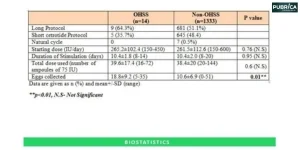
Research Services
- Physician Writing
- Sample Work
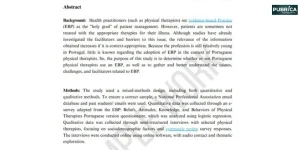
Physician Writing Service
- Statistical Analyses
- Sample Work
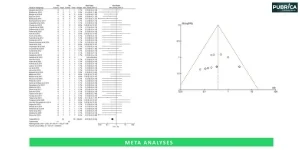
Statistical Analyses
- Data Collection
- AI and ML Services
- Sample Work
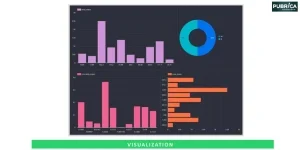
AI and ML Services
- Medical Writing
- Sample Work
Medical Writing
- Research Impact
- Sample Work
Research Impact
- Medical & Scientific Communication
- Sample Work
Medical & Scientific Communication
- Medico Legal Services
- Educational Content
- Academic Editorial Services
- Sample Work
Academic Editorial Services
- Educational Editorial Service
-
Education Editorial Services
- Sample Work
Education Editorial Services
-
- Industries
- Subjects
- About Us
- Academy
- Insights
- Contact Us
Meta-Analysis for High-Impact Journals: GRADE Certainty, Heterogeneity & Reproducibility
High-Impact Journals
- Understanding Meta-Analysis in High-Impact Research
- Why GRADE Certainty Assessment Matters
- Managing Heterogeneity in Meta-Analysis
- Improving Reproducibility in Meta-Analysis
- Integrating GRADE, Heterogeneity, and Reproducibility
- Common Challenges in Meta-Analysis and Their Solutions
- Essential Strategies for Publishing High-Quality Meta-Analyses
- The Future of Meta-Analysis and Evidence Synthesis
- Conclusion
Interesting topics
Meta-Analysis for High-Impact Journals: GRADE Certainty, Heterogeneity & Reproducibility
Meta-analysis has emerged as one of the top forms of evidence in the realm of evidence-based research as it entails the numerical representation of results from various independent studies. Nowadays, high impact journals have been requiring that any systematic review and meta-analysis for high-impact journals must be transparent and statistically strong along with reproducible in nature. Other than synthesizing results of various studies, researchers are required to perform an appropriate GRADE certainty of evidence assessment using the GRADE approach to evidence synthesis, take care of heterogeneity in meta-analysis, and ensure reproducibility in meta-analysis throughout their entire analysis.
A good meta-analysis enhances the credibility of science and helps in making evidence-based decisions. This paper will focus on the importance of GRADE certainty assessment, heterogeneity analysis, and reproducibility in developing journal-worthy meta-analyses.[1]
1. Understanding Meta-Analysis in High-Impact Research
Meta-analysis refers to a type of statistical analysis which pools the results of several similar studies to produce an overall estimate for the intervention or relationship under investigation. Meta-analysis together with a systematic review methodology reduces the effects of random errors and increases statistical power.[2]
High-impact journals usually demand that the authors show:
- Extensive literature search
- Study selection transparency
- Adequate statistical models
- Certainty of evidence
- Analytical reproducibility
These aspects increase the robustness of published results.
2. Why GRADE Certainty Assessment Matters
Grading of Recommendations Assessment, Development and Evaluation (GRADE) methodology has a systematic process for measuring the quality of the research evidence.[3]
It does not just measure the statistical significance of the results but the level of confidence that the readers should have in the results.
GRADE Evaluation Domains
GRADE Domain | Purpose |
Risk of Bias | Evaluates methodological quality of included studies |
Inconsistency | Assesses variability between study findings |
Indirectness | Determines applicability of evidence to the research question |
Imprecision | Evaluates confidence intervals and sample size adequacy |
Publication Bias | Identifies selective publication of positive findings (publication bias assessment) |
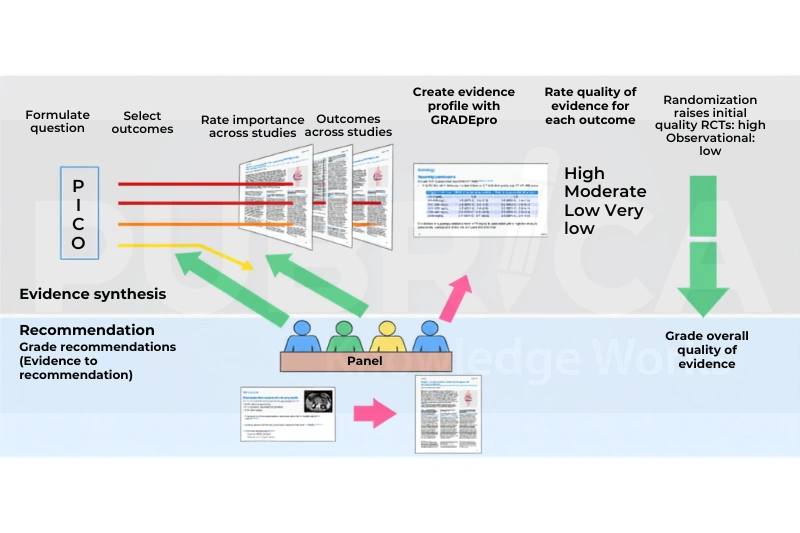
GRADE classifies evidence into four certainty levels:
Certainty Level | Interpretation |
High | Very confident in the estimated effect |
Moderate | Moderately confident; future evidence may change conclusions |
Low | Limited confidence in current estimates |
Very Low | Evidence remains highly uncertain |
Applying GRADE strengthens the interpretation of meta-analysis findings, improves evidence quality grading, and aligns with recommendations from organisations such as Cochrane and the World Health Organisation.
3. Managing Heterogeneity in Meta-Analysis
Heterogeneity refers to differences among included studies that may influence pooled estimates. Ignoring heterogeneity can lead to misleading conclusions and reduced publication quality.
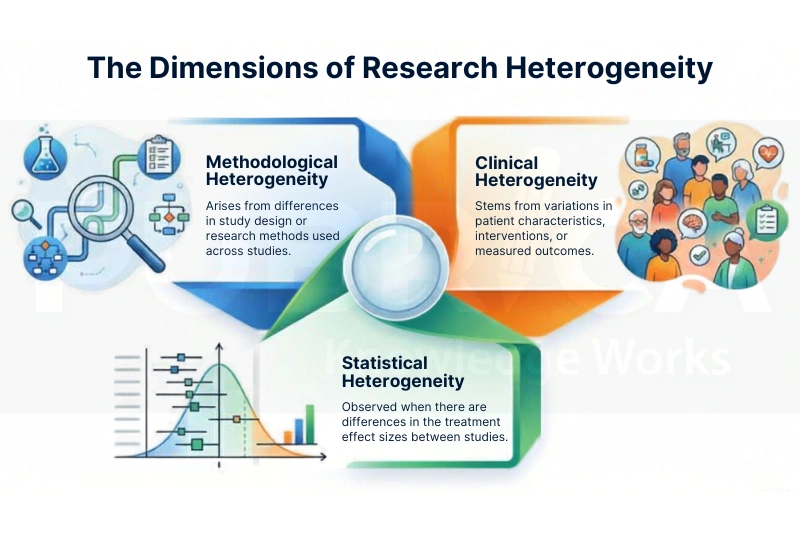
Heterogeneity can arise from several sources:
Type | Description |
Clinical | Differences in participants, interventions, or outcomes |
Methodological | Variations in study design or quality |
Statistical | Differences in reported effect sizes |
Researchers commonly evaluate heterogeneity using:
- Cochran’s Q Test
- I² statistic and heterogeneity
- Tau² Variance
These methods are fundamental for statistical heterogeneity testing. And I² value above 50% generally indicates moderate-to-high heterogeneity, often requiring a random-effects vs fixed-effects model decision or additional subgroup analyses.
4. Improving Reproducibility in Meta-Analysis
Reproducibility is when other scientists can reproduce your results based on the exact same methodology and dataset. Top-notch journals are increasingly demanding complete transparency from the beginning to the end of the research process while following internationally accepted meta-analysis reporting standards.
Reproducibility should involve such aspects as:
- Presence of protocol registration before the review (e.g., PROSPERO)
- PRISMA 2020 guidelines
- Search strategies
- Extracted datasets where applicable
- Software and its version for analysis
- Code for analysis where possible
5. Integrating GRADE, Heterogeneity, and Reproducibility
The highest-quality meta-analyses integrate all three components into a unified workflow.[4]
Research Stage | Recommended Practice |
Literature Search | Comprehensive database searching |
Study Selection | PRISMA guidelines for meta-analysis (PRISMA 2020-compliant screening) |
Quality Assessment | Risk of Bias evaluation |
Data Analysis | Appropriate fixed/random-effects model |
Heterogeneity Assessment | I², Q-test, subgroup analysis |
Evidence Assessment | GRADE certainty evaluation |
Reporting | |
Reproducibility | Share protocols, code, and datasets |
6. Challenges in Meta-Analysis and Effective Solutions
Challenge | Recommended Solution |
High study heterogeneity | Perform subgroup and sensitivity analyses to explore variability. |
Small sample sizes | Interpret pooled effect estimates cautiously and discuss limitations. |
Missing outcome data | Contact study authors or apply appropriate sensitivity analyses. |
Publication bias | Assess bias using funnel plots and Egger’s regression test. |
Incomplete or poor reporting | Adhere to the PRISMA 2020 reporting guidelines. |
Systematically addressing these challenges enhances the methodological quality, transparency, and likelihood of publication in peer-reviewed journals.
7. Essential Strategies for Publishing High-Quality Meta-Analyses
To improve the quality, transparency, and publication success of your meta-analysis, consider the following best practices:[5]
- Develop and Register a Protocol: Prepare and register your review protocol before data collection begins.
- Perform a Comprehensive Literature Search: Search multiple databases to ensure complete and unbiased evidence retrieval.
- Assess Risk of Bias: Use standardised risk-of-bias assessment tools to evaluate study quality.
- Evaluate the Certainty of Evidence: Apply the GRADE framework to assess the strength and reliability of the findings.
- Analyse Heterogeneity Appropriately: Use suitable statistical methods to identify and interpret variability among studies.
- Conduct Sensitivity and Subgroup Analyses: Explore the robustness of results and potential sources of heterogeneity when necessary.
- Follow PRISMA 2020 Reporting Guidelines: Report methods and findings transparently to meet international publication standards.
- Promote Research Transparency: Share analytical methods, datasets, and supplementary materials whenever possible.
Adhering to these practices strengthens scientific rigor, improves reproducibility, and increases the likelihood of publication in high-impact peer-reviewed journals.
8. The Future of Meta-Analysis and Evidence Synthesis
The introduction of new technologies is transforming the synthesis of evidence using techniques such as artificial intelligence, machine learning, data extraction and curation, living systematic review and open science projects. With the integration of GRADE and reproducibility, these technological advancements will facilitate the continuous production of meta-analyses.[6]
Connect with us to explore how we can support you in maintaining academic integrity and enhancing the visibility of your research across the world!
Conclusion
Conducting an evidence synthesis of good quality that is publishable in top scientific journals not only entails the use of sophisticated statistics but also includes assessing certainty of evidence using the GRADE approach, proper handling of heterogeneity, and implementing reproducibility practices. This will ensure credibility of the review process in addition to fulfilling the requirements of top journals. The following are the steps for conducting a good review that incorporates internationally accepted reporting standards and sound statistics.
Meta-Analysis for High-Impact Journals: GRADE Certainty, Heterogeneity & Reproducibility. Our Pubrica consultants are here to guide you. [Get Expert Publishing Support] or [Schedule a Free Consultation]
Frequently Asked Questions (FAQs)
A meta-analysis is a statistical method that combines data from multiple independent studies to produce a more precise estimate of an intervention or outcome. It strengthens evidence-based research by improving statistical power and supporting informed clinical and policy decisions.
The GRADE (Grading of Recommendations Assessment, Development and Evaluation) approach is a standardized framework used to assess the certainty or quality of evidence. It evaluates factors such as risk of bias, inconsistency, indirectness, imprecision, and publication bias.
Heterogeneity refers to the variability among included studies in terms of participants, interventions, study design, or outcomes. It is commonly assessed using Cochran’s Q test, the I² statistic, and Tau² to determine whether differences between studies affect the pooled results.
Reproducibility ensures that other researchers can verify and replicate the findings using the same methods and data. It improves research transparency, enhances scientific credibility, and meets the expectations of high-impact journals.
Researchers can improve quality by registering a review protocol, conducting comprehensive literature searches, following PRISMA 2020 guidelines, applying the GRADE framework, evaluating heterogeneity appropriately, and sharing analytical methods and datasets whenever possible.
Common challenges include high study heterogeneity, small sample sizes, missing outcome data, publication bias, and incomplete reporting. These issues can be addressed through subgroup and sensitivity analyses, standardized reporting guidelines, and rigorous methodological practices.
References
- Strawbridge, R., Sharma, D., Kisely, S., Cristea, I. A., Young, A. H., & Kaufman, K. R. (2025). Enhancing the quality of systematic reviews and meta-analyses. BJPsych open, 11(6), e266. https://doi.org/10.1192/bjo.2025.10876
- Fang, X., Zhao, N., & Zhu, Z. Q. (2021). Overview of meta-analysis. Ibrain, 7(1), 52–56. https://doi.org/10.1002/j.2769-2795.2021.tb00065.x
- Zeng, L., Brignardello-Petersen, R., & Guyatt, G. (2021). When applying GRADE, how do we decide the target of certainty of evidence rating?. Evidence-based mental health, 24(3), 121–123. Advance online publication. https://doi.org/10.1136/ebmental-2020-300170
- Liu, C., Zhou, D., Xu, W., Pan, H., Wang, X., Peng, J., Ji, X., Huang, J., & Zhu, Z. (2025). Umbrella Reviews: Concepts, Methodological Frameworks, and Step-by-Step Implementation. Journal of evidence-based medicine, 18(4), e70092. https://doi.org/10.1111/jebm.70092
- Glisic, M., Raguindin, P. F., Gemperli, A., Taneri, P. E., Salvador, D. J., Voortman, T., Marques Vidal, P., Papatheodorou, S. I., Kunutsor, S. K., Bano, A., Ioannidis, J. P. A., & Muka, T. (2023). A 7-Step Guideline for Qualitative Synthesis and Meta-Analysis of Observational Studies in Health Sciences. Public health reviews, 44, 1605454. https://doi.org/10.3389/phrs.2023.1605454
- Riaz, I. B., Naqvi, S. A. A., Hasan, B., & Murad, M. H. (2024). Future of Evidence Synthesis: Automated, Living, and Interactive Systematic Reviews and Meta-analyses. Mayo Clinic proceedings. Digital health, 2(3), 361–365. https://doi.org/10.1016/j.mcpdig.2024.05.023