

Graphical vs. Video Abstracts: Tools for Clear and Engaging Scientific Communication
High-Impact Journals
- What Are Graphical and Video Abstracts?
- Why Visual Research Communication Matters
- Comparison Between Graphical and Video Abstracts
- Advantages of Graphical Abstracts
- Advantages of Video Abstracts
- Challenges of Each Format
- Best Practices for Effective Abstract Design
- Future Trends in Visual Scientific Communication
- Conclusion
Interesting topics
Graphical vs. Video Abstracts: Tools for Clear and Engaging Scientific Communication
Scientific communication has developed from basic text-only abstracts to visual and media formats that increase access to research and create interest. An example of new formats in communicating complex research to many different audiences are graphical abstracts and video abstracts. Both formats are intended to enhance the visibility and understanding of research but differ in how the information is presented, how the audience engages with the information, and the resources needed to produce each format. The choice of the format for communicating research can have a significant impact on how research is shared, interpreted, and referenced. [1]
1. What Are Graphical and Video Abstracts?
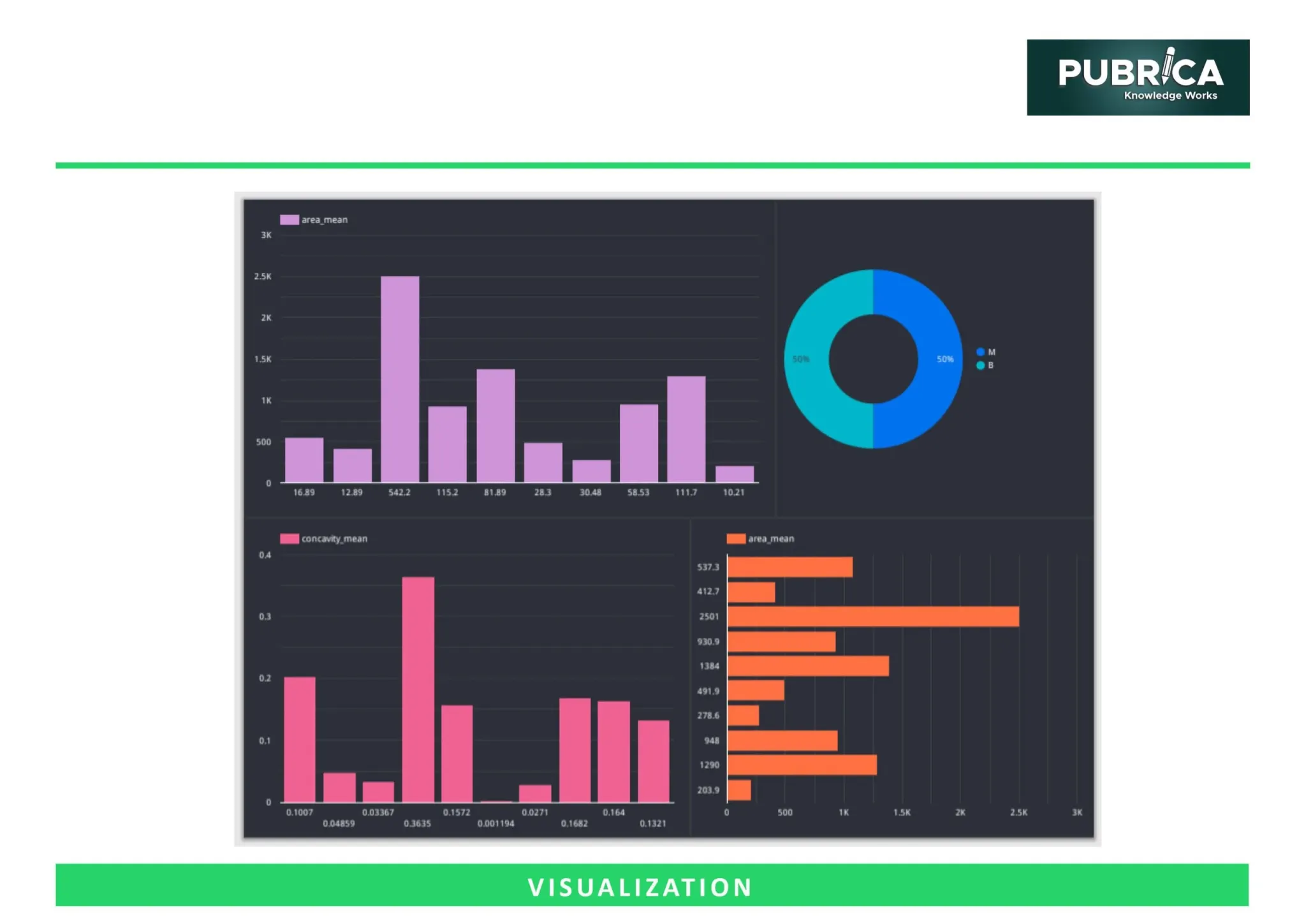
Graphical abstracts in scientific communication refer to pictorial representations summarising the main theme of the research by using charts, images, icons, and textual descriptions. They enable viewers to get an overview of the research aims, methodology, and results. A video abstract in research refers to a video summary that takes up to one to three minutes, during which the researcher elaborates on their research through narrations, animations, images, and key data. [2]
Two types of abstracts help with scientific communication in distinct ways.
2. Why Visual Research Communication Matters
The rising number of published scientific papers has led to greater difficulty in researchers and readers in quickly finding appropriate studies. Researchers can leverage research visualization techniques and visual communications tools to increase discoverability and engagement with their research in many ways, including: [3]
- Simplifying complex ideas
- Providing a larger audience for research materials
- Improving readers’ ability to remember information
- Increasing the visibility of research results on digital platforms
There is also evidence that visual content receives significantly greater levels of engagement than text-only summary-type content on both academic and social media websites.
3. Comparison Between Graphical and Video Abstracts
Feature | Graphical Abstract | Video Abstract |
Format | Static visual summary | Multimedia presentation |
Duration | Viewed in seconds | 1–3 minutes |
Information Density | Concise and focused | More detailed explanation |
Production Effort | Moderate | High |
Audience Engagement | Quick overview | Interactive storytelling |
Social Media Sharing | Excellent | Excellent |
Journal Acceptance | Widely adopted | Increasingly adopted |
4. Advantages of Graphical Abstracts
Journals are now requiring graphical abstracts in scientific communication increasingly frequently. This is due to the ability of graphical abstracts to provide a fast overview of the findings of a study.
Advantages of using graphical abstracts include:
- Easily produced and distributed to readers.
- Increase the visibility of your article. How graphical abstracts improve research visibility
- Help the reader understand your article quickly.
- Acceptable for submission into journal submission systems.
- Good for conferences.
Journals often find graphical abstracts useful for studies that utilize workflows, experimental design, and provide key results that can be displayed in visual form.
5. Advantages of Video Abstracts
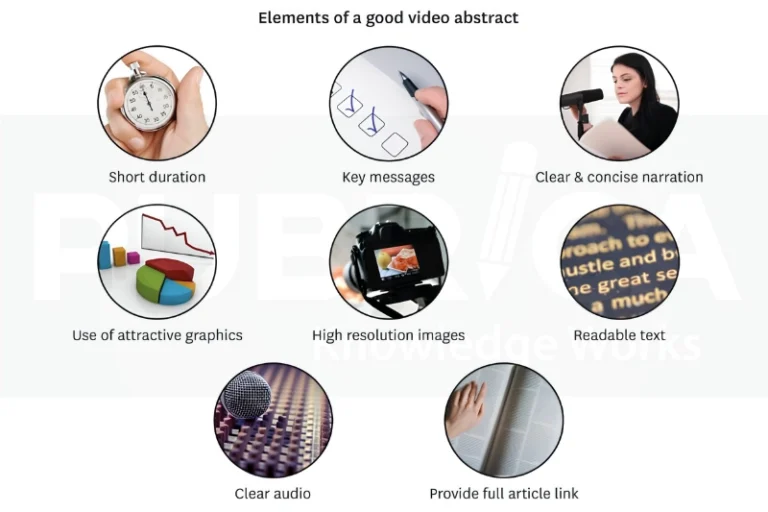
Video abstracts in research offer an innovative way of delivering the message, as they bring together audio and visual elements.
Advantages of Abstract Videos:
- More audience engagement
- Better delivery of complicated information
- More shares on social networks
- Better comprehension of scientific research among the general population
- More branding for researchers
Abstract videos can be especially useful in explaining multidisciplinary studies, health care-related research, and very technical results.
6. Challenges of Each Format
Difficulties in Preparing Graphical Abstracts
- Limited area to explain
- Necessitates good graphic design skills
- Can lead to over-simplification of the findings
Difficulties in Creating Video Abstracts
- Time-consuming
- Skilful use of video editing needed
- High cost
- Captions for better accessibility
Careful consideration is required by the researchers before deciding on a particular format.
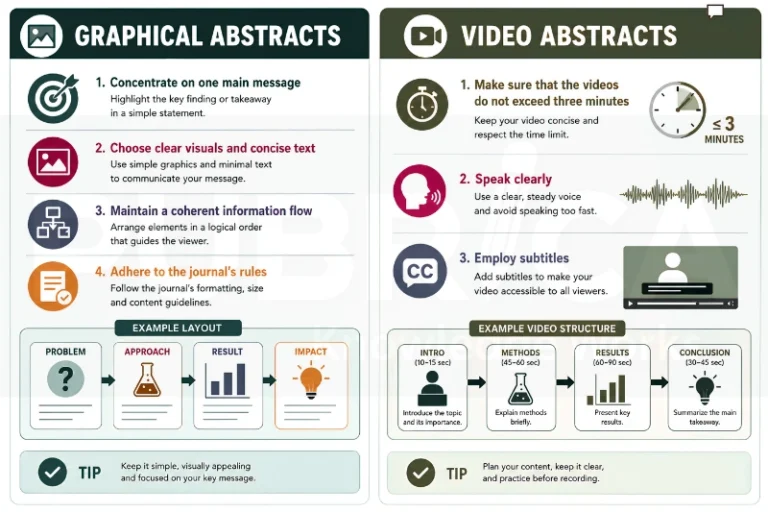
7. Best Practices for Effective Abstract Design
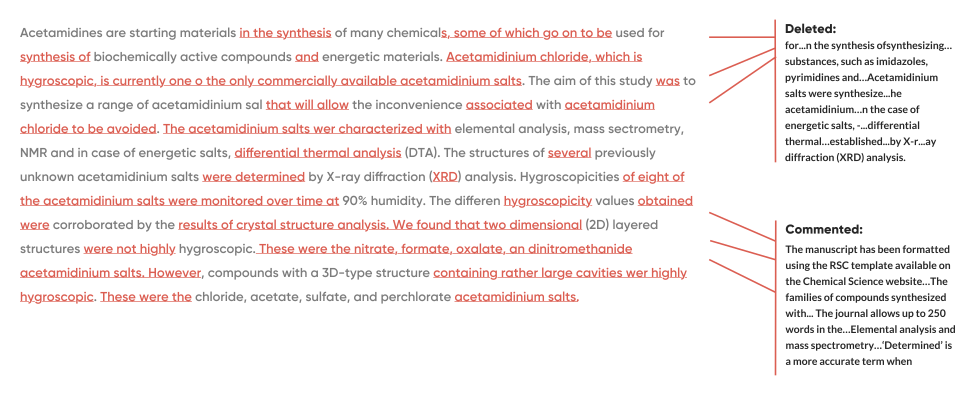
An abstract must be able to convey the essence of the research study effectively.[4]
8. Future Trends in Visual Scientific Communication
The following are some of the new emerging trends in scientific communication, considering digital publishing, artificial intelligence, and interactive media advancements.
- Use of AI in generating graphical abstracts
- Interactive visual abstracts
- Animated graphical abstracts
- Use of virtual and augmented reality for presenting scientific work.
Connect with us to explore how we can support you in maintaining academic integrity and enhancing the visibility of your research across the world!
Conclusion
It is worth mentioning that graphical abstracts and video abstracts have recently emerged as important means that help make scientific communication more efficient. The use of graphical abstracts is an effective way of creating concise visual summaries that will facilitate the process of discovering and comprehending information. Video abstracts are used to provide a more detailed explanation of the study results.
Graphical vs. Video Abstracts: Tools for Clear and Engaging Scientific Communication. Our Pubrica consultants are here to guide you. [Get Expert Publishing Support] or [Schedule a Free Consultation]
References
- Krukowski, R. A., & Goldstein, C. M. (2023). The potential for graphical abstracts to enhance science communication. Translational behavioral medicine, 13(12), 891–895. https://doi.org/10.1093/tbm/ibad069
- Jeyaraman, M., Ratna, H. V. K., Jeyaraman, N., Maffulli, N., Migliorini, F., Nallakumarasamy, A., & Yadav, S. (2023). Graphical Abstract in Scientific Research. Cureus, 15(9), e45762. https://doi.org/10.7759/cureus.45762
- Vandemeulebroecke, M., Baillie, M., Margolskee, A., & Magnusson, B. (2019). Effective Visual Communication for the Quantitative Scientist. CPT: pharmacometrics & systems pharmacology, 8(10), 705–719. https://doi.org/10.1002/psp4.12455
- Polanin, J. R., Pigott, T. D., Espelage, D. L., & Grotpeter, J. K. (2019). Best practice guidelines for abstract screening large‐evidence systematic reviews and meta‐Research Synthesis Methods, 10(3), 330–342. https://doi.org/10.1002/jrsm.1354