

Scientific Developmental Editing for High-Impact Journal Publishing
- Home
- Academy
- Research Impact
- Scientific Developmental Editing for High-Impact Journal Publishing
High-Impact Journals
Interesting topics
Scientific Developmental Editing for High-Impact Journal Publishing
Scientific developmental editing is a high-level, substantive review that refines a manuscript’s logic, structure, data presentation, and argumentative flow to meet the rigorous standards of high-impact journals (e.g., Nature, Lancet). Scientific Manuscript Editing Services contribute to this process by improving structural coherence and strengthening scholarly communication. Unlike copyediting, this process strengthens the core narrative, ensures scientific rigour, and aligns research significance with target journal expectations.
Publishing in high-impact journals does not just require strong data It also requires clarity, coherence, good methodological practices, and an effective position of your work. Through High Impact Journal Manuscript Editing, authors can strategically position their research for competitive peer review. Scientific developmental editing helps develop the link between your strong research and a successful publication by enhancing your argumentation, clarifying structure, and making your manuscript to be consistent with the expectations of the journal you want to publish in. Unlike language editing, developmental editing constitutes a transformation of the individual’s scientific narrative using logic, methodological clarity, and appropriate standards for reporting.[1]
1. What Is Scientific Developmental Editing?
The scientific developmental editing process is an extensive improvement process for manuscripts, which focuses on:
- Improving and clarifying the research question and hypothesis
- Clarifying study design
- Ensuring methodological transparency
- Improving the interpretation and discussion of the results
- Meeting journal scope and reviewer expectations
The trending emphasis in high-impact journals includes reproducibility, completeness of reporting and integrity of research. Therefore, developmental editing provides a proactive means of addressing these issues before the manuscript is submitted. [2]
2. Why It Matters for High-Impact Journals
Prominent Journals value innovation, high-quality research, and clear writing. Unsatisfactory organisation/structure or inadequate framing generally result in rejection without having been reviewed. Evidence exists indicating that incomplete data and/or ambiguous methods will lead to reduced acceptance rates for publication.
- Coherence of your IMRaD components will be improved.
- The alignment of your article with appropriate publication reporting frameworks [3]
- The quality of your critical discussions and the contextual interpretation(s) of your critical discussions will be enhanced.
- The reviewer’s ability to read and engage with your article will be enhanced.
3. Core Components of Scientific Developmental Editing
- Clarity of Concepts: Ensures that research objectives, hypotheses, and theoretical frameworks are stated clearly
- Flow of Structure: Refinement of connections in the logical order of Introduction, Methods, Results, and Discussion (IMRAD)
- Rigor in Methodology: Increasing transparency in study design; controlling for bias and appropriately reporting statistical analysis
- Compliance with Reporting Guidelines: Aligning manuscripts with the EQUATOR Network standards to provide for completeness.
- Strength of Interpretations and Impact: Improving implications for practice, clinical significance, and translational value. [4]
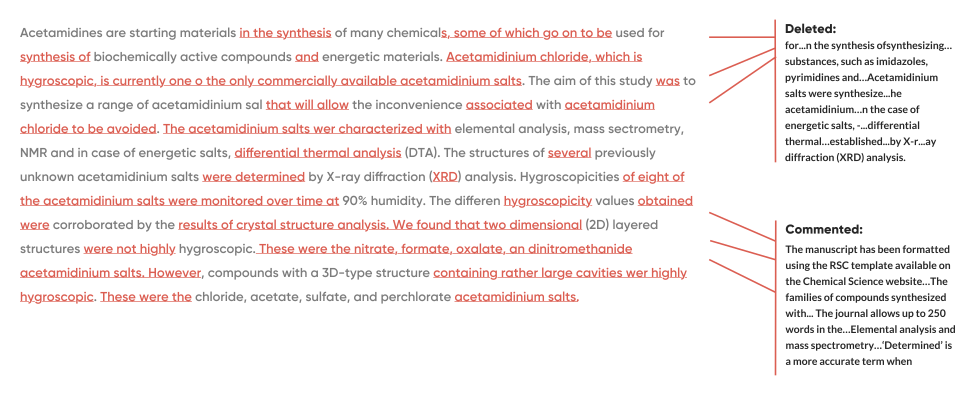
- Before Editing:
- “The results showed significant improvement in patients.”
- After Developmental Editing:
- “Compared with baseline, the intervention group demonstrated a 23% relative reduction in symptom severity (95% CI 15–31%, p<0.001), supporting the hypothesized therapeutic benefit.”
- Impact: Specificity, statistical clarity, and stronger inference.
4. Addressing Reproducibility and Research Quality
The quality of science has been increasingly scrutinised by scientists due to growing concerns over reproducibility and transparency in scientific literature. Developing an editorial process that incorporates the following components strengthens the credibility of edited materials and aligns them with international standards for evidence-based research processes[5]:
- Explicitly defined inclusion and exclusion criteria.
- Clearly defined statistical methods.
- Discussion of potential biases related to the research method.
- Concisely describe the limitations of the study with a balanced interpretation of findings.
These principles form the foundation of scientific developmental editing services.
5. How Developmental Editing Increases Publication Success
A study indicates that manuscripts prepared with established reporting and methodological standards have experienced superior results during peer review. Benefits include:
- Reduced number of manuscripts rejected at desk review
- Decreased number of reviews requiring many revisions
- Improved confidence of reviewer’s decision
- Increased chances of being cited. [6]
Key Deliverables in Developmental Editing
✔ Logical restructuring of manuscript sections
✔ Gap analysis against target journal scope
✔ Statistical clarity and consistency check
✔ Strengthened discussion and novelty positioning
✔ Reviewer-response readiness
Expert Manuscript Editing for Journals addresses structural clarity, methodological transparency, and alignment with journal expectations during manuscript preparation.
6. Optimising for High-Impact Journal Standards
High-impact journals look for the following in submissions:
- Originality and contribution to knowledge
- Strong methodology
- Transparency
- Objectivity in results
- Compliance with ethical standards
Developmental editing helps to ensure submissions meet these high standards before being sent for review, thus greatly enhancing their chances of being reviewed favourably. Developmental Editing for Academic Journals ensures that manuscripts are carefully refined to meet these expectations.
Connect with us to explore how we can support you in maintaining academic integrity and enhancing the visibility of your research across the world!
Conclusion
For researchers who intend to publish their findings in influential journals, scientific developmental editing represents a valuable starting point. It helps research projects move from potentiality to publishable form by enhancing their structure, improving the strength of the methodology used, and maintaining completeness of reporting. Researchers must provide published materials that are clear, rigorous, transparent and therefore successful in the current publishing environment, where computational academic publishing and other forms of scholarly communication exist. With Professional Academic Editing Services, authors can confidently prepare manuscripts that meet international publication standards.
Ready to publish in leading journals? Partner with Pubrica’s expert scientific developmental editors to refine your manuscript’s structure, strengthen methodology, and align with high-impact journal standards. [Get Expert Publishing Support] or [Schedule a Free Consultation]
References
- Ioannidis, J. P. A. (2022). Correction: Why most published research findings are false. PLoS Medicine, 19(8), e1004085. https://doi.org/10.1371/journal.pmed
- Nosek, B. A., Alter, G., Banks, G. C., Borsboom, D., Bowman, S. D., Breckler, S. J., Buck, S., Chambers, C. D., Chin, G., Christensen, G., Contestabile, M., Dafoe, A., Eich, E., Freese, J., Glennerster, R., Goroff, D., Green, D. P., Hesse, B., Humphreys, M., Ishiyama, J., … Yarkoni, T. (2015). SCIENTIFIC STANDARDS. Promoting an open research culture. Science (New York, N.Y.), 348(6242), 1422–1425. https://doi.org/10.1126/science.aab23
- Hopewell, S., Dutton, S., Yu, L. M., Chan, A. W., & Altman, D. G. (2010). The quality of reports of randomised trials in 2000 and 2006: comparative study of articles indexed in PubMed. BMJ (Clinical research ed.), 340, c723. https://doi.org/10.1136/bmj.c723
- Sterne, J. A. C., Savović, J., Page, M. J., Elbers, R. G., Blencowe, N. S., Boutron, I., Cates, C. J., Cheng, H. Y., Corbett, M. S., Eldridge, S. M., Emberson, J. R., Hernán, M. A., Hopewell, S., Hróbjartsson, A., Junqueira, D. R., Jüni, P., Kirkham, J. J., Lasserson, T., Li, T., McAleenan, A., … Higgins, J. P. T. (2019). RoB 2: a revised tool for assessing risk of bias in randomised trials. BMJ (Clinical research ed.), 366, l4898. https://doi.org/10.1136/bmj.l4898
- Guyatt, G. H., Oxman, A. D., Vist, G. E., Kunz, R., Falck-Ytter, Y., Alonso-Coello, P., Schünemann, H. J., & GRADE Working Group (2008). GRADE: an emerging consensus on rating quality of evidence and strength of recommendations. BMJ (Clinical research ed.), 336(7650), 924–926. https://doi.org/10.1136/bmj.39489.470
- Turner, L., Shamseer, L., Altman, D. G., Schulz, K. F., & Moher, D. (2012). Does use of the CONSORT Statement impact the completeness of reporting of randomised controlled trials published in medical journals? A Cochrane review. Systematic reviews, 1, 60. https://doi.org/10.1186/2046-4053-1-60