
- Services
- Discovery & Intelligence Services
- Publication Support Services
- Sample Work
Publication Support Service
- Editing & Translation
-
Editing and Translation Services
- Sample Work
Editing and Translation Service
-
- Research Services
- Sample Work
Research Services
- Physician Writing
- Sample Work
Physician Writing Service
- Statistical Analyses
- Sample Work
Statistical Analyses
- Data Collection
- AI and ML Services
- Sample Work
AI and ML Services
- Medical Writing
- Sample Work
Medical Writing
- Research Impact
- Sample Work
Research Impact
- Medical & Scientific Communication
- Sample Work
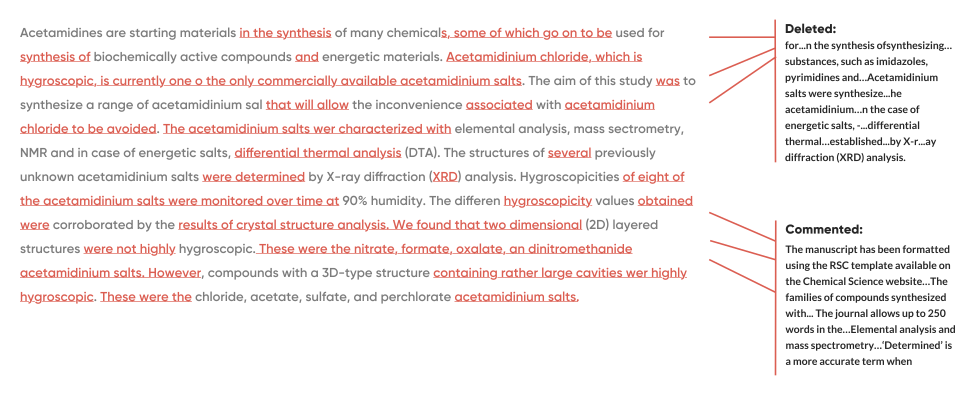
Medical & Scientific Communication
- Medico Legal Services
- Educational Content
- Academic Editorial Services
- Sample Work
Academic Editorial Services
- Educational Editorial Service
-
Education Editorial Services
- Sample Work
Education Editorial Services
-
- Industries
- Subjects
- About Us
- Academy
- Insights
- Contact Us
GRAMMS Guidelines for Reporting Mixed Methods Research
- Home
- Academy
- Poster Presentation
- GRAMMS Guidelines for Reporting Mixed Methods Research
Research Impact
Interesting topics
GRAMMS Guidelines for Reporting Mixed Methods Research
The GRAMMS (Good Reporting of A Mixed Methods Study) guidelines are a six-item checklist to ensure transparent reporting of mixed methods research, requiring justification for the approach, clear description of design (purpose, priority, sequence), separate details for each method (sampling, data collection, analysis), explicit explanation of integration, acknowledgement of limitations, and description of insights gained from mixing methods, helping readers assess study quality.
The GRAMMS Guidelines for Mixed Methods Research are internationally recognised as a benchmark for improving transparency and consistency in mixed methods reporting. Mixed methods research, which integrates quantitative and qualitative approaches, has gained significant attention in recent years because it allows researchers to provide both statistical evidence and contextual understanding. However, the quality of reporting in mixed methods studies is often inconsistent, limiting reproducibility and trust in findings. To address this, the Good Reporting of A Mixed Methods Study (GRAMMS) guidelines provide practical Mixed Methods Reporting Checklist for transparent reporting of mixed methods research . Applying established Mixed Methods Research Quality Criteria helps address common reporting gaps and enhances the credibility of mixed methods studies.
1. What Is Mixed Methods Research?
By combining both quantitative data (i.e. surveys and experiments) with qualitative data (i.e., interviews and focus groups), researchers can take an all-encompassing approach to the research question[5]. Mixed method researchers may choose to do so for several reasons:
- Complementarity: Researchers explore various dimensions of a single phenomenon using different types of data [6]
- Triangulation: Researchers corroborate the findings from each of the methods through using multiple means to confirm the same results and
- Development: Researchers build upon the findings from one method to continue developing their findings with the next method [7]
A well-defined Mixed Methods Research Design clearly specifies how qualitative and quantitative components are planned, implemented, and connected.
2. The Six GRAMMS Reporting Criteria
The GRAMMS Framework has Six Components to Reporting on Mixed Methodology that authors are expected to clearly address in their manuscripts.
GRAMMS Criterion | Focus Area |
1. Justification for mixed methods | State the justification for utilising mixed methods in this study. |
Describe the type, priority and sequence of the different methods of study employed. | |
3. Methods detail | Describe the sampling approach for both quantitative and qualitative data collection and description of data analysis method for both methods. |
4. Integration | State how the quantitative and qualitative data was integrated. |
5. Method limitations | Identify the limitations associated with combining the two methods used for the study (mixed methods). |
6. Insights from integration | Provide details of any new knowledge gained through the integration of quantitative and qualitative data. |
This structured process allows for an author to provide the basis for their design decisions and increased transparency about their methodology [8].
NOTE:
- Integration in Mixed Methods Research is a defining feature of methodological rigor and distinguishes true mixed methods studies from parallel reporting.
- Effective Qualitative and Quantitative Integration ensures that findings are meaningfully connected rather than interpreted in isolation.
- Explicit reporting of Mixed Methods Data Collection and Analysis further supports reproducibility and critical appraisal.
3. Benefits of Using GRAMMS Guidelines
Using the GRAMMS framework when conducting mixed-methods research can enhance the overall usability of a research project in many ways.
- Provides a clear rationale for choosing mixed-methods design.
- Provides a comprehensive view of the mixed-methods design process, including how the various methods will be sequenced and what the relative priorities are.
- Provides a detailed account of how data from the various methods will be integrated to create meaningful and coherent results.
- Increases the chances of acceptance by journals, thereby providing more opportunities for publication.
These advantages align the GRAMMS framework with broader Reporting Standards for Health Services Research, particularly in applied and policy-focused studies.
4. Common Reporting Issues in Mixed Methods Studies
In many cases, despite the established advantages of mixed-method studies, a large proportion of the studies fail to report many of the GRAMMS elements considered critical. The percentages of mixed-method studies that reported on several GRAMMS Elements are as follows:
GRAMMS Item | Percentage of Studies Reporting |
Justification for mixed methods | 60% |
Description of mixed method design | 23% |
Description of the Mixed Methods | 77% |
Description of the Integration Process | 61% |
Limitations of Mixing | 16% |
Insights gained from integration | 62% |
Under-reporting is frequently seen about study design or describing the integration process between qualitative and quantitative data and recognizing the limitations of combining these data types. Such gaps often reflect limited use of structured Mixed Methods Reporting Tools during study documentation and manuscript preparation.
5. Step-by-Step Guide to Applying GRAMMS Guidelines

6. GRAMMS Guidelines and Journal Submissions
For all peer-reviewed articles:
- Include a statement in the Method section that the research complied with the GRAMMS guidelines.
- Attach a copy of the GRAMMS Checklist as a supporting document.
- Organise you’re writing into structured headings (i.e. quantitative, qualitative, integration, discussion of findings and limitations) to help readers easily understand your article.
The need for compliance with reporting standards, such as GRAMMS, for mixed-method studies is being recognised by many editors [1,4]. Many researchers also rely on Mixed Methods Manuscript Support Services to strengthen reporting quality and reduce the risk of desk rejection.
Connect with us to explore how we can support you in maintaining academic integrity and enhancing the visibility of your research across the world!
Conclusion
Enhancing Transparency in Mixed Methods Research the GRAMMS guideline is designed to provide maximal impact and to create a consistent high level of transparency and quality in the reporting of Mixed Methods Research, thus enhancing the clarity, replicability, and reliability of the findings. Adhering to the GRAMMS guidelines when preparing a Mixed Methods Research Manuscript will guarantee that it complies with all the current and high-level expectations that have become a part of today’s peer-reviewed academic publishing. Specialised mixed methods research services provide methodological guidance, reporting support, and compliance checks to help authors meet GRAMMS requirements effectively. Comprehensive Academic Publication Support for Mixed Methods Studies plays a key role in ensuring that complex designs meet evolving expectations in scholarly publishing.
Need expert support with GRAMMS-compliant mixed methods reporting? Pubrica provides end-to-end mixed methods manuscript and publication support to help you publish with confidence. [Get Expert Publishing Support] or [Schedule a free consultation]
References
- O’Cathain, A., Murphy, E., & Nicholl, J. (2008). The quality of mixed methods studies in health services research. Journal of health services research & policy, 13(2), 92–98. https://doi.org/10.1258/jhsrp.2007.007074
- Ahmed, S. (2017). Media review: Mixed methods research: A guide to the field. Journal of Mixed Methods Research, 11(3), 415–416. https://doi.org/10.1177/1558689816666438
- Fetters, M. D., Curry, L. A., & Creswell, J. W. (2013). Achieving integration in mixed methods designs-principles and practices. Health Services Research, 48(6 Pt 2), 2134–2156. https://doi.org/10.1111/1475-6773.12117
- Johnson, R. B., Onwuegbuzie, A. J., & Turner, L. A. (2007). Toward a definition of mixed methods research. Journal of Mixed Methods Research, 1(2), 112–133. https://doi.org/10.1177/1558689806298224
- Ivankova, N. V., Creswell, J. W., & Stick, S. L. (2006). Using mixed-methods sequential explanatory design: From theory to practice. Field Methods, 18(1), 3–20. https://doi.org/10.1177/1525822×05282260
- Curry, L. A., Nembhard, I. M., & Bradley, E. H. (2009). Qualitative and mixed methods provide unique contributions to outcomes research. Circulation, 119(10), 1442–1452. https://doi.org/10.1161/CIRCULATIONAHA.107.742775
- Emary, P. C., Stuber, K. J., Mbuagbaw, L., Oremus, M., Nolet, P. S., Nash, J. V., Bauman, C. A., Ciraco, C., Couban, R. J., & Busse, J. W. (2023). Quality of Reporting Using Good Reporting of A Mixed Methods Study Criteria in Chiropractic Mixed Methods Research: A Methodological Review. Journal of manipulative and physiological therapeutics, 46(3), 152–161. https://doi.org/10.1016/j.jmpt.2023.11.004