- Services
- Discovery & Intelligence Services
- Publication Support Services
- Sample Work
Publication Support Service
- Editing & Translation
-
Editing and Translation Services
- Sample Work
Editing and Translation Service
-
- Research Services
- Sample Work
Research Services
- Physician Writing
- Sample Work
Physician Writing Service
- Statistical Analyses
- Sample Work
Statistical Analyses
- Data Collection
- AI and ML Services
- Sample Work
AI and ML Services
- Medical Writing
- Sample Work
Medical Writing
- Research Impact
- Sample Work
Research Impact
- Medical & Scientific Communication
- Sample Work
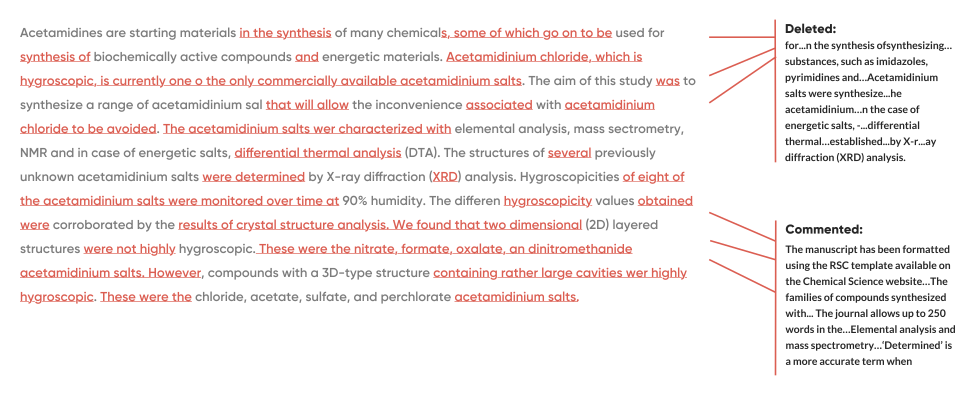
Medical & Scientific Communication
- Medico Legal Services
- Educational Content
- Academic Editorial Services
- Sample Work
Academic Editorial Services
- Educational Editorial Service
-
Education Editorial Services
- Sample Work
Education Editorial Services
-
- Industries
- Subjects
- About Us
- Academy
- Insights
- Contact Us
Publishing a case report involves more than clinical knowledge; it also demands strategic journal selection. Choosing the wrong journal can result in rejection, delays in publication, and reduced impact. This article provides physicians with a methodical, evidence-based approach to identifying the best journal for their case report so that the project matches the journal’s scope, audience, and submission requirements.
How Physicians Can Write Clear and Impactful Patient Education Materials
- Home
- Academy
- Physician Writing
- How Physicians Can Write Clear and Impactful Patient Education Materials
Journal for Submitting a Case Report
Interesting topics
How Physicians Can Write Clear and Impactful Patient Education Materials
1. Introduction
2. Why Patient Education Materials Matter
3. Key Principles of Writing Effective Patient Education Materials
3.1 Know Your Audience
3.2 Use Plain Language
3.3 Structure the Content Logically
3.4 Visual Aids and Infographics
3.5 Write With Cultural Competence
3.6 Incorporate Behavioural and Motivational Techniques
4. Case Study: Improving Discharge Instructions
5. Example Comparison Table
11. Conclusion
12. References
Introduction
Effective patient education materials (PEMs) are crucial for promoting health literacy, enhancing treatment adherence, and facilitating shared decision-making. However, physicians may face difficulty in translating complicated medical terminology into language that patients from a wide range of literacy levels can understand. [1] The article here illustrates how to assist physicians in producing clean, relevant, and evidence-based patient education content.
1. Why Patient Education Materials Matter
- Enhance Patient Outcomes: Educated patients have a better understanding of their condition and treatment, helping lead to improved adherence and outcomes.
- Lower Readmission Rates: Clear discharge instructions will help eliminate hospital readmissions. [2]
- Encourage Shared Decision-Making: Quality information supports consumer decision-making.
2. Key Principles of Writing Effective Patient Education Materials
2.1. Know Your Audience
- Assess patients’ literacy, language, and cultural background.
- Use tools such as the Rapid Estimate of Adult Literacy in Medicine or the Test of Functional Health Literacy in Adults.
Key Considerations:
- Health literacy levels: Nearly 77 million adults in the U.S. have basic or Intermediate health literacy. [3]
- Demographics: Age, education, language proficiency, and cultural background influence comprehension.
- Emotional context: Patients may be stressed, anxious, or overwhelmed when receiving medical information.
Example
For a community with limited literacy, avoid using medical terms like hypertension and instead use high blood pressure.
2.2. Use Plain Language
Plain language ensures accessibility for the general population.
| Principle | Application Example |
| Use plain language | “High blood pressure” instead of “hypertension” |
| Limit information | Focus on 3–5 key takeaways |
| Use active voice | “Take the medicine with food” instead of “The medicine should be taken with food.” |
| Short sentences | Aim for 8–12 words per sentence |
| Readable fonts | Use at least 12-point sans-serif font (e.g., Arial) |
Tools to Assess Readability:
- Flesch-Kincaid Grade Level
- SMOG Index
- Patient Education Materials Assessment Tool (PEMAT)
2.3. Structure the Content Logically
Patients benefit from organized and scannable formats.
Recommended Structure:
- Title: Simple and specific, e.g., Managing Your Diabetes: A Daily Guide
- Introduction: What is the material about? Why is it important?
- Body: Organized with clear headings and bullet points
- Action Steps: Clear instructions on what the patient should do
- Contact Information: Who to call for help or clarification
2.4. Visual Aids and Infographics
Visuals improve recall by up to 65%. [4]
Tips:
- Include diagrams or illustrations showing the condition or how to take medication.
- Use charts for comparison (e.g., blood sugar levels).
- Label visuals clearly with layman’s terms.
Example
A diagram showing how insulin helps glucose enter the cells can help explain diabetes to visual learners.
2.5. Write With Cultural Competence
Patient materials should reflect the cultural and linguistic needs of diverse populations.
Culturally Appropriate Practices:
- Translate materials into the patient’s preferred language with the aid of certified translators.
- Adapt content to cultural norms (e.g., dietary recommendations based on cuisine in a specific region).
- Do not use idioms or culturally-specific references.
Example
Instead of: “Eat whole wheat bagels.” Use: “Eat whole grain options like chapati or brown rice.”
2.6. Incorporate Behavioural and Motivational Techniques
- Use positive framing (“You can improve your breathing with these exercises”).
- Include goal-setting sections (e.g., weekly trackers).
- Use affirming language to enhance self-efficacy.
Example
Patient Leaflet for Hypertension
Title: Controlling Your Blood Pressure
Introduction: High blood pressure can lead to heart problems. Here’s how to manage it.
What You Can Do:
- Take medicine daily as directed
- Eat less salt
- Check your pressure at home
- Exercise 30 minutes a day
Call to Action: Bring your logbook to every appointment.
3. Case Study: Improving Discharge Instructions
- Problem: A hospital observed 20% of heart failure patients being readmitted within 30 days.
- Intervention: Revised discharge instructions using plain language, visuals, and a checklist.
- Outcome: Readmission rates decreased to 11% within six months
4. Example Comparison Table
| Poor Example | Improved Version |
| “You have idiopathic hypertension.” | “You have high blood pressure, but the cause is not known.” |
| “Take your antihypertensive medication BID.” | “Take your blood pressure pill two times a day.” |
| “Avoid sodium and excess calories.” | “Eat less salt and avoid high-calorie foods like fried snacks.” |
Connect with us to explore how we can support you in maintaining academic integrity and enhancing the visibility of your research across the world!
Conclusion
Patient education is not just about transferring knowledge but empowering patients to take control of their health. Physicians play a crucial role in this process, and clear communication is key to ensuring adherence, better outcomes, and trust in healthcare systems.
References
- Koh, H. K., Brach, C., Harris, L. M., & Parchman, M. L. (2013). A proposed ‘health literate care model’ would constitute a systems approach to improving patients’ engagement in care. Health affairs (Project Hope), 32(2), 357–367. https://doi.org/10.1377/hlthaff.2012.1205
- Jack, B. W., Chetty, V. K., Anthony, D., Greenwald, J. L., Sanchez, G. M., Johnson, A. E., Forsythe, S. R., O’Donnell, J. K., Paasche-Orlow, M. K., Manasseh, C., Martin, S., & Culpepper, L. (2009). A reengineered hospital discharge program to decrease rehospitalization: a randomized trial. Annals of internal medicine, 150(3), 178–187. https://doi.org/10.7326/0003-4819-150-3-200902030-00007
- Kutner, M., Greenberg, E., Jin, Y., & Paulsen, C. (2006). The Health Literacy of America’s Adults: Results From the 2003 National Assessment of Adult Literacy. National Center for Education Statistics.
- Houts, P. S., Doak, C. C., Doak, L. G., & Loscalzo, M. J. (2006). The role of pictures in improving health communication: a review of research on attention, comprehension, recall, and adherence. Patient education and counseling, 61(2), 173–190. https://doi.org/10.1016/j.pec.2005.05.004