
- Services
- Discovery & Intelligence Services
- Publication Support Services
- Sample Work
Publication Support Service
- Editing & Translation
-
Editing and Translation Services
- Sample Work
Editing and Translation Service
-
- Research Services
- Sample Work
Research Services
- Physician Writing
- Sample Work
Physician Writing Service
- Statistical Analyses
- Sample Work
Statistical Analyses
- Data Collection
- AI and ML Services
- Sample Work
AI and ML Services
- Medical Writing
- Sample Work
Medical Writing
- Research Impact
- Sample Work
Research Impact
- Medical & Scientific Communication
- Sample Work
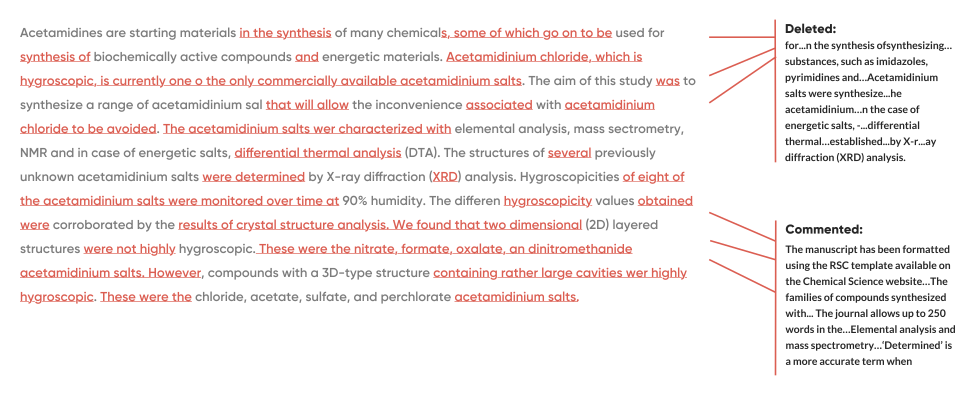
Medical & Scientific Communication
- Medico Legal Services
- Educational Content
- Academic Editorial Services
- Sample Work
Academic Editorial Services
- Educational Editorial Service
-
Education Editorial Services
- Sample Work
Education Editorial Services
-
- Industries
- Subjects
- About Us
- Academy
- Insights
- Contact Us
Targeted literature searches are a fundamental part of writing clinical manuscripts that will meet the standards of high-quality journals and contribute meaningfully to evidence-based practice. When physicians write clinical manuscripts, utilizing a targeted literature search can identify high-quality, relevant, and current evidence. While a general literature review is useful, a targeted literature search is specific to the clinical question and should be completed through frameworks established, such as PICO (Population, Intervention, Comparator, Outcome) and PRISMA [1].
How to Conduct a PICO-Based Clinical Literature Review
- Home
- Academy
- Physician Writing
- How to Conduct a PICO-Based Clinical Literature Review
Revising for a New Journal
- Understanding the PICO Framework
- PICO-Based Clinical Literature Review
- Define the Clinical Question
- Search Strategy and Database Selection
- Develop Inclusion and Exclusion Criteria
- Screen and Select Studies
- Data Extraction
- Critical Appraisal
- Data Synthesis and Analysis
- Report Writing and Discussion
- Tips for Effective PICO-Based Reviews
Interesting topics
How to Conduct a PICO-Based Clinical Literature Review
Table of Content
1. Step-by-Step Guide to Conducting a PICO-Based Clinical Literature Review
2.1. Define the Clinical Question
2.2. Search Strategy and Database Selection
2.3. Develop Inclusion and Exclusion Criteria
2.4. Screen and Select Studies
2.5. Data Extraction
2.6. Critical Appraisal
2.7. Data Synthesis and Analysis
2.8. Report Writing and Discussion
2. Tips for Effective PICO-Based Reviews
3. Conclusion
4. References
Clinical literature reviews are integral to evidence-based medicine (EBM), informing clinical and policy decisions. One of the most systematic strategies for developing clinical review questions is the PICO framework, which stands for Population, Intervention, Comparison, and Outcome. This method enhances search precision, improves the relevance of included studies, and supports replicable, systematic inquiry [1].
This article provides a step-by-step guide on conducting a PICO-based clinical literature review that is intended for students, clinicians, and researchers generating high-quality, focused reviews.
1. Understanding the PICO Framework
The PICO framework helps to translate a clinical question into a searchable format. It consists of [2]:
Example:
| Category | Description | Example |
| P (Population) | The patient group or problem | Adults aged ≥65 with type 2 diabetes |
| I (Intervention) | The treatment or exposure | Metformin therapy |
| C (Comparison) | A control or alternative intervention | Sulfonylurea (Glipizide) |
| O (Outcome) | The expected result or effect | Cardiovascular mortality |
“In older adults with type 2 diabetes, does metformin compared to sulfonylureas reduce cardiovascular mortality?”
2. Step-by-Step Guide to Conducting a PICO-Based Clinical Literature Review
2.1. Define the Clinical Question
Begin by translating the clinical problem into a clear, structured PICO question.
Example:
In adults with type 2 diabetes (P), does metformin (I), compared to insulin therapy (C), result in better glycaemic control (O)?
Begin by translating the clinical problem into a clear, structured PICO question.
2.2. Search Strategy and Database Selection
Use PICO elements to create a search strategy using Boolean operators and Medical Subject Headings (MeSH).
Databases commonly used:
- PubMed/MEDLINE
- Cochrane Library
- CINAHL
- EMBASE
- Scopus
Example Search String (PubMed):
(“Type 2 Diabetes Mellitus”[MeSH]) AND (“Metformin”[MeSH] OR metformin) AND (“Insulin”[MeSH] OR insulin therapy) AND (“Glycated Haemoglobin A”[MeSH] OR HbA1c)
2.3. Develop Inclusion and Exclusion Criteria
Criteria should align with the PICO elements to ensure relevant data is captured.
| Criteria Type | Inclusion Example | Exclusion Example |
| Population | ICU patients diagnosed with sepsis | Paediatric populations or outpatients |
| Intervention | Corticosteroid therapy within 24 hours | Corticosteroids initiated after 72 hours |
| Comparator | Placebo or no corticosteroid | Comparison to other immune-modulating drugs |
| Outcome | 28-day all-cause mortality | Studies reporting only biochemical markers |
| Study Design | RCTs, cohort studies | Case reports, editorials, review articles |
2.4. Screen and Select Studies
Use the PRISMA 2020 flowchart to document the selection process. Screening typically includes:
- Title/Abstract screening
- Full-text eligibility check
- Duplicate removal
A software tool like Rayyan or Covidence can help manage this process systematically.
2.5. Data Extraction
Use a structured data extraction sheet that maps to the PICO elements.
Data Extraction Table
| Study | P (Population) | I (Intervention) |
C (Comparison) | O (Outcome) | Key Findings |
|---|---|---|---|---|---|
| Smith et al., 2021 | Adults with sepsis | Hydrocortisone 200mg/day | Placebo | 28-day mortality | Reduced mortality (RR 0.82) |
| Lee et al., 2022 | ICU patients | Early methylprednisolone | Usual care | ICU length of stay | No significant difference |
2.6. Critical Appraisal
Use standardized appraisal tools to evaluate the quality and bias of the included studies.
Recommended tools:
- Cochrane Risk of Bias Tool (for RCTs)
- Newcastle-Ottawa Scale (for cohort and case-control studies)
- GRADE approach to rate the strength of evidence
Key aspects to assess:
- Randomization method
- Blinding
- Attrition bias
- Outcome assessment
- Reporting bias
2.7. Data Synthesis and Analysis
If quantitative synthesis is possible, perform a meta-analysis. If not, conduct a narrative synthesis aligned with the PICO structure.
Meta-analytic Summary Example:
Cardiovascular mortality in the sulfonylurea group was not significantly higher compared with the metformin group (RR 1.47, 95% CI 0.54 to 4.01; I2 = 0%) [3].
If heterogeneity is high (I² > 50%), consider subgroup analysis or random-effects models.
2.8. Report Writing and Discussion
Structure the review based on PRISMA or other relevant guidelines.
Sections to include:
- Introduction: Rationale and objective
- Methods: PICO question, databases, criteria, appraisal
- Results: PRISMA flow, study characteristics, findings
- Discussion: Clinical relevance, limitations, implications
- Conclusion: Summary and recommendation for practice
Connect with us to explore how we can support you in maintaining academic integrity and enhancing the visibility of your research across the world!
3. Tips for Effective PICO-Based Reviews
- Ensure conceptual alignment between the PICO question and included studies.
- Use MeSH terms and synonyms to capture all relevant articles.
- Maintain a transparent audit trail using tools like EndNote or Zotero.
- Report limitations, especially in population heterogeneity and outcome variability.
- Engage a second reviewer for study selection to minimize bias.
Conclusion
A clinical literature review accomplished through the PICO framework will provide a definitive and reproducible methodological data approach to summarizing evidence. The PICO methodology is especially useful in the area of medical and healthcare research since clarifying intervention-outcome relationships is essential for decision-making.
Need help designing a PICO-based clinical review? Contact Pubrica for expert support in systematic evidence-based reviews.
References
- Schardt, C., Adams, M. B., Owens, T., Keitz, S., & Fontelo, P. (2007). Utilization of the PICO framework to improve searching PubMed for clinical questions. BMC medical informatics and decision making, 7, 16. https://doi.org/10.1186/1472-6947-7-16
- Hong, J., Zhang, Y., Lai, S., Lv, A., Su, Q., Dong, Y., … & Ning, G. (2013). Effects of metformin versus glipizide on cardiovascular outcomes in patients with type 2 diabetes and coronary artery disease. Diabetes Care, 36(5), 1304–1311. https://doi.org/10.2337/dc12-0719
- Hemmingsen, B., Schroll, J. B., Wetterslev, J., Gluud, C., Vaag, A., Sonne, D. P., Lundstrøm, L. H., & Almdal, T. (2014). Sulfonylurea versus metformin monotherapy in patients with type 2 diabetes: a Cochrane systematic review and meta-analysis of randomized clinical trials and trial sequential analysis. CMAJ open, 2(3), E162–E175. https://doi.org/10.9778/cmajo.20130073