Meta-Analysis Guide: How to Perform, Interpret & Report Meta-Analyses
- Home
- Academy
- Meta Analysis
- Meta-Analysis Guide: How to Perform, Interpret & Report Meta-Analyses
High-Impact Journals
- What Is a Meta-Analysis and Why It Matters
- Step-by-Step Process to Conduct a Meta-Analysis
- Meta Analysis Workflow
- Common Effect Size Measures in Meta-Analysis
- Fixed-Effect vs Random-Effects Models
- Assessing Heterogeneity Between Studies
- Interpreting Meta-Analysis Results
- Reporting Meta-Analyses Using PRISMA Guidelines
Interesting topics
Meta-Analysis Guide: How to Perform, Interpret & Report Meta-Analyses
1. Introduction to Meta-Analysis and Its Importance
2. Step-by-Step Guide to Conducting a Meta-Analysis
3. Workflow Overview for Meta-Analysis
4. Key Effect Size Measures Explained
5. Choosing Between Fixed-Effect and Random-Effects Models
6. Evaluating Heterogeneity Across Studies
7. How to Interpret Meta-Analysis Findings
8. Reporting Meta-Analysis Using PRISMA Guidelines
A meta-analysis systematically combines data from multiple studies to identify patterns, effect sizes, and heterogeneity, providing a more precise estimate of an effect than individual studies. Key steps include defining a PICO question, conducting a comprehensive search, performing quality assessment, and calculating pooled effects, ideally reported using PRISMA guidelines.
Meta analysis is considered to be one of the most important tools that can be utilized to perform evidence-based research. It is utilized to statistically integrate the results of various independent research studies and assist in achieving more precise results. It is generally utilised in medicine, psychology, economics, and many other areas. It is considered to be a widely utilized tool to perform research and has emerged as a significant tool to attain precise results. This guide is considered to assist researchers in learning about performing and reporting a meta-analysis. It also provides information about the best practices and pitfalls in performing this research.[1] Researchers frequently search for guidance on How to conduct a meta-analysis to ensure methodological rigor and reliable results.
1. What Is a Meta-Analysis and Why It Matters
A meta-analysis is a quantitative method for synthesizing results from several studies, all of which investigate the same research question. A meta-analysis is often carried out within the context of a systematic review, where literature searches are undertaken to identify the relevant studies This approach is commonly used in a Systematic review and meta-analysis to synthesize evidence from multiple studies. Researchers use meta-analyses to:
- Increase statistical power
- Clarify inconsistent findings
- Estimate effect size
- Investigate study variability
- Develop robust evidence for decisions
A meta-analysis has come to be regarded as critical in evidence-based medicine, especially where guidelines or treatment recommendations are influenced by pooled data.[2]
2. Step-by-Step Process to Conduct a Meta-Analysis
Conducting a high-quality meta-analysis requires careful planning and methodological rigor. The typical workflow includes the following stages.
2.1. Define a Clear Research Question
A well-structured research question is usually developed with a PICO format consisting of:
- P – Population
- I – Intervention
- C – Comparator
- – Outcome
Example: Does telemedicine improve glycemic control compared with standard care in patients with type 2 diabetes?
2.2. Conduct a Systematic Literature Search
A systematic literature search is carried out to ensure all relevant studies are included. For this purpose, various databases are searched, including:
- PubMed
- Scopus
- Web of Science
- Cochrane Library
- Embase
Boolean operators and controlled vocabulary may be used to improve the accuracy of the search results.[3]
2.3. Study Selection and Screening
- Title screening
- Abstract screening
- Full-text screening
Example :
A meta-analysis investigating the effectiveness of mindfulness interventions for anxiety may include randomized controlled trials comparing mindfulness-based therapies with standard care or placebo
A meta-analysis investigating the effectiveness of mindfulness interventions for anxiety may include randomized controlled trials comparing mindfulness-based therapies with standard care or placebo.
3. Meta Analysis Workflow
The following steps represent the standard process used in most meta-analyses.
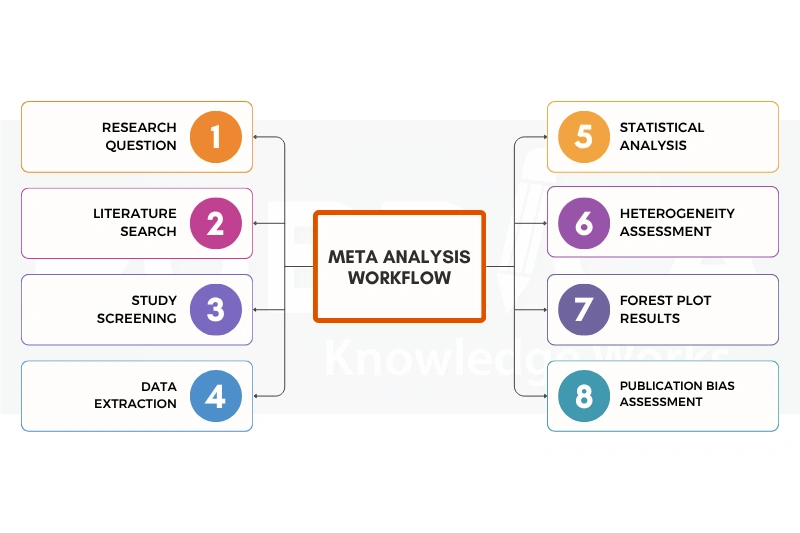
These steps rely heavily on robust Meta-analysis statistical methods to calculate pooled effect sizes and evaluate heterogeneity across studies.
4. Common Effect Size Measures in Meta-Analysis
The choice of effect size depends on the type of outcome reported in the included studies.
| Effect Size | Used For | Example |
| Risk Ratio (RR) | Binary outcomes | Mortality rates |
| Odds Ratio (OR) | Case–control studies | Disease odds |
| Mean Difference (MD) | Continuous outcomes | Blood pressure |
| Standardized Mean Difference (SMD) | Different measurement scales | Psychological scores |
Effect sizes are used to standardize outcomes from different studies to combine them statistically.[4]
5. Fixed-Effect vs Random-Effects Models
The selection of an appropriate statistical model is vital in carrying out a meta-analysis.
| Model | Assumption | When to Use |
| Fixed-effect model | All studies are estimating the same true effect | Low heterogeneity |
| Random-effects model | True effects vary across studies | High heterogeneity |
Most meta-analyses are conducted using random-effects models since variation is a common feature in most studies.[5]
6. Assessing Heterogeneity Between Studies
Heterogeneity means the variation in the results of the studies, which cannot be explained by chance factors.
Common statistical measures used to assess heterogeneity include:
- I² Statistic – the percentage of variation due to heterogeneity
- Cochran’s Q Test – the statistical test for heterogeneity
- Tau² – the estimate of variance between the studies
Interpretation of the results of the I² statistic:
- 25% – Low Heterogeneity
- 50% – Moderate Heterogeneity
- 75% – High Heterogeneity
Why Heterogeneity Matters
High levels of heterogeneity can imply differences in population, interventions, and methodologies. Researchers can conduct subgroup analyses and meta-regression to explore these differences.
7. Interpreting Meta-Analysis Results
Meta-analysis results are usually presented through forest plots, which display individual study effects alongside the pooled estimate. Usually, the outcomes are presented using forest plots. Some of the key outcomes to be considered are:
- The effect of each individual study
- The confidence interval
- The weight assigned to each of the studies
- The pooled effect
Another aspect to be considered is publication bias, which is usually seen as significant studies being more likely to be published. Some of the tools used to check this are:
- Funnel plots
- Egger’s test
- Trim and fill method.[6]
Careful Meta-analysis interpretation and reporting ensures that pooled results are accurately presented and transparently explained.
8. Reporting Meta-Analyses Using PRISMA Guidelines
Transparent reporting is essential for reproducibility and credibility. The PRISMA (Preferred Reporting Items for Systematic Reviews and Meta-Analyses) guideline offers a standard reporting checklist. Essential components of the PRISMA guideline:
- Structured abstract
- Search strategy
- Study selection
- Risk of bias assessment
- Statistical synthesis
- Limitations and implications
Compliance with the PRISMA guideline is necessary for transparency and assessment of quality.[7]
Best Practices for High-Quality Meta-Analyses
- Pre-registering of the protocol (e.g., PROSPERO)
- Multiple reviewers for screening
- Assessing risk of bias
- Sensitivity analyses
- Complete search strategies
Many researchers also seek professional Meta-analysis research services to support statistical synthesis and evidence integration in complex studies.
Connect with us to explore how we can support you in maintaining academic integrity and enhancing the visibility of your research across the world!
Conclusion
Meta-analysis is also very important for consolidating scientific evidence and increasing the results obtained from research studies. Meta-analysis helps increase the precision of the results and detect more general trends in the data. In order for meta-analysis to be effective and increase the reliability of research results, it is important to use proper methodology and reporting guidelines such as PRISMA. Using appropriate guidelines such as PRISMA for carrying out meta-analysis is important for advancing evidence-based research. In complex projects, institutions and researchers may also rely on Systematic review and meta-analysis consulting to ensure methodological accuracy and publication-ready results.
Turn complex research data into powerful, publishable evidence. Get expert assistance with systematic reviews and meta-analyses to meet international publication standards with Pubrica. [Get Expert Publishing Support] or [Schedule a Free consultation].
References
- Glass, G. V. (1976). Primary, secondary, and meta-analysis of research. Educational Researcher (Washington, D.C.: 1972), 5(10), 3–8. https://doi.org/10.3102/0013189×005
- DerSimonian, R., & Laird, N. (1986). Meta-analysis in clinical trials. Controlled Clinical Trials, 7(3), 177–188. https://doi.org/10.1016/0197-2456(86)90046-2
- Glanville, J. M., Lefebvre, C., Miles, J. N. V., & Camosso-Stefinovic, J. (2006). How to identify randomized controlled trials in MEDLINE: ten years on. Journal of the Medical Library Association, 94(2), 130–136. https://pmc.ncbi.nlm.nih.gov/article
- What is Effect Size and Why Does It Matter? Scribbr.com. Retrieved March 11, 2026, from https://www.scribbr.com/statistics
- Dettori, J. R., Norvell, D. C., & Chapman, J. R. (2022). Fixed-Effect vs Random-Effects Models for Meta-Analysis: 3 Points to Consider. Global spine journal, 12(7), 1624–1626. https://doi.org/10.1177/2192568222111
- Egger, M., Davey Smith, G., Schneider, M., & Minder, C. (1997). Bias in meta-analysis detected by a simple, graphical test. BMJ (Clinical Research Ed.), 315(7109), 629–634. https://doi.org/10.1136/bmj.315.7109.6
- Page, M. J., McKenzie, J. E., Bossuyt, P. M., Boutron, I., Hoffmann, T. C., Mulrow, C. D., Shamseer, L., Tetzlaff, J. M., Akl, E. A., Brennan, S. E., Chou, R., Glanville, J., Grimshaw, J. M., Hróbjartsson, A., Lalu, M. M., Li, T., Loder, E. W., Mayo-Wilson, E., McDonald, S., … Moher, D. (2021). The PRISMA 2020 statement: an updated guideline for reporting systematic reviews. BMJ (Clinical Research Ed.), 372, n71. https://doi.org/10.1136/bmj.n71