
- Services
- Discovery & Intelligence Services
- Publication Support Services
- Sample Work
Publication Support Service
- Editing & Translation
-
Editing and Translation Services
- Sample Work

Editing and Translation Service
-
- Research Services
- Sample Work
Research Services
- Physician Writing
- Sample Work
Physician Writing Service
- Statistical Analyses
- Sample Work

Statistical Analyses
- Data Collection
- AI and ML Services
- Sample Work

AI and ML Services
- Medical Writing
- Sample Work
Medical Writing
- Research Impact
- Sample Work
Research Impact
- Medical & Scientific Communication
- Sample Work
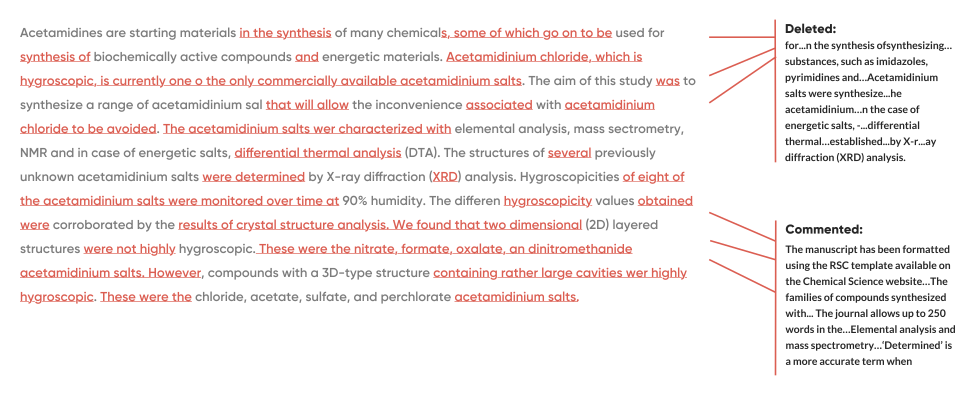
Medical & Scientific Communication
- Medico Legal Services
- Educational Content
- Academic Editorial Services
- Sample Work
Academic Editorial Services
- Educational Editorial Service
-
Education Editorial Services
- Sample Work
Education Editorial Services
-
- Industries
- Subjects
- About Us
- Academy
- Insights
- Contact Us
Targeted literature searches are a fundamental part of writing clinical manuscripts that will meet the standards of high-quality journals and contribute meaningfully to evidence-based practice. When physicians write clinical manuscripts, utilizing a targeted literature search can identify high-quality, relevant, and current evidence. While a general literature review is useful, a targeted literature search is specific to the clinical question and should be completed through frameworks established, such as PICO (Population, Intervention, Comparator, Outcome) and PRISMA [1].
How to Write a High-Impact Radiology Case Report for Physicians
- Home
- Academy
- Research Impact
- How to Write a High-Impact Radiology Case Report for Physicians
High-Impact Journals
Interesting topics
How to Write a High-Impact Radiology Case Report for Physicians
Case reports in radiology are a valuable component of medical literature, providing insight into infrequent presentations, new diagnostic techniques, or unique complications. Writing a meaningful case report is dependent on your ability to be clear, provide clinical significance, and follow professional ethics. This article will provide a structured framework to guide the writing of good and meaningful radiology case reports. [1,2]
1. Purpose of a Radiology Case Report
By means of case reports, radiologists can do the following:[3]
- Document rare diseases or atypical presentations.
- Share unique imaging findings.
- Foster medical education for trainees and clinicians.
- Help guide clinical decision-making in complex cases.
1.1. Goals of Radiology Case Reports
Goal | Description | Example |
Rare Presentation | Document unusual diseases | Cerebral cavernous malformation on 7T MRI |
Diagnostic Insight | Novel imaging findings | PET-CT identifying occult tumor |
Educational Value | Teaching tool for trainees | Paediatric bone infection patterns |
Clinical Guidance | Inform management | Imaging follow-up of post-surgical complications |
2. Selecting the Right Case
An impactful case has the following characteristics:[4]
- Novel: Unusual or rare pathology
- Clinically Relevant: Provides important information that can influence clinical care
- Educational: Contains important “take-home” points
- Complete: Provides sufficient imaging and clinical information.
2.1. Checklist for Case Selection
- Is the case rare or unusual?
- Does it present a diagnostic challenge?
- Are imaging findings reproducible and clear?
- Does it provide learning value?
- Have patient consent and ethical approvals been obtained?
3. Structuring the Case Report
Follow the steps for organization. [5]
Title
- Should be brief and informative.
- Should include the most important radiologic finding.
Example: “Unusual Appearance of Cerebral Cavernous Malformation on 7T MRI”
Abstract (150 – 250 words)
Summary of case, important imaging findings, and relevance.
Introduction
- Short overall background on disease or modality.
- Indicate why this case stands out.
Case Presentation
- Age, sex, relevant medical history, clinical information.
- All relevant imaging findings and measures.
- Laboratory data or procedural data, if appropriate.
3.1. Example Format for Case Presentation
Section | Content |
Patient Info | Age, gender, relevant history |
Clinical Findings | Symptoms, signs, and lab results |
Imaging Findings | MRI, CT, X-ray, and PET with descriptions |
Diagnosis | Primary and differential diagnoses |
Treatment | Intervention, follow-up plan |
3.2. Imaging Figures
- Include high-resolution images.
- Annotate with arrows, labels, or measurements.
3.3. Suggested Imaging Figures
Figure Type | Purpose |
MRI / CT scans | Demonstrate pathology clearly |
Ultrasound | Support diagnosis |
X-ray / Fluoroscopy | Highlight structural anomalies |
PET / Nuclear Imaging | Show functional activity |
3.4. Discussion
- Compare findings with published literature.
- Explain diagnostic challenges.
- Discuss clinical implications and recommendations.
3.5. Conclusion
- Summarize key learning points.
- Emphasize clinical relevance and take-home messages.
4. Writing Style for Impact
- Use concise, precise language.
- Maintain logical flow: Introduction → Case → Discussion → Conclusion.
- Highlight learning points with bullets or tables.
- Annotate images clearly.
5. Ethical Considerations
Ethics are crucial in case reporting:[6]
- Obtain written informed consent.
- Remove patient identifiers.
- Follow institutional and journal ethical guidelines.
6. Enhancing the Impact of Your Report
- Stress Newness: Stress rare findings.
- Use Quality Images: Clear, labelled, and well annotated.
- Summarizing Takeaways: End with the practical lessons.
- Compare and Contrast with the Literature: Show how it adds to the literature base.
- Select Target Journals: Look to appropriate journals that accept high-quality case reports (Radiology Case Reports, BMJ Case Reports).
Connect with us to explore how we can support you in maintaining academic integrity and enhancing the visibility of your research across the world!
Conclusion
High-impact radiology case reports are an important body of medical knowledge that brings more clinical awareness to the literature, especially if the cases are rare or unusual. The case report should follow a clear genre structure, be written clearly and concisely, and include high-quality images to be deemed readable and impactful. Ethical reporting and patient consent are essential for reporting in the medical field. Relating the findings of the case reports to the existing literature provides valuable educational value. Ultimately, case reports that are well-prepared contribute to clinical practices and the overall advancement of radiology.
How to Write a High-Impact Radiology Case Report for Physicians? Our Pubrica consultants are here to guide you. [Get Expert Publishing Support] or [Schedule a Free Consultation]
References
- Sun Z. (2013). Tips for writing a case report for the novice author. Journal of Medical Radiation Sciences, 60(3), 108–113. https://doi.org/10.1002/jmrs.18
- Alsaywid, B. S., & Abdulhaq, N. M. (2019). Guideline on writing a case report. Urology annals, 11(2), 126–131. https://doi.org/10.4103/UA.UA_177_18
- Wang, M., Zhu, Y., Luo, X., Xiao, X., Wang, L., Lv, M., Wang, Q., Chen, Y., Lei, J., & Tian, J. (2022). Protocol for developing the reporting guidelines for radiological case reports: Case Report for Radiology statement. Annals of translational medicine, 10(2), 107. https://doi.org/10.21037/atm-21-7028
- Cao, A. M., Cox, M. R., & Eslick, G. D. (2016). Study design in evidence-based surgery: What is the role of case-control studies? World Journal of Methodology, 6(1), 101–104. https://doi.org/10.5662/wjm.v6.i1.101
- Guidelines To Writing A Clinical Case Report. (2017). Heart views : the official journal of the Gulf Heart Association, 18(3), 104–105. https://doi.org/10.4103/1995-705X.217857
- Shevell M. I. (2004). The ethics of case reports. Paediatrics & child health, 9(2), 83–84. https://doi.org/10.1093/pch/9.2.83