savings for a limited time.

- Services
- Discovery & Intelligence Services
- Publication Support Services
- Sample Work
Publication Support Service
- Editing & Translation
-
Editing and Translation Services
- Sample Work
Editing and Translation Service
-
- Research Services
- Sample Work
Research Services
- Physician Writing
- Sample Work
Physician Writing Service
- Statistical Analyses
- Sample Work
Statistical Analyses
- Data Collection
- AI and ML Services
- Sample Work
AI and ML Services
- Medical Writing
- Sample Work
Medical Writing
- Research Impact
- Sample Work
Research Impact
- Medical & Scientific Communication
- Sample Work
Medical & Scientific Communication
- Medico Legal Services
- Educational Content
- Academic Editorial Services
- Sample Work
Academic Editorial Services
- Educational Editorial Service
-
Education Editorial Services
- Sample Work
Education Editorial Services
-
- Industries
- Subjects
- About Us
- Academy
- Insights
- Contact Us
Clinical Trial Manuscript Support: Ensuring CONSORT Compliance, ICMJE Standards, and Successful Journal Submission
High-Impact Journals
- Understanding Clinical Trial Manuscript Reporting
- Why CONSORT Reporting Matters
- Key Components of the CONSORT Checklist
- ICMJE Recommendations for Clinical Trial Publications
- Clinical Trial Manuscript Development Workflow
- Common Challenges During Clinical Trial Manuscript Preparation
- How to Improve Your Journal Submission Quality
- Benefits of Professional Clinical Trial Manuscript Support
- The Future Landscape of Clinical Trial Reporting
- Conclusion
Interesting topics
Clinical Trial Manuscript Support: Ensuring CONSORT Compliance, ICMJE Standards, and Successful Journal Submission
Preparing papers for publication in connection with clinical trials is not only about presenting the results from such trials. For instance, manuscript preparation is important in terms of transparency, ethical compliance and adherence to globally accepted standards of reporting. In this regard, scientific journals require the authors of randomised controlled trials (RCTs) to report their research in such a way so that it is possible to evaluate the validity, reproducibility and applicability of the research conducted.
In this regard, CONSORT 2025 Statement presents the contemporary standard for reporting RCTs. Furthermore, the latest version of the Recommendations made by the International Committee of Medical Journal Editors (ICMJE), which was updated in January 2026, deals with the issues of authorship, ethics, manuscript preparation, registration of clinical trials, data sharing, and publishing. CONSORT 2025 supersedes the earlier CONSORT 2010 statement, and it consists of a 30-item checklist and participant flow diagram for transparent reporting of randomized trials.
The paper describes the significance of CONSORT reporting guidelines, ICMJE compliance, and journal submission support strategies for clinical trials. [1]
1. Understanding Clinical Trial Manuscript Reporting
Clinical trial papers provide information about the evidence created from interventional research for healthcare professionals, researchers, regulatory agencies, and policy makers. Good reporting helps ensure that study results can be critically analysed and replicated. High-quality RCT reporting standards are essential for producing reliable scientific evidence. [2]
The aims of clinical trial reporting include the following:
- Clear description of study methodology
- Full report of the outcome of the trial
- Ethical reporting of how the trial was conducted
- Conformity with international publishing guidelines
Well-structured manuscripts enhance scientific credibility while supporting evidence-based clinical practice.
2. Why CONSORT Reporting Matters
The CONSORT Statement provides a standardised reporting framework specifically developed for randomised controlled trials. It consists of a 25-item checklist and participant flow diagram that help authors report every critical aspect of study design, execution, analysis, and interpretation. [3]
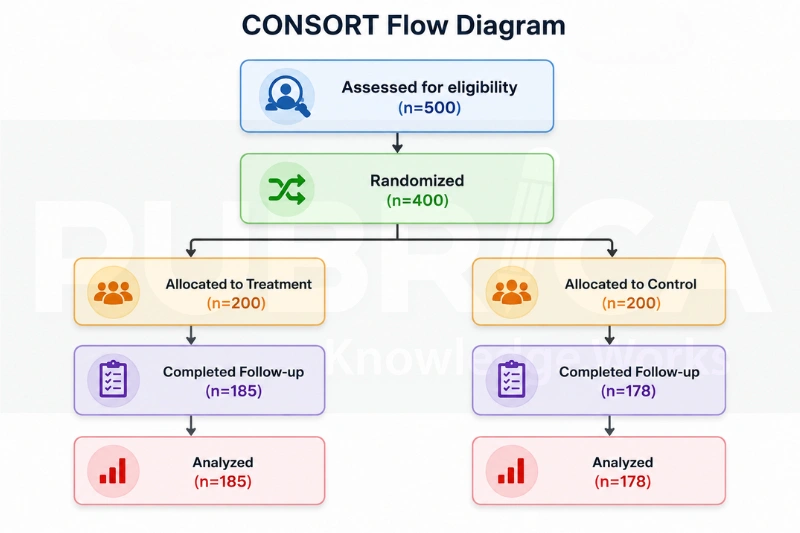
CONSORT statement enhances:
- Transparency of research methodology
- Reporting of results
- Replicability of research results
- Peer-review quality
- The chances of paper acceptance
Non-adherence to the CONSORT guidelines often leads to incomplete reporting and revisions of the manuscript.
3. Key Components of the CONSORT Checklist
The CONSORT 2025 checklist guides authors through the major sections of a randomised trial manuscript.
Manuscript Section | CONSORT 2025 Reporting Requirement |
Title & Abstract | Identify the study as a randomised trial and provide essential information about the study |
Introduction | Scientific background, rationale, and study objectives |
Methods | Trial design, participants, interventions, outcomes, randomisation, and statistical methods |
Results | Participant flow, recruitment, baseline data, outcome analysis, and analysis populations |
Harms | Reporting of harms and unintended effects |
Discussion | Interpretation, limitations, applicability, and implications |
Open Science | Trial registration, protocol/SAP availability, data sharing, and related transparency information |
Other Information | Funding, conflicts of interest, and other relevant publication information |
Following the checklist ensures consistency across journals and improves reporting quality while meeting RCT reporting standards.
4. ICMJE Recommendations for Clinical Trial Publications
The International Committee of Medical Journal Editors (ICMJE) sets out the ethics and editorial guidelines for biomedical publications. [4]
Some of the ICMJE guidelines are related to:
- Authorship qualifications
- Disclosure of conflict of interest
- Registration of trials
- Ethics approval
- Concealment of patients’ identity
- Data transparency
These guidelines assure the integrity of the publishing process.
5. Manuscript Development Workflow
Clinical trial manuscripts typically follow a structured development process from study completion to journal submission.
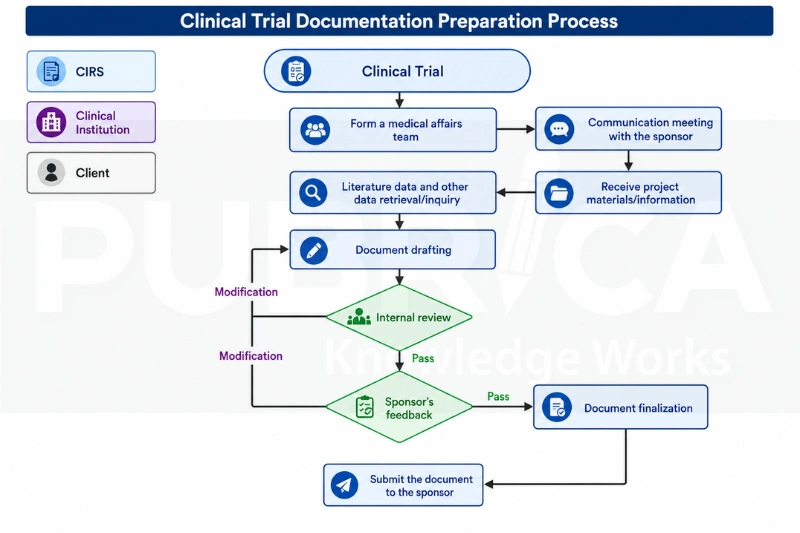
Workflow pattern:
- Completion of clinical study
- Statistical analysis of data
- Interpretation of data
- Manuscript writing
- CONSORT 2025 checklist verification
- ICMJE compliance check
- Internal manuscript check
- Journal submission
- Peer review
- Revision and publishing
Such a systematic workflow helps to avoid submission mistakes and is often strengthened by professional clinical trial manuscript support.
6. Common Challenges During Clinical Trial Manuscript Preparation
Authors face difficulties when working on their manuscripts. [5]
Some of these are as follows:
- Insufficient detail regarding trial methodology
- Lack of CONSORT flow diagram
- Unclear statistical details
- Lack of clarity regarding randomisation
- Failure to declare any conflict of interest
- Lack of discussion about limitations of the study
Handling such problems beforehand avoids problems at the review stage and improves compliance with CONSORT 2025 reporting recommendations.
7. How to Improve Your Journal Submission Quality
Submission to an appropriate journal entails much more than writing good science.
Tips for successful journal submission support include:
- Suitable journal selection
- Author guidelines of the selected journal
- Filling the necessary reporting form and checklist
- References formatting
- Tables and figures preparation
- Linguistic and scientific consistency
- CONSORT 2025 adherence
- ICMJE compliance
- Trial registration and open-science information verification
Prepared submission shows professionalism and helps in evaluating the submission.
8. Benefits of Professional Clinical Trial Manuscript Support
Professional clinical trial manuscript support and medical writing services can improve manuscript quality throughout the publication process. [6]
Major benefits include:
Support Service | Benefit |
Clear and structured presentation | |
Statistical Review | Accurate interpretation of findings |
CONSORT 2025 Compliance | Complete reporting of randomised trials |
ICMJE Compliance | Ethical and publication standards adherence |
Language Editing | Improved readability and clarity |
Journal Submission Support | Reduced formatting and submission errors |
These services help researchers prepare publication-ready manuscripts while maintaining scientific integrity.
9. The Future Landscape of Clinical Trial Reporting
Trial reporting is constantly advancing towards becoming more open and transparent.
Recent trends in the field include:
- CONSORT 2025 implementation
- Automated CONSORT checklist completion
- Open data and data sharing
- Living trial report
- Digital platforms for better reporting transparency
Such tools are expected to improve research reproducibility, strengthen CONSORT reporting guidelines implementation, and speed up scientific dissemination.
Connect with us to explore how we can support you in maintaining academic integrity and enhancing the visibility of your research across the world!
Conclusion
Scientific writings that adhere to high standards are supposed to comply with the concepts of precise scientific reporting, ethical conduct of research, and proper publication. The CONSORT 2025 Statement is the current guideline on how randomised trial papers should be reported and replaces the previous one, CONSORT 2010, while the present ICMJE Recommendations serve to uphold authorship integrity and other aspects of ethical publication.
Researchers who follow CONSORT 2025 reporting recommendations, adhere to ICMJE compliance, utilise clinical trial manuscript support, and seek journal submission support or professional medical writing services can produce reliable, publication-ready manuscripts that contribute to evidence-based medicine.
Clinical Trial Manuscript Support: Ensuring CONSORT Compliance, ICMJE Standards, and Successful Journal Submission.Our Pubrica consultants are here to guide you. [Get Expert Publishing Support] or [Schedule a Free Consultation]
Frequently Asked Questions (FAQs)
The CONSORT (Consolidated Standards of Reporting Trials) Statement is an internationally recognised reporting guideline for randomised controlled trials (RCTs). It helps authors present clinical trial methods and results transparently, improving reproducibility, peer review, and journal acceptance.
The ICMJE Recommendations provide guidance on authorship, ethical approval, clinical trial registration, conflict of interest disclosures, patient confidentiality, and manuscript preparation to ensure ethical and high-quality biomedical publications.
Many biomedical journals require CONSORT compliance because it ensures complete and standardized reporting of randomized clinical trials, enabling editors, reviewers, and readers to accurately evaluate the study’s validity and reliability.
Common challenges include incomplete methodology reporting, missing CONSORT flow diagrams, inadequate statistical descriptions, unclear randomization procedures, inconsistent formatting, and failure to disclose conflicts of interest or study limitations.
Professional manuscript support helps authors improve scientific writing, ensure CONSORT and ICMJE compliance, enhance language quality, verify statistical reporting, and meet journal formatting requirements, increasing the likelihood of successful publication.
Before submission, authors should confirm journal selection, follow author guidelines, complete CONSORT reporting requirements, verify references, prepare high-quality tables and figures, review language and scientific consistency, and ensure all ethical and regulatory requirements are met.
References
- Hopewell, S., Chan, A. W., Collins, G. S., Hróbjartsson, A., Moher, D., Schulz, K. F., Tunn, R., Aggarwal, R., Berkwits, M., Berlin, J. A., Bhandari, N., Butcher, N. J., Campbell, M. K., Chidebe, R. C. W., Elbourne, D., Farmer, A., Fergusson, D. A., Golub, R. M., Goodman, S. N., Hoffmann, T. C., … Boutron, I. (2025). CONSORT 2025 statement: Updated guideline for reporting randomised trials. PLoS medicine, 22(4), e1004587. https://doi.org/10.1371/journal.pmed
- Bandholm, T., Thorborg, K., Ardern, C. L., Christensen, R., & Henriksen, M. (2022). Writing up your clinical trial report for a scientific journal: the REPORT trial guide for effective and transparent research reporting without spin. British journal of sports medicine, 56(12), 683–691. https://doi.org/10.1136/bjsports-2021
- Merkow, R. P., Kaji, A. H., & Itani, K. M. F. (2021). The CONSORT Framework. JAMA surgery, 156(9), 877–878. https://doi.org/10.1001/jamasurg.2021.0549
- Naudet, F., Siebert, M., Pellen, C., Gaba, J., Axfors, C., Cristea, I., Danchev, V., Mansmann, U., Ohmann, C., Wallach, J. D., Moher, D., & Ioannidis, J. P. A. (2021). Medical journal requirements for clinical trial data sharing: Ripe for improvement. PLoS medicine, 18(10), e1003844. https://doi.org/10.1371/journal.pmed
- Varse, F., Janani, L., Moradi, Y., Solaymani-Dodaran, M., Baradaran, H. R., & Rimaz, S. (2019). Challenges in the design, conduct, analysis, and reporting in randomized clinical trial studies: A systematic review. Medical journal of the Islamic Republic of Iran, 33, 37. https://doi.org/10.34171/mjiri.33.37
- Bouzalmate-Hajjaj, A., Massó Guijarro, P., Khan, K. S., Bueno-Cavanillas, A., & Cano-Ibáñez, N. (2022). Benefits of Participation in Clinical Trials: An Umbrella Review. International journal of environmental research and public health, 19(22), 15368. https://doi.org/10.3390/ijerph1922153