

Literature Review & Research Gap Services: Systematic, Scoping & Narrative Reviews (PRISMA 2020)
High-Impact Journals
Interesting topics
Literature Review & Research Gap Services: Systematic, Scoping & Narrative Reviews (PRISMA 2020)
A good literature review is the cornerstone of any evidence-based study since it helps to discover current knowledge, appraise existing evidence, and determine research gaps. In case of preparation of any research proposal, thesis, dissertation, or journal article, choosing the right type of review methodology becomes vital to generate valid results. Among the most popular criteria for the reports, one can highlight the PRISMA 2020 guidelines (Preferred Reporting Items for Systematic Reviews and Meta-Analyses) that help to conduct and report a systematic review.
Literature review and research gap services, including systematic literature review service, scoping review writing service, narrative review service, and evidence synthesis support, help researchers to find appropriate evidence, synthesize it, and select review methodologies such as systematic, scoping, and narrative reviews. This will improve the quality and transparency of the research as well as help researchers build a solid scientific ground.[1]
1. Understanding Literature Review Methodologies
Different methodologies of literature reviews have different purposes for research. It is dependent on the research question, existing literature, and the output desired.[2]
There are three most frequently used methods of literature reviews, and they are as follows:
- Systematic Review – Addresses a specific research question by identifying and critically appraising all evidence related to it using established systematic review methodology help and PRISMA 2020 guidelines.
- Scoping Review – Maps out existing literature to find trends, concepts, and evidence gaps and is often supported through a scoping review writing service.
- Narrative Review – Descriptive review of existing literature without a systematic protocol.
2. Importance of Research Gap Identification
Identification of research gaps is an important aspect in research because it helps in ensuring that:[3]
- The research is original.
- The research is not repetitive.
- The objectives of the research can be justified.
- There are prospects for future research.
Conducting a literature review in an organized manner, supported by evidence synthesis support, will help in differentiating between well researched areas and those which require more research.
3. Comparison of Literature Review Types
| Review Type | Primary Purpose | Reporting Framework | Typical Outcome |
| Systematic Review | Answer a focused research question | PRISMA 2020 | Evidence synthesis with critical appraisal |
| Scoping Review | Map available evidence | PRISMA-ScR | Identification of research trends and gaps |
| Narrative Review | Summarise existing knowledge | Author-guided approach | Broad conceptual overview |
Selecting the appropriate review methodology improves research quality and ensures alignment with study objectives. Researchers often seek systematic literature review service or systematic review methodology help to ensure methodological accuracy.
4. PRISMA 2020 Framework for Systematic Reviews
The PRISMA 2020 guideline enhances transparency throughout the systematic review process by standardising reporting practices.[4]
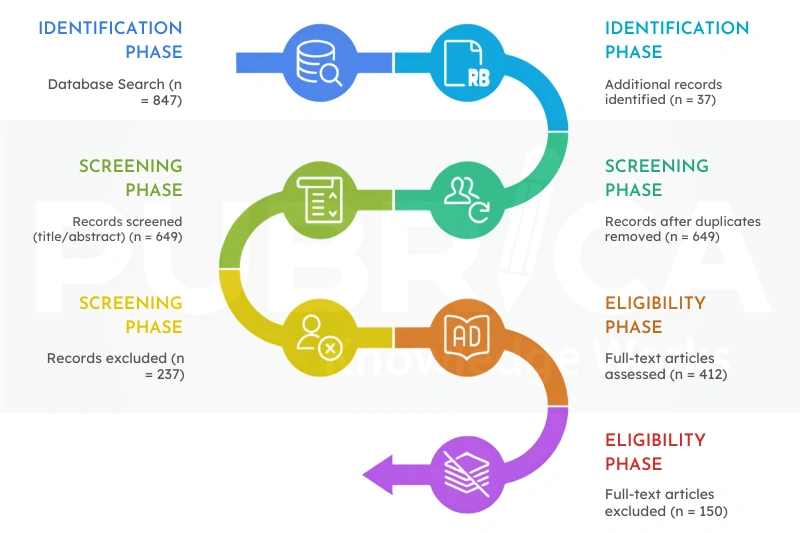
The framework generally includes:
- Research question formulation
- Database search strategy
- Study identification
- Screening and eligibility assessment
- Critical appraisal
- Data extraction
- Evidence synthesis
- Reporting and interpretation
Following PRISMA 2020 guidelines improves reproducibility and facilitates peer review while strengthening evidence synthesis support.
5. Research Gap Analysis Process
Gap Analysis in Research refers to the analysis of existing literature with an objective of identifying research gaps in the current body of literature. Some of the typical gaps that may exist are:
- Theoretical Gaps
- Methodological Gaps
- Empirical Gaps
- Contextual Gaps
- Gaps relating to Specific Populations
These findings help researchers formulate novel research objectives and strengthen proposal justification. Professional systematic literature review service providers also assist in identifying these gaps through structured evidence evaluation.
6. Benefits of Professional Literature Review Services
Professional literature review services provide methodological support throughout the evidence synthesis process.
- Comprehensive database searching
- Structured screening and study selection
- PRISMA 2020-compliant reporting
- Critical appraisal of evidence
- Research-gap identification
- Publication-ready literature synthesis
These services improve research efficiency while maintaining methodological quality.
Connect with us to explore how we can support you in maintaining academic integrity and enhancing the visibility of your research across the world!
Conclusion
The literature review is essential for conducting reliable and evidence-based research. Regardless of whether it is a systematic, scoping, or narrative literature review, choosing the right methodology guarantees that the process of evidence synthesis will be accurate and the gaps in research will be identified. The PRISMA 2020 guidelines are designed to offer reliable recommendations for conducting systematic literature reviews.
Scientists who utilize literature review methodologies create solid scientific grounds and open new areas for research. Professional systematic literature review service, scoping review writing service, narrative review service, evidence synthesis support, systematic review methodology help, and case report journal selection assistance can further enhance the quality, transparency, and publication readiness of research.
Literature Review & Research Gap Services: Systematic, Scoping & Narrative Reviews (PRISMA 2020). Our Pubrica consultants are here to guide you. [Get Expert Publishing Support] or [Schedule a Free Consultation]
Frequently Asked Questions (FAQs)
A systematic literature review service helps researchers identify, evaluate, and synthesise all relevant studies on a focused research question using a structured methodology. These services often follow the PRISMA 2020 guidelines to ensure transparency, reproducibility, and high-quality evidence synthesis.
The PRISMA 2020 guidelines are internationally recognized reporting standards for systematic reviews and meta-analyses. They improve the transparency, accuracy, and completeness of the review process by providing a standardized framework for study identification, screening, data extraction, evidence synthesis, and reporting.
A systematic review answers a specific research question through comprehensive and structured evidence synthesis. A scoping review maps existing literature to identify research trends and gaps, while a narrative review provides a broad summary of existing knowledge without following a strict systematic protocol. Depending on research objectives, researchers may seek a scoping review writing service or narrative review service for expert support.
Research gap identification helps researchers discover areas where evidence is limited, inconsistent, or unavailable. Identifying theoretical, methodological, empirical, or contextual gaps enables researchers to develop original research questions, justify their study objectives, and contribute meaningful knowledge to their field.
Evidence synthesis support includes comprehensive database searching, study selection, critical appraisal, data extraction, literature synthesis, and preparation of PRISMA-compliant reports. It helps researchers produce reliable, high-quality literature reviews suitable for theses, dissertations, and journal publications.
Yes. In addition to literature review and evidence synthesis, many professional research support services also provide case report journal selection assistance. They help researchers identify suitable journals based on the manuscript’s scope, indexing, publication requirements, and target audience, improving the chances of successful publication.
References
- Page, M. J., McKenzie, J. E., Bossuyt, P. M., Boutron, I., Hoffmann, T. C., Mulrow, C. D., Shamseer, L., Tetzlaff, J. M., Akl, E. A., Brennan, S. E., Chou, R., Glanville, J., Grimshaw, J. M., Hróbjartsson, A., Lalu, M. M., Li, T., Loder, E. W., Mayo-Wilson, E., McDonald, S., McGuinness, L. A., … Moher, D. (2021). The PRISMA 2020 statement: An updated guideline for reporting systematic reviews. PLoS medicine, 18(3), e1003583. https://doi.org/10.1371/journal.pme
- Paré G, Kitsiou S. Chapter 9 Methods for Literature Reviews. In: Lau F, Kuziemsky C, editors. Handbook of eHealth Evaluation: An Evidence-based Approach [Internet]. Victoria (BC): University of Victoria; 2017 Feb 27. Available from: https://www.ncbi.nlm.nih.gov/book
- Robinson KA, Akinyede O, Dutta T, et al. Framework for Determining Research Gaps During Systematic Review: Evaluation [Internet]. Rockville (MD): Agency for Healthcare Research and Quality (US); 2013 Feb. Introduction. Available from: https://www.ncbi.nlm.nih.gov/books
- Page, M. J., Moher, D., Bossuyt, P. M., Boutron, I., Hoffmann, T. C., Mulrow, C. D., Shamseer, L., Tetzlaff, J. M., Akl, E. A., Brennan, S. E., Chou, R., Glanville, J., Grimshaw, J. M., Hróbjartsson, A., Lalu, M. M., Li, T., Loder, E. W., Mayo-Wilson, E., McDonald, S., McGuinness, L. A., … McKenzie, J. E. (2021). PRISMA 2020 explanation and elaboration: updated guidance and exemplars for reporting systematic reviews. BMJ (Clinical research ed.), 372, n160. https://doi.org/10.1136/bmj.n160