
Strategic Journal Selection and Manuscript Optimisation for
Academic Publishing
High-Impact Journals
- Importance of Strategic Journal Selection
- Evaluating Journal Suitability
- Manuscript Optimisation for Publication Success
- Improving Scientific Writing Quality
- Aligning with Journal Guidelines
- Visual Presentation of Research Results
- Responding to Reviewer Feedback and Common Reasons for Manuscript Rejection
- Conclusion
Interesting topics
Strategic Journal Selection and Manuscript Optimisation for Academic Publishing
Journal submission is a fundamental step in scientific information dissemination and the development of the scientific careers of researchers. Nevertheless, the quality of many manuscripts is rejected for reasons including improper choice of journal, low-level formatting, or inappropriate alignment with the journal requirements. Choosing the right journal and optimising manuscripts are essential for successful research publication.
It is not enough to conduct research and have results to publish them successfully. Authors need to choose appropriate journals and optimise their manuscripts. [1]
1. Importance of Strategic Journal Selection
The selection of the appropriate journal plays a crucial role in determining whether a manuscript gets accepted or not. [2]
Some important considerations while choosing a journal are:
- Aims and scope of the journal
- Target audience
- Impact factor and citations
- Acceptance rate
- Publication schedule
- Open access policy
A manuscript sent to an inappropriate journal is generally rejected without any second thoughts. This highlights the importance of how to select the right journal for publication.
2. Evaluating Journal Suitability
Researchers should systematically evaluate potential journals before submission.
Journal Selection Criteria
Criteria | Importance |
Scope Alignment | Ensures topic relevance |
Impact Factor | Indicates journal influence |
Indexing Status | Improves visibility and discoverability |
Peer Review Process | Maintains publication quality |
Publication Speed | Affects dissemination timeline |
Open Access Options | Enhances accessibility |
A well-matched journal increases both acceptance probability and readership engagement, reducing factors affecting journal acceptance.
3. Manuscript Optimisation for Publication Success
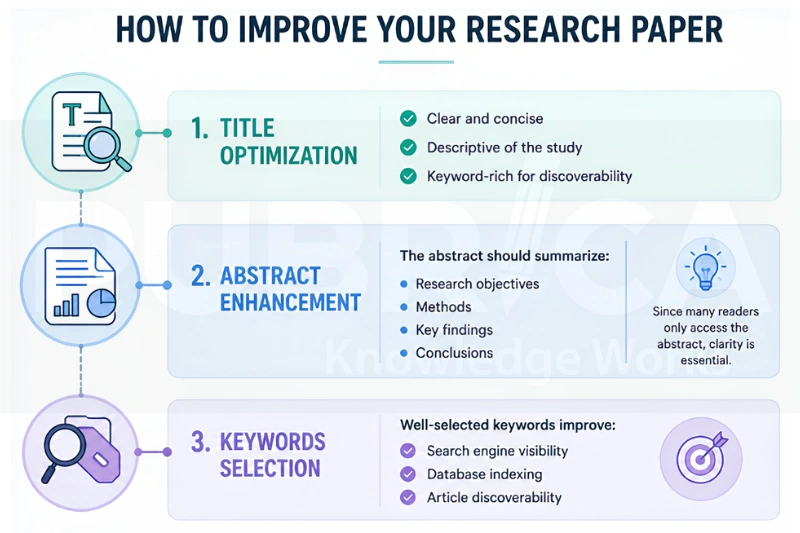
Once a suitable journal is identified, the manuscript should be carefully optimized to meet editorial and reviewer expectations. [3]
Important areas include Manuscript Preparation for Publication
4. Improving Scientific Writing Quality
Good scientific writing helps improve clarity and evaluation of your paper.
The researcher needs to concentrate on:
- Organization
- Linguistic clarity
- Terminology consistency
- Grammatical and syntactical correctness
- Brief reporting of results
Bad writing can hide good research that might have been rejected, consequently, making Manuscript Improvement for Journals essential.
5. Aligning with Journal Guidelines
Each journal offers clear author guidelines. Non-compliance with these guidelines is one of the most frequent reasons for desk rejection.
The authors must check:
- The format of the manuscript;
- The citation style;
- Word limits;
- The form of figures and tables;
- Ethical statements;
- Supplemental information.
Following these properly supports manuscript editing for academic publishing.
6. Visual Presentation of Research Results
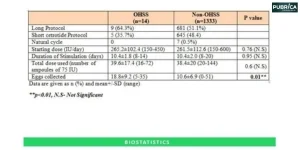
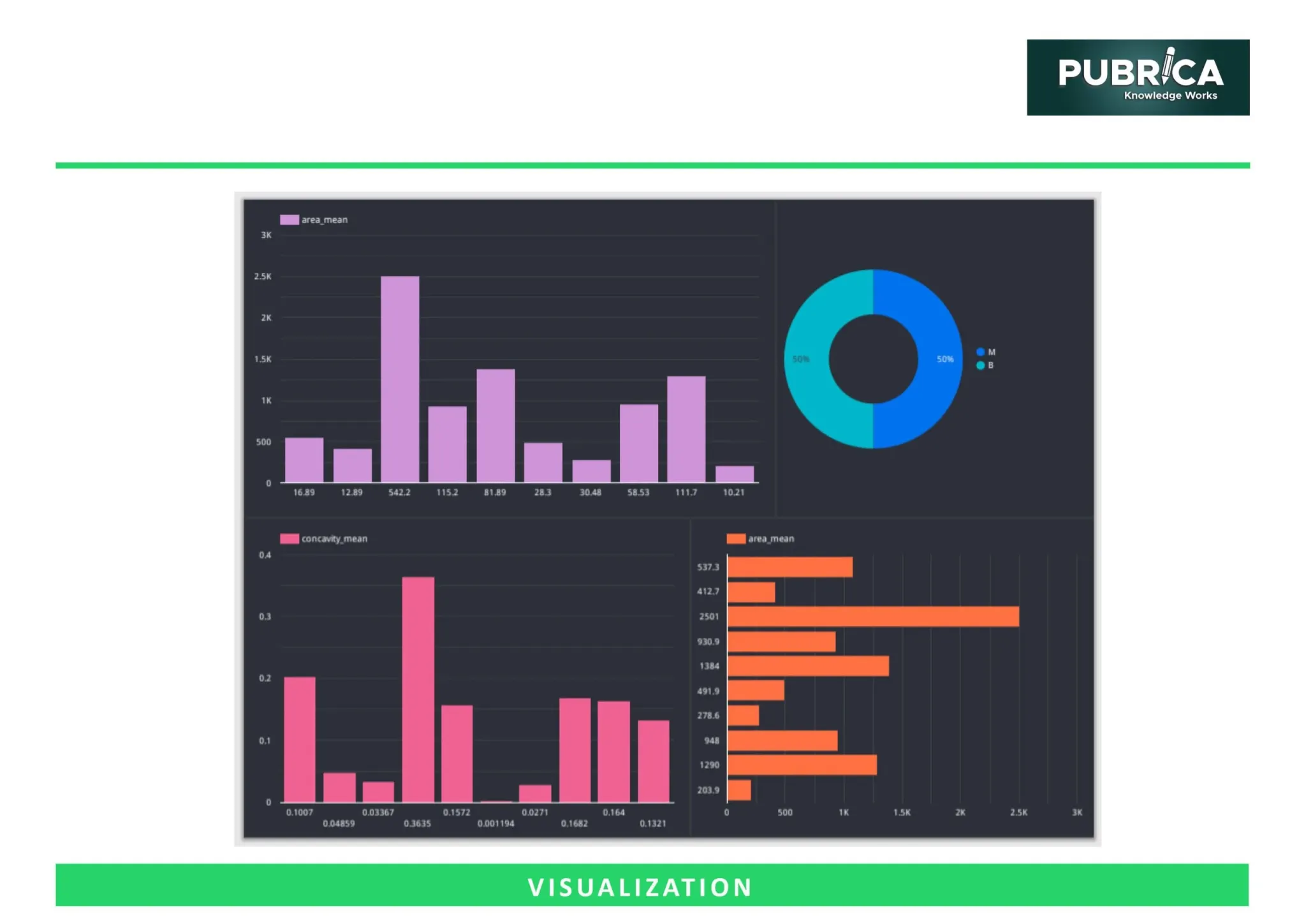
A clear visualisation makes the results easy to understand and contributes to high-quality research. High resolution, clear labels, no repetitions, and explanatory captions are expected from researchers when presenting their results visually. [4]
7. Responding to Reviewer Feedback and Common Reasons for Manuscript Rejection
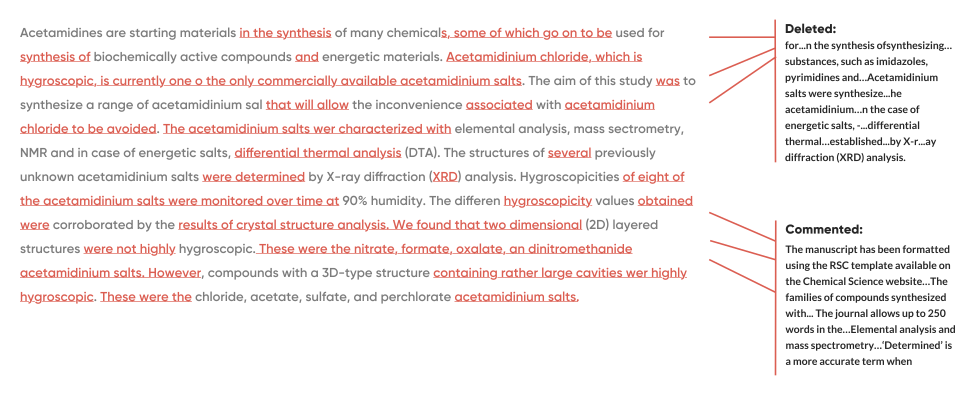
Peer review is an important element of academic publishing, and effective replies include responding to reviewer comments one by one, giving evidence-based justifications, using a professional tone, and emphasising changes made to the manuscript. The constructive response to the reviewer will help in achieving publication success. [5]
But there are many reasons why the manuscript is often rejected for publication. Among these reasons are inappropriate choice of the journal, weak methodology, a lack of novelty, insufficient literature review, improper formatting, and bad language use, which are part of common reasons for manuscript rejection. It is helpful to know them to improve the manuscript before submitting.
Connect with us to explore how we can support you in maintaining academic integrity and enhancing the visibility of your research across the world!
Conclusion
The selection of journals and optimisation of manuscripts is critical for publishing academic works. Proper choice of journals, tailoring the manuscript according to the journal’s guidelines, and good presentation of research work can help in achieving higher chances of acceptance. Researchers spending time on journal selection, scientific writing improvement, and publication preparation have an advantage over others.
Strategic Journal Selection and Manuscript Optimisation for Academic Publishing. Our Pubrica consultants are here to guide you. [Get Expert Publishing Support] or [Schedule a Free Consultation]
Frequently Asked Questions (FAQs)
Choosing the right journal increases the chances of acceptance by ensuring the manuscript matches the journal’s scope, audience, and standards.
Key factors include scope, impact factor, indexing status, acceptance rate, publication speed, target audience, and open access policy.
Journal scope defines the topics a journal accepts. Submitting outside the scope often leads to immediate rejection.
Compare your research topic with the journal’s aims, read recent articles, and review author guidelines and indexing databases.
Manuscript optimisation involves improving structure, language, formatting, and clarity to meet journal and reviewer expectations.
References
- Madden, J. C., Kandarova, H., Neuhaus, W., Osborne, N., Paini, A., Seabra, R., & Trigwell, S. (2024). Journeying through journals: The publishing process and how to maximise research impact. Alternatives to Laboratory Animals: ATLA, 52(6), 334–351. https://doi.org/10.1177/02611929241286624
- Gaffney, S. G., & Townsend, J. P. (2022). Jot: guiding journal selection with suitability metrics. Journal of the Medical Library Association : JMLA, 110(3), 376–380. https://doi.org/10.5195/jmla.2022.1499
- Wong, C. C., Tapper, E. B., Malhi, H., & Gores, G. J. (2024). Manuscript best practices: Takeaways from a community conversation. Hepatology (Baltimore, Md.), 79(6), 1243–1245. https://doi.org/10.1097/HEP.0000000000000849
- Butdisuwan, S., M Annamma, L., Subaveerapandiyan, A., George, B. T., & Kataria, S. (2024). Visualising Medical Research: Exploring the Influence of Infographics on Professional Dissemination. TheScientificWorldJournal, 2024, 5422121. https://doi.org/10.1155/2024/5422121
- Hidouri, S., Kamoun, H., Salah, S., Jellad, A., & Ben Saad, H. (2024). Key Guidelines for Responding to Reviewers. F1000Research, 13, 921. https://doi.org/10.12688/f1000research.154614.3