
How to Identify Predatory Journals: 2026 Evidence-Based Guidelines and Checklist
High-Impact Journals
- Understanding Predatory Journals
- Why Researchers Must Avoid Predatory Journals
- Common Characteristics of Predatory Journals
- Evidence-Based Guidelines to Identify Predatory Journals
- Importance of Publication Ethics
- Role of Impact Factor and Metrics
- Checklist Before Submitting a Manuscript
- Risks Associated with Predatory Publishing
- Support for Early-Career Researchers
- Future Trends in 2026
- Conclusion
Interesting topics
How to Identify Predatory Journals: 2026 Evidence-Based Guidelines and Checklist
Predatory journals have become a matter of great importance in recent times, as far as scholarly publishing is concerned. Predatory journal checklist 2026 and awareness about how to identify predatory journals 2026 have become essential tools for researchers. Predatory journals prioritise making money over any scientific considerations. Such predatory journals do not provide adequate peer review, editing services, or ethical publishing practices, but instead require payments from authors. With the rise of open-access publishing, many predatory publishers lure researchers through phishing emails, fake impact factors, and false indexes. Knowing predatory publishing warning signs can prevent scholars from falling victim.
Students, scholars, and researchers should know about such predatory journals. In 2026, researchers need to be extra cautious regarding the publication of their papers. Submission to predatory journals may harm academic reputation, limit citations, and hinder career progression. This makes identifying fake research journals an important skill for every researcher. [1]
1. Understanding Predatory Journals
Predatory journals can be described as either fake or poor-quality journals that tend to mimic credible scholarly journals. Their main aim is the acquisition of Article Processing Charges (APC) from researchers while ignoring academic standards. [2]
As opposed to genuine scholarly journals, predatory journals tend to forgo the peer review process, lack good editorial services, and post articles hastily without conducting any form of quality check. Scholars often fall victim to these journals due to their initial appearance of credibility. How to spot a predatory journal is key to avoiding these pitfalls.
2. Why Researchers Must Avoid Predatory Journals
Publication in predatory journals poses several risks. Firstly, publications in these journals will not be accepted by any institutions or funding organisations. This will influence the credibility of the research being conducted. The risk in predatory publication lies in the undermining of the quality and integrity of scientific research. [3]
3. Common Characteristics of Predatory Journals
Researchers should carefully examine journals before submission because predatory publishers often display identifiable warning signs.
Legitimate Journals | Predatory Journals |
Transparent peer review | Fake or absent peer review |
Verified indexing | False indexing claims |
Professional website | Poor website quality |
Recognized editorial board | Fake editor information |
Ethical publishing policies | Missing ethics guidelines |
Realistic publication timelines | Extremely fast acceptance |
4. Evidence-Based Guidelines to Identify Predatory Journals
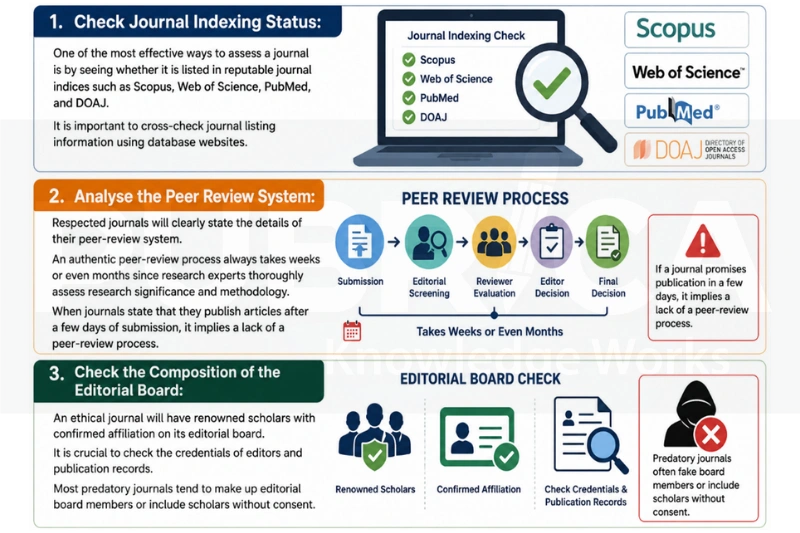
To identify predatory journals 2026, researchers should rely on verified sources, cross-check journal indexing, verify editorial boards, and review peer review policies. Always ensure that journal impact factor verification tips are followed to distinguish real metrics from fake ones. [4]
5. Importance of Publication Ethics
The ethics of publications are very important for ensuring the integrity of research. Ethical publication requires adhering to certain publication standards as set out by professional bodies like the Committee on Publication Ethics (COPE).
It is critical to find out from the journals whether they offer some form of ethical policy regarding issues such as plagiarism, authorship, copyright issues, conflict of interest, and research misconduct. [5]
6. Role of Impact Factor and Metrics
Predatory journals publish impact factors that are fictitious to attract submissions. Researchers need to know that the true values are provided by agencies only, such as Journal Citation Report (JCR), Scopus Cite Score, and SC Imago Journal Rank (SJR).
The fictitious values will have names that resemble the name of the real metric. Scholars should always verify the metrics of any journal using proper journal impact factor verification tips.
7. Checklist Before Submitting a Manuscript
Before submitting research work, authors should perform a complete journal evaluation. Following a predatory journal checklist 2026 ensures that all aspects are covered. [6]
Evaluation Criteria | Questions to Ask |
Journal Scope | Does the journal match the research topic? |
Indexing | Is the journal listed in trusted databases? |
Is the review process clearly explained? | |
Editorial Board | Are editors academically recognised? |
Publication Fees | Are APC charges transparent? |
Ethics Policy | Are plagiarism and ethics policies available? |
8. Risks Associated with Predatory Publishing
Academics who submit papers to predatory journals may suffer from long-term academic ramifications. Many universities and funding institutions nowadays pay greater attention to the quality of research articles rather than their number.
Submission to fraudulent journals may result in loss of credibility, failure during a promotion process, decreased research exposure, inability to receive funding, and poor citation potential. For all these reasons, choosing a journal became one of the crucial aspects of research publishing. Awareness of predatory publishing warning signs and predatory journals list can help mitigate these risks.
9. Support for Early-Career Researchers
Early-career researchers are highly susceptible to predatory journals as they might not have the experience to judge a journal. Training sessions on publication ethics, journal indexing, and manuscript submission should be conducted by universities and research organisations.
Training sessions could go a long way in minimising predatory journal submissions. Knowing how to spot a predatory journal is a vital part of such training.
10. Future Trends in 2026
The tactics used by the predatory publishers are changing with new technologies. The current fraudulent publishers can apply artificial intelligence to make professional websites that appear legitimate, have comments from reviewers that are not real, and have false editorial systems.
The more complex predatory publishers are becoming, the more important it is for the researcher to have evidence-based means of verifying the publisher’s legitimacy rather than simply using visual means. How to identify predatory journals 2026 is evolving with AI-based deception, making scrutiny more critical than ever.
Connect with us to explore how we can support you in maintaining academic integrity and enhancing the visibility of your research across the world!
Conclusion
Predatory journals have become one of the most significant issues in the domain of academic publishing. Scholars should take into consideration the need for proper assessment of journals before submitting papers there. The verification of indexing, examination of the process of peer review, analysis of editorial practices, and investigation of the ethical principles are the primary criteria that could help identify reputable journals. Following predatory journal checklist 2026, being aware of predatory publishing warning signs, and using journal impact factor verification tips are key to ensuring research credibility.
How to Identify Predatory Journals: 2026 Evidence-Based Guidelines and Checklist. Our Pubrica consultants are here to guide you. [Get Expert Publishing Support] or [Schedule a Free Consultation]
References
- Sethuraman R. M. (2026). Predatory journals: Preventive measures for this 21st-century phenomenon. Saudi journal of anaesthesia, 20(1), 241–242. https://doi.org/10.4103/sja.sja_723_25
- Elmore, S. A., & Weston, E. H. (2020). Predatory Journals: What They Are and How to Avoid Them. Toxicologic pathology, 48(4), 607–610. https://doi.org/10.1177/0192623320920209
- Yildizhan E. (2022). Avoiding Predatory Journals: Four Main Points. Noro psikiyatri arsivi, 59(3), 167–168. https://doi.org/10.29399/npa.28243
- Laine, C., & Winker, M. A. (2017). Identifying Predatory or Pseudo-Journals. The international journal of occupational and environmental medicine, 8(2), 117–124. https://doi.org/10.15171/ijoem.2017.1048
- Singh, P. K., Kumar, V., Ameen, S., Sarkhel, S., Praharaj, S. K., & Menon, V. (2022). Publication Ethics. Indian journal of psychiatry, 64(Suppl 1), S81–S92. https://doi.org/10.4103/indianjpsychiatry.indianjpsychiatry_78_21
- Matsubara, S., & Matsubara, D. (2024). A Checklist Confirming Whether a Manuscript for Submission Adheres to the Fundamentals of Academic Writing: A Proposal. JMA journal, 7(2), 276–278. https://doi.org/10.31662/jmaj.2023-0201