
- Services
- Discovery & Intelligence Services
- Publication Support Services
- Sample Work
Publication Support Service
- Editing & Translation
-
Editing and Translation Services
- Sample Work
Editing and Translation Service
-
- Research Services
- Sample Work
Research Services
- Physician Writing
- Sample Work
Physician Writing Service
- Statistical Analyses
- Sample Work
Statistical Analyses
- Data Collection
- AI and ML Services
- Sample Work
AI and ML Services
- Medical Writing
- Sample Work
Medical Writing
- Research Impact
- Sample Work
Research Impact
- Medical & Scientific Communication
- Sample Work
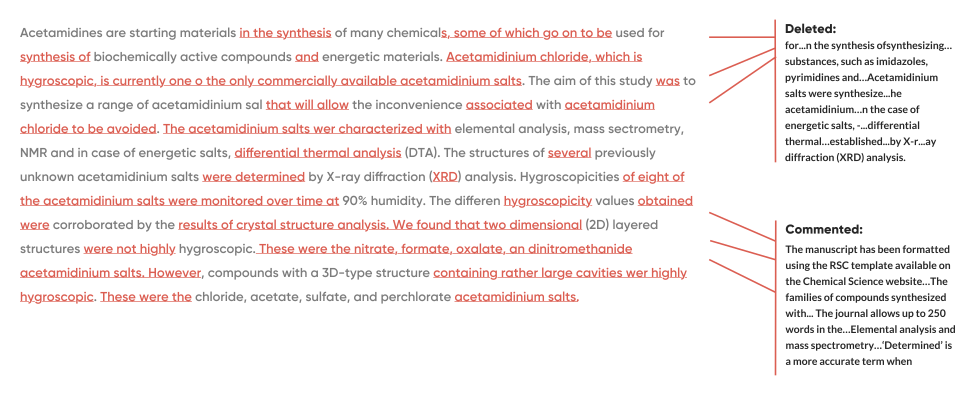
Medical & Scientific Communication
- Medico Legal Services
- Educational Content
- Academic Editorial Services
- Sample Work
Academic Editorial Services
- Educational Editorial Service
-
Education Editorial Services
- Sample Work
Education Editorial Services
-
- Industries
- Subjects
- About Us
- Academy
- Insights
- Contact Us
Top Hybrid Journals in 2025
- Home
- Insights
- News
- Top Hybrid Journal In 2025
An Academy Guide
Interesting topics


Top Hybrid Journals in 2025
The hybrid journal model is growing rapidly in the research marketplace, combining subscription access and traditional journals with open-access options for authors. Authors had the choice of whether to benefit from increased visibility and public access for their articles using the open-access policy or they had to be satisfied with the traditional scholarly journal model for subscribership access. [1]
In 2025, hybrid journals will continue to develop, and change based on technology and research funding developments. This article will, subsequently, highlight the hybrid journals to watch in 2025, continuing key trends affecting the hybrid journal landscape, and implications for authors and researchers.

1. What are hybrid journals
Hybrid journals are academic journals which publish subscription articles and provide open access. Authors can decide which articles will be open access while the rest of the journal will remain subscription based. This provides an opportunity to share research with broader audiences while still retaining the subscription recommendations for sustainability.

2. Top Hybrid Journals in 2025
Increased Open Access | In 2025, higher levels of open access use in hybrid journals is expected to increase, largely because of institutional and funders’ policies. This will allow higher levels of access to publicly funded research, improving the performance and visibility of academic publications. |
Greater Author Flexibility | Authors will have greater flexibility in their choice of access models for their articles. As more institutions embrace hybrid models, researchers will be in a better position to access funds for open access fees thereby allowing their work to be distributed widely. |
Preprint Server Collaborations | Hybrid journals are involving preprint servers more. Preprint servers are platforms where researchers can upload early versions of their paper, enabling speedier dissemination of research and peer feedback. This trend is likely to continue to grow in 2025 as we expect to see research shared free of cost before the peer review stage. |
Increased Discoverability and Impact Metrics
| The emergence of hybrid journals correlates with increased discoverability and improved citation tracking. Hybrid models that provide open access specifically have been found to represent greater discoverability and citation potential because articles published in hybrid journals are more readily accessible globally. |
Sustainability of Publishing Models | As concerns around funding for open access publishing mounted, many hybrid journals began working out cost models for sustainability. Hybrid journals seek to minimize reliance on subscription revenues while incorporating affordable business models that leverage article processing charges (APCs), and in essence, hybrid will last beyond the years of funding. |

3. Top Hybrid Journals in 2025
| Journal Name | Subject Area | Key Features |
| Nature Communications [2] | Multidisciplinary | Leading hybrid journal with strong impact metrics. Open access option available. |
| Scientific Reports | Life Sciences, Physics | A highly successful open-access hybrid journal offering rapid publication. |
| PLOS Biology [3] | Biological Sciences | Full open-access model with optional hybrid options. |
| IEEE Access [4] | Engineering, Technology | A leading hybrid journal in engineering with a focus on wide accessibility. |
| Frontiers in Psychology [5] | Psychology | A well-regarded hybrid journal offering immediate open access on publication. |

4. Advantages of Hybrid Journals for Researchers
- Flexibility: Hybrid journals allow researchers to determine the most appropriate publication option depending on their aims (e.g., visibility vs. traditional access).
- Funding Support: Most hybrid journals have grants or are partnered with funding organizations to help support open-access publication (or help researchers with the cost of publication).
- Fast Publication: Hybrid journals are generally experts when it comes to open-access publishing and have fast-track publication processes that help accelerate the dissemination of research

5. Challenges of Hybrid Journals
- APCs (Article Processing Charges): Authors choosing an open access option in hybrid journals may incur APCs, which can present a financial burden, especially for research that lacks institutional support.
- Inconsistent Impact: Hybrid journals are highly visible, but the impact may be “hit or miss.” Some hybrid journals are not necessarily impactful. Some may have very low citation impacts when compared to their fully open-access or subscription journals.
- Quality Control: Articles published in hybrid journals can be regarded as questionable in quality due to the speedy publication of documents under an APC for open access.
Conclusion
Hybrid journals are poised to increase in 2025, offering researchers greater accessibility and publish ability with open-access options. Hybrid journals are a means of facilitating more rapid dissemination of research, but there are many positives and negatives when it comes to selecting an appropriate journal. Being aware of hybrid journal trends in an increasingly hybrid environment will help researchers choose wisely, as there are implications for maximizing their research impact.
Top Hybrid Journals in 2025? Our academic consultants are here to guide you. [Get Expert Publishing Support] or [Schedule a Free Consultation]

Frequently Asked Questions (FAQs)
1. What are hybrid journals?
- Hybrid journals are academic journals that combine traditional subscription-based access with open access options. Authors can choose whether to make their articles freely available (open access) or allow them to be available only through subscription
- This flexibility provides a balance between the benefits of traditional publishing and the increased visibility of open-access publications.
2. What are the key advantages of publishing in hybrid journals?
- Flexibility: Researchers can choose the publishing model (open access or subscription-based) depending on their goals.
- Increased Visibility: Open access options allow research to reach a broader audience and increase its impact.
- Faster Publication: Hybrid journals often offer quicker turnaround times for article publication compared to traditional subscription-only journals.
3. What are the challenges associated with hybrid journals?
- Article Processing Charges (APCs): Authors who choose the open-access option must often pay APCs, which can be financially burdensome.
- Inconsistent Impact: Not all hybrid journals maintain the same citation impact or credibility, which can vary across disciplines.
- Quality Control: Rapid publication, especially for open-access articles, may raise concerns about the thoroughness of the peer-review process and quality of research.
4. What are the top hybrid journals to watch in 2025?
- Nature Communications (Multidisciplinary) – A leading hybrid journal with strong impact metrics and an open access option.
- Scientific Reports (Life Sciences, Physics) – Known for its rapid publication and hybrid publishing model.
- PLOS Biology (Biological Sciences) – Offers full open access with optional hybrid options for authors.
- IEEE Access (Engineering, Technology) – A prominent hybrid journal in the engineering field.
- Frontiers in Psychology (Psychology) – Provides immediate open access on publication.
5. How will hybrid journals evolve in 2025?
- Increase Open Access: More institutions and funding bodies are pushing for greater access to publicly funded research, which will likely increase the number of open-access articles published in hybrid journals.
- Greater Author Flexibility: Researchers will have more control over how they publish their work, including financial support for APCs.
- Collaborate with Preprint Servers: Hybrid journals are increasingly collaborating with preprint servers to ensure faster dissemination of research before peer review.

References
- Fuchs, P. X., Shiang, T. Y., & Herzog, W. (2023). Observations regarding open access publishing in hybrid journals in sport sciences. Journal of sport and health science, 12(1), 1–2. https://doi.org/10.1016/j.jshs.2022.09.005
- Cheng, X., Wang, H., Tang, L., Jiang, W., Zhou, M., & Wang, G. (2024). Open peer review correlates with altmetrics but not with citations: Evidence from Nature Communications and PLoS One. Journal of Informetrics, 18(3), 101540. https://doi.org/10.1016/j.joi.2024.101540
- Pariente, N., & PLOS Biology staff editors (2023). PLOS Biology at 20: Ain’t no mountain high enough. PLoS biology, 21(1), e3002011. https://doi.org/10.1371/journal.pbio.3002011
- Raman, R., Singh, P., Singh, V. K., Vinuesa, R., & Nedungadi, P. (2022). Understanding the bibliometric patterns of publications in IEEE access. IEEE Access: Practical Innovations, Open Solutions, 10, 35561–35577. https://doi.org/10.1109/access.2022.3161639
- Ke, L., Tong, S., Cheng, P., & Peng, K. (2025). Exploring the frontiers of LLMs in psychological applications: a comprehensive review. Artificial Intelligence Review, 58(10). https://doi.org/10.1007/s10462-025-11297-5