
- Services
- Discovery & Intelligence Services
- Publication Support Services
- Sample Work
Publication Support Service
- Editing & Translation
-
Editing and Translation Services
- Sample Work
Editing and Translation Service
-
- Research Services
- Sample Work
Research Services
- Physician Writing
- Sample Work
Physician Writing Service
- Statistical Analyses
- Sample Work
Statistical Analyses
- Data Collection
- AI and ML Services
- Sample Work
AI and ML Services
- Medical Writing
- Sample Work
Medical Writing
- Research Impact
- Sample Work
Research Impact
- Medical & Scientific Communication
- Sample Work
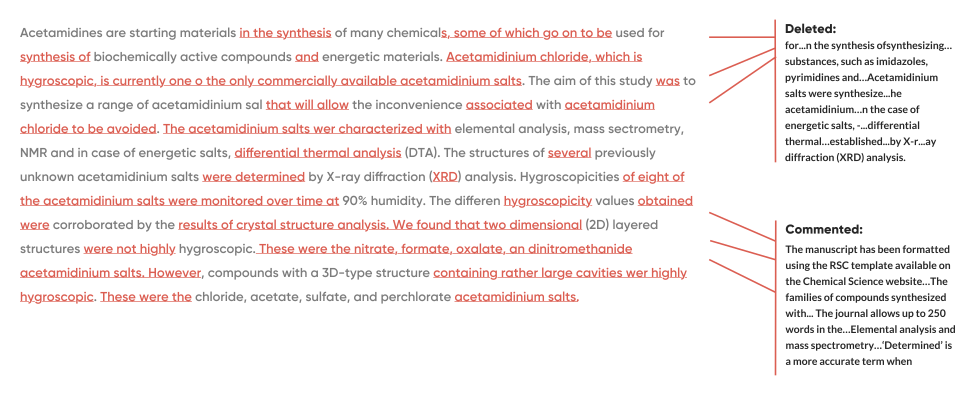
Medical & Scientific Communication
- Medico Legal Services
- Educational Content
- Academic Editorial Services
- Sample Work
Academic Editorial Services
- Educational Editorial Service
-
Education Editorial Services
- Sample Work
Education Editorial Services
-
- Industries
- Subjects
- About Us
- Academy
- Insights
- Contact Us
Journal Rejection: Key Reasons, and Tips for Improving Your Manuscripts
- Home
- services
- Journal Selection
- Journal Rejection, Key Reasons, and Tips for Improving Your Manuscripts
Journal Rejection
Interesting topics


Journal Rejection: Key Reasons, and Tips for Improving Your Manuscripts
It is common for researchers to be faced with the challenge of having a manuscript rejected by a journal. If authors understand the reasons for journal rejection, they can greatly improve their chances for acceptance in the future. Even if researchers address common reasons for rejection, they can still improve the quality of research paper, so it meets the expectations of an academic journal submission process. [1] [2]

1. Key Reasons for Journal Rejection
WOS is an online service that provides access to a wide variety of academic content, using journal articles, conference proceedings, books, etc. It has a wide number of subjects, more than science, technology, medicine, social sciences, and humanities, so it is likely to add to academic publishing considerably. [1],[2]
1.1. Poor Structure and Organization
- A manuscript without clear structure and logical flow is a reason to reject. Editors and reviewers may have difficulty determining the central thesis, and overall scope, if there is an incoherent manuscript.
- Organize your manuscript into clear sections, and utilize good transitions (Introduction, Methods, Results, Discussions). [3]
1.2. Lack of Novelty or Contribution to the Field
- The papers that journals want are ones that provide new insight or value. Oftentimes journals will reject a research paper with no new findings.
- Make sure your research contributes original findings, and that your manuscript clearly states its contributions to the literature.
1.3. Inadequate Literature Review
- A truncated or superficial literature review may indicate that the author did not sufficiently grasp the context and prior work in relation to their topic.
- Conduct a proper literature review and explicitly state how your research fills gaps or contributes to the existing body of knowledge.
1.4. Poor Writing Quality
- Unclear or poorly written content often contributes to manuscript rejection, which detracts from the host’s understanding of your research.
- Consider using professional manuscript editing for clarity of writing, grammar, and presentation.

2. The Role of Peer Review in Journal Rejection
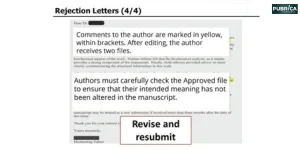
Peer review is an important part of the journal submission process. In many cases when a paper is rejected, the action of the reviewer; issues are brought up regarding the methodology of the research, a concern around the interpretation of the results, or the theoretical contribution is confused. Being rejected through peer review can be disappointing, however, it can also be a fruitful opportunity to provide better clarity for your manuscript. [4]
Respond to reviewer comments constructively, address their concern fully and reflect on changes that improve clarity and makes the research findings more valid.

3. Tips for Dealing with Peer Review Feedback
- Be receptive to criticism: While peer review may feel harsh, it usually presents useful feedback which will improve your writing.
- Clarify any misunderstandings: If the reviewers have misunderstood a specific concept or result, then provide the appropriate level of detail and consider revising the relevant section.
- Be brief and professional: Be polite and focused in your responses. Clearly state how you addressed the reviewer comments. [5]

4. Best Tips for Improving Your Manuscript Quality
4.1. Review Journal Guidelines Thoroughly
- Adhere to the journal’s submission guidelines regarding formatting, word length, and reference style.
4.2. Ensure Strong Research Design
- Make sure to double-check the research methodology for its soundness, reproducibility and conformance to accepted academic practices.
4.3. Write Clearly and Concisely
- Avoid jargon and long, convoluted sentences. Write in a clear, direct manner that highlights your main findings.
4.4. Utilize Professional Editing Services
- A professional manuscript editing service can help polish your paper, improve grammar, and align the writing with academic standards. [6]
| Rejection Reason | Solution |
| Poor Structure and Organization | Organize the manuscript into clear sections. |
| Lack of Novelty | Highlight the novelty of your research findings. |
| Inadequate Literature Review | Conduct a comprehensive literature review. |
| Methodological Issues | Ensure research methods are robust and clear. |
| Poor Writing Quality | Hire a professional manuscript editor. |

5. The Impact of Target Journal Selection
Choosing the correct journal for your manuscript contributes immensely to its success. Occasionally, the submitted manuscript may not be rejected because of inadequate quality, but rather because it has been submitted to a journal with incompatible aims, audience and or quality expectations. [7]
Be sure to research the journals that you intend to submit to so that you can be sure that your manuscript is aligned with the journal’s aims and scope.
Tips for Choosing the Right Journal
- Check the journal’s scope and aims: Make sure your manuscript’s topic fits within the journal’s focus area.
- Review recent articles: Examine the types of papers the journal has published in the past year to determine if your work is suitable.
- Consider journal impact factor: While it’s not the only factor, selecting a journal with a good reputation can increase the likelihood of acceptance. [8]

Conclusion
Grasping the common rejection reasons for manuscript rejection and taking steps to overcome them can tremendously accelerate your probability for publishing. The more detail, structure and quality you place into your work, the more likely you will meet the journals’ expectations. Take the information, create a polished paper, followed journal submission requirements and use professional help if necessary. All of these things can get you from rejection to acceptance when submitting to an academic journal.
Journal Rejection, Key Reasons, and Tips for Improving Your Manuscripts? Our academic consultants are here to guide you. [Get Expert Publishing Support] or [Schedule a Free Consultation]
Frequently Asked Questions (FAQs)
1. What are the most common reasons for journal rejection?
Some of the common rejection reasons include poor structure and organization, lack of novelty or contribution to the field, an inadequate literature review, and poor writing quality. Addressing these issues will significantly improve your chances of acceptance.
2. How can I improve my manuscript’s structure?
- Ensure clear sections with appropriate headings (Introduction, Methods, Results, Discussion).
- Make sure that the paper flows logically, with smooth transitions between sections and paragraphs.
- Double-check that the central thesis is easy to identify and well-supported throughout the paper.
3. How important is the peer review process in the journal submission?
The peer review process is crucial as it provides constructive feedback on your manuscript. While rejection can be disheartening, reviewer comments often highlight areas for improvement, such as methodology or theoretical contributions. Take the opportunity to refine your work based on their feedback.
4. How does journal selection impact manuscript acceptance?
Choosing the right journal is crucial. A manuscript may be rejected not due to poor quality, but because it doesn’t align with the journal’s scope or audience. Ensure that your paper fits the journal’s aims and scope to increase the likelihood of acceptance.
5. What should I do if my manuscript gets rejected?
If your manuscript is rejected, don’t be discouraged. Review the feedback carefully and make the necessary revisions. Ensure that the paper addresses the reviewers’ concerns, improve any weak sections, and then submit the manuscript to a more appropriate journal if needed.

References
- Ali J. (2010). Manuscript rejection: causes and remedies. Journal of young pharmacists : JYP, 2(1), 3–6. https://doi.org/10.4103/0975-1483.62205
- Ehara, S., & Takahashi, K. (2007). Reasons for rejection of manuscripts submitted to AJR by international authors. American Journal of Roentgenology, 188(2), W113-6. https://doi.org/10.2214/AJR.06.0448
- Gladden, W. (2024). Quality assurance- most common reasons for rejection. Dentistry Review (New York, N.Y.), 4(3), 100100. https://doi.org/10.1016/j.dentre.2024.100100
- Pollock, N. W. (2019). Rejection under peer review. Wilderness & Environmental Medicine, 30(1), 1. https://doi.org/10.1016/j.wem.2018.12.007
- Moore, C., & Teather, S. (2013). Engaging students in peer review: Feedback as learning. Issues in Educational Research, 23(2), 196–211. https://search.informit.org/doi/10.3316/informit.354576626678153
- Balch, C. M., McMasters, K. M., Klimberg, V. S., Pawlik, T. M., Posner, M. C., Roh, M., Tanabe, K. K., Whippen, D., & Ikoma, N. (2018). Steps to getting your manuscript published in a high-quality medical journal. Annals of Surgical Oncology, 25(4), 850–855. https://doi.org/10.1245/s10434-017-6320-6
- Beshyah S. A. (2019). Authors’ Selection of Target Journals and Their Attitudes to Emerging Journals: A survey from two developing regions. Sultan Qaboos University medical journal, 19(1), e51–e57. https://doi.org/10.18295/squmj.2019.19.01.010
- Boxer, E. (2023). Submitting your manuscript: how do you choose the right journal? The Veterinary Record, 193(12), 484–485. https://doi.org/10.1002/vetr.3783