
- Services
- Discovery & Intelligence Services
- Publication Support Services
- Sample Work

Publication Support Service
- Editing & Translation
-
Editing and Translation Services
- Sample Work

Editing and Translation Service
-
- Research Services
- Sample Work
Research Services
- Physician Writing
- Sample Work
Physician Writing Service
- Statistical Analyses
- Sample Work
Statistical Analyses
- Data Collection
- AI and ML Services
- Sample Work
AI and ML Services
- Medical Writing
- Sample Work
Medical Writing
- Research Impact
- Sample Work

Research Impact
- Medical & Scientific Communication
- Sample Work
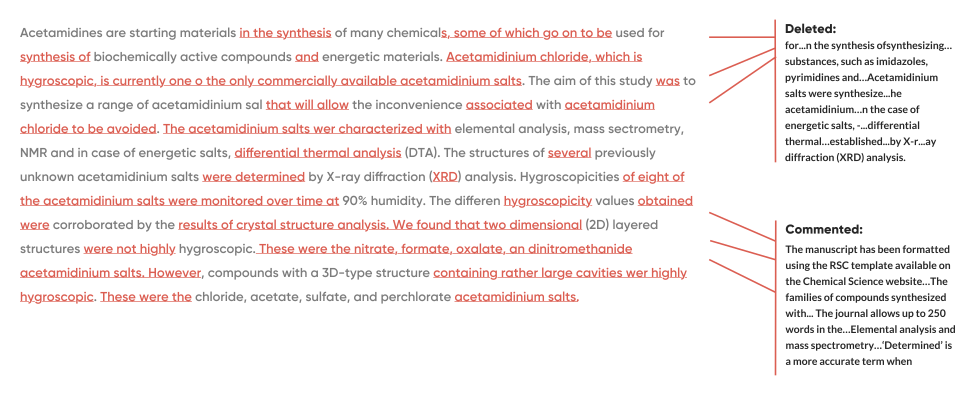
Medical & Scientific Communication
- Medico Legal Services
- Educational Content
- Academic Editorial Services
- Sample Work
Academic Editorial Services
- Educational Editorial Service
-
Education Editorial Services
- Sample Work
Education Editorial Services
-
- Industries
- Subjects
- About Us
- Academy
- Insights
- Contact Us
Understanding Disability-Adjusted Life Year (DALY): A Comprehensive Overview
- Home
- Publication Support
- Journal Selection
- Understanding Disability-Adjusted Life Year (DALY): A Comprehensive Overview
An Academy Guide
Interesting topics


Understanding Disability-Adjusted Life Year (DALY): A Comprehensive Overview
The Disability-Adjusted Life Year (DALY) is an important measure in epidemiology and public health measurement and is used to describe the total burden of disease. It includes the years of life lost (YLL) because of premature mortality and the years lived with disability (YLD), which provides a summary measure of population health. DALY enables researchers, healthcare professionals, and policymakers to prioritize interventions, allocate resources, and monitor health outcomes globally.[1]
Health interventions aim to prevent or mitigate DALYs, thereby maximizing the number of years a person spends in good health. [2]
- YLL is derived from the number of deaths (n) multiplied by the standard life expectancy at the age of death (L1). This reflects lost life expectancy.
- YLD is from the number of new cases of a disease (I) multiplied by a disability weight (DW) multiplied by the average time a person would live with the disease until remission or death (L2). This measure reflects the loss of quality of life for an affected individual from injury or illness.

1. DALY vs. QALY
DALY and the Quality Adjusted Life Year (QALY) are two widely used health status measures that represent health outcomes with respect to the amount of time and quality of life experienced by individuals. The QALY is the first developed health status measure and is most used in more developed countries. A QALY can be described as a year of life that is lived in full health.[2], [3]
In this way, a QALY indicates the number of years in full health gained, while a DALY indicates the number of years in full health lost. It is for this reason that health interventions tend to aim to maximize QALYs while aiming to minimize DALYs.
One final note is that the QALY model typically will use preference-based weights, while the DALY will typically use standardized weights for the levels of disability. This difference makes the DALY an effective measure in comparing disease burdens between countries, and especially in developing countries.

2. What Medical Conditions and Disabilities are Included in a DALY Score?
DALY encompasses a broad range of health conditions, injuries, and disabilities that affect a given population when it generates a score for DALY. These include.[3]
- Lifestyle-related health conditions focusing on diabetes, heart disease, cancer, and high cholesterol
- Birth defects and Age-related, gene-related health conditions such as Alzheimer’s
- Pregnancy and pregnancy-related
- Nutritional deficiencies
- Physical disability such as blindness or deafness
- Physical violence, injuries due to road accidents
- Substance abuse
- Mental health conditions such as anxiety or depression
This wide coverage makes DALY a robust disease impact measurement tool for health intervention assessment and preventive healthcare evaluation.
3. How Can You Improve Your DALY Score?
Research suggests that you can increase the total years lived in good health and reduce the overall burden of disease by.
- Reducing your body mass index (BMI), which is a measure of body fat based on height and weight.
- Cutting back or quitting smoking.
- Cutting back or quitting alcohol.
- Improving physical activity and exercise.
4. Why Are DALYs Useful?
Investigating the burden of disease may clarify
- Primary causes of death by age, sex, and disease
- Causes of death in different global regions
- Number of people affected by disease and disability by geography
- Number of people made ill every year locally and globally
- What causes populations to lose good health and may live a full, productive life
5. Are There Any Limitations to DALY?
DALY uses just one number to capture all costs and losses from diseases or disabilities, but it might not capture the whole picture. That’s because not any disease or disability is the same, nor is your capacity to cope with them. To illustrate, having asthma for a few years is not the same as living with schizophrenia. This is challenging to calculate, and one must consider the social determinants of various international populations’ health outcomes.
Conclusion
Disability-Adjusted Life Years (DALY) is a measure of disease burden that includes early death with years lived with disability. Effectively, it helps public health policymakers and researchers prioritize interventions and directions for health policy and resource allocation. While it has its shortcomings, it is ultimately a valuable and practical outcome for evidence-based public health planning to monitor global health.
Understanding Disability-Adjusted Life Year (DALY): A Comprehensive Overview? Our Pubrica consultants are here to guide you. [Get Expert Publishing Support] or [Schedule a Free Consultation]
References
- Global health estimates: Leading causes of DALYs. (n.d.). Who.int. Retrieved August 19, 2025, from https://www.who.int/data/gho/data/themes/mortality-and-global-health-estimates/global-health-estimates-leading-causes-of-dalys
- Global health CEA – the DALY. (n.d.). Ghcearegistry.org. Retrieved August 19, 2025, from http://ghcearegistry.org/orchard/the-daly
- Sreenivas, S. (2023, January 19). What is DALY? https://www.webmd.com/a-to-z-guides/what-is-daly