
- Services
- Discovery & Intelligence Services
- Publication Support Services
- Sample Work

Publication Support Service
- Editing & Translation
-
Editing and Translation Services
- Sample Work

Editing and Translation Service
-
- Research Services
- Sample Work

Research Services
- Physician Writing
- Sample Work

Physician Writing Service
- Statistical Analyses
- Sample Work

Statistical Analyses
- Data Collection
- AI and ML Services
- Sample Work

AI and ML Services
- Medical Writing
- Sample Work
Medical Writing
- Research Impact
- Sample Work

Research Impact
- Medical & Scientific Communication
- Sample Work
Medical & Scientific Communication
- Medico Legal Services
- Educational Content
- Academic Editorial Services
- Sample Work
Academic Editorial Services
- Educational Editorial Service
-
Education Editorial Services
- Sample Work
Education Editorial Services
-
- Industries
- Subjects
- About Us
- Academy
- Insights
- Contact Us
What Are the Ethical Considerations in Research Design?
High-Impact Journals
Interesting topics
What Are the Ethical Considerations in Research Design?
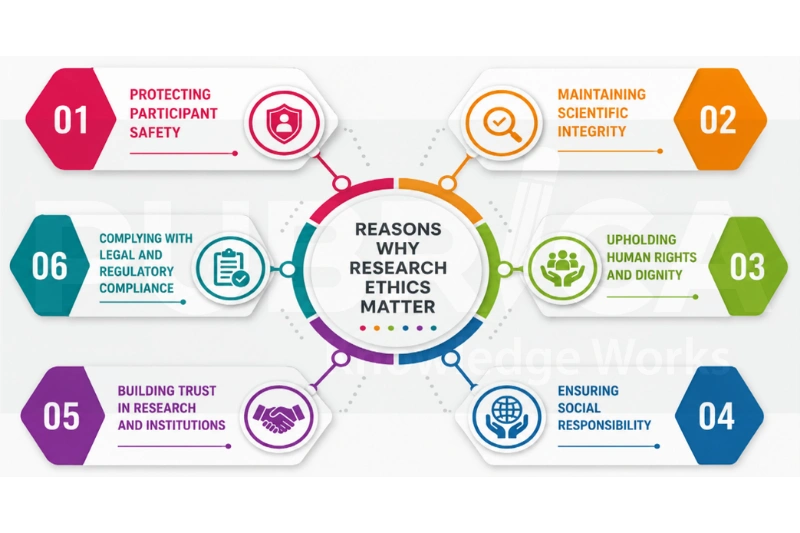
Conducting research is one of the important factors that lead to an improvement in acquiring knowledge, although the process of gaining the discovery must be conducted with proper surveillance and accountability. Ethical considerations in research design, research design ethics, and research ethics in study design ensure that research participants, research information, and research results are all well protected. The issue of ethics when designing a research study ensures that research participants, research information and research results are all well protected. This essay highlights some of the important factors involved in ensuring ethical research, including the importance of IRB, how ethical approval takes place, and the possible negative results of unethical research. [1]
1. Ethical Issues in Research Design
Ethical concerns may arise during various stages of the research process. The researcher needs to be concerned with the issue of informed consent in research, confidentiality, and the possibility of some form of harm to participants. Researchers must also consider risk of harm in research, human subjects’ protection, and how violations may lead to bias or conflict of interest in research that could compromise research integrity and ethical practice. [2]
1.1 Examples of Ethical Issues
Ethical Issue | Description | Example |
Informed Consent | Participants agree voluntarily | Signing consent forms |
Confidentiality | Protect personal data | Anonymising survey responses |
Minimizing Harm | Avoid physical/psychological harm | Using non-invasive procedures |
Bias & Objectivity | Avoid manipulating data | Peer-reviewed methodology checks |
Conflict of Interest | Avoid personal gain affecting results | Financial sponsorship disclosure |
2. Institutional Review Boards (IRBs)
Institutional Review Board (IRB) refers to the panel assigned to protect the welfare of human subjects during the research process. An IRB examines research projects in terms of their adherence to ethical approval in research design, including obtaining valid consent, reducing risk of harm in research, equitable selection of subjects, and addressing other research methodology ethical issues. In the end, an IRB acts as a safeguard system, which promotes knowledge while safeguarding human participants’ rights. [3]
3. IRB Responsibilities
Institutional Review Boards (IRBs) play a crucial role in safeguarding ethical standards in research by ensuring that studies involving human participants are conducted responsibly, fairly, and with full protection of their rights and well-being.
Responsibility | Purpose |
Risk Assessment | Minimise harm to participants |
Informed Consent Review | Ensure participants understand the study |
Equitable Recruitment | Fair selection of participants |
Monitoring & Oversight | Maintain ongoing ethical compliance |
4. Applying for Ethical Approval
To get ethical approval in research design, researchers must submit a detailed project proposal outlining the goals, procedures, and ethical considerations. Applications typically include a consent form, a risk statement, and measures to protect the information obtained from participants. Ethical consideration in research involves engaging researchers in research design ethics, ensuring credibility, and building trust with stakeholders, including participants, by demonstrating adherence to the law and regulations. [4]
- Compliance with the rules and regulations
- Accountability of the researcher
- Protection of the participants
- Building trust in research
5. Key Documents Required for Ethical Approval
Ethical approval is a crucial process that ensures research is conducted responsibly and according to established research ethics in study design. Researchers must submit key documents to demonstrate participant safety, informed consent in research, and the integrity of the proposed study.

6. The Dangers of Unethical Practices
Unethical research studies can create serious consequences, including physical or psychological injury to participants, legal repercussions, or discredit within the scientific world. Historical cases, such as the Tuskegee Syphilis Study, demonstrate how unethical practices and sampling bias ethical issues can produce long-term social and ethical ramifications. [5]
- Injury to participants: Physical and psychological injuries
- Legal repercussions: Imposition of fines or sanctions
- Discredit within the scientific world: Reputation damages
7. Importance of Compliance in Research
Adherence to ethics and regulations promotes integrity in research, ensures the safety of participants, and builds public confidence in science. Following research methodology, ethical issues enhance researchers’ credibility while pursuing scientific knowledge.
- Promotes integrity and honesty in scientific work.
- Ensures the safety and well-being of research participants.
- Builds public trust and confidence in scientific findings.
- Enhances the credibility and professional reputation of researchers.
- Encourages adherence to legal and institutional regulations.
- Supports responsible conduct in the pursuit of new knowledge.
Connect with us to explore how we can support you in maintaining academic integrity and enhancing the visibility of your research across the world!
Conclusion
Knowledge can be advanced through responsible conduct, made possible by conducting research ethically. Ethical conduct ensures that participants’ rights are protected, and research integrity is maintained. Conducting research ethically safeguards participants and strengthens validity in research design, promotes research integrity and ethical practice, and ensures adherence to research ethics in study design.
Descriptive Research Design: Definition, Methods, and Modern Applications. Our Pubrica consultants are here to guide you. [Get Expert Publishing Support] or [Schedule a Free Consultation]
References
- (2024). Graphical Abstracts Guidelines. Retrieved from https://www.elsevier.com/authors/tools-and-resources
- (2023). Author Resources for Visual Abstracts. Retrieved from https://authorservices.wiley.com
- ACS Publications. (2023). Supporting Information and TOC Graphic Guide. Retrieved from https://pubs.acs.org
- Sahu, T., Ratre, Y. K., Chauhan, S., Bhaskar, L. V. K. S., Nair, M. P., & Verma, H. K. (2021). Nanotechnology based drug delivery system: Current strategies and emerging therapeutic potential for medical science. Journal of Drug Delivery Science and Technology, 63(102487), 102487. https://doi.org/10.1016/j.jddst.2021.102487
- (2024). Scientific Illustration Resources. https://biorender.com