Artificial Intelligence in Healthcare: A Systematic Review and Meta-analysis
High-Impact Journals
- Understanding Artificial Intelligence in Healthcare
- Role of Systematic Reviews and Meta-analysis in AI Research
- Applications of Artificial Intelligence in Healthcare
- Methodology of a Systematic Review and Meta-analysis
- Benefits of AI in Healthcare
- Challenges and Limitations
- Quality Assessment in AI Systematic Reviews
- Future Directions of Artificial Intelligence in Healthcare
- Conclusion
Interesting topics
Artificial Intelligence in Healthcare: A Systematic Review and Meta-analysis
Artificial Intelligence in Healthcare is increasingly transforming the healthcare field as it enables more accurate diagnostics, improves decision-making in clinical settings, enhances treatment plans, and streamlines healthcare processes. Machine learning, deep learning, natural language processing (NLP), and computer vision are now common elements of modern healthcare. Within the last ten years, many systematic review artificial intelligence studies and meta-analysis AI in medicine publications have assessed the effectiveness of the use of artificial intelligence across different medical specialities.[1]
Nevertheless, there are some difficulties associated with the implementation of AI in healthcare clinical applications due to the issues of data quality, the need for algorithm transparency, and ethical concerns. A systematic review and meta-analysis are types of literature research that offer comprehensive evidence based on the analysis of several studies.
1. Understanding Artificial Intelligence in Healthcare
Artificial Intelligence in Healthcare refers to computer software that can perform tasks requiring human intelligence, such as learning, inference, forecasting, vision, and language processing. The use of AI in medicine includes analysing large amounts of clinical information, supporting artificial intelligence diagnostics, and giving recommendations based on evidence.[2]
The technologies of AI applied in medicine are as follows:
- Machine Learning (ML)
- Deep Learning (DL)
- Natural Language Processing (NLP)
- Computer Vision (CV).
2. Role of Systematic Reviews and Meta-analysis in AI Research
Systematic review artificial intelligence studies and meta-analysis AI in medicine are important in assessing the effectiveness of healthcare interventions involving artificial intelligence. The goals are:[3]
- Assessing the accuracy and the predictive ability of the AI systems.
- The comparison between the artificial intelligence systems and the traditional systems used in the clinics.
- Assessing the heterogeneity among the studies.
- Assisting in evidence-based healthcare decision-making.
3. Applications of Artificial Intelligence in Healthcare
AI in healthcare clinical applications is widely applied across multiple healthcare domains.
Healthcare Area | AI Application | Clinical Benefit |
Medical Imaging | Disease detection from CT, MRI, X-ray | Improved diagnostic accuracy |
Oncology | Cancer prediction and treatment planning | Early diagnosis and personalised therapy |
ECG interpretation and risk prediction | Faster clinical decisions | |
Drug Discovery | Molecule screening and drug development | Reduced research time |
Electronic Health Records | Clinical decision support | Improved patient management |
Disease surveillance and outbreak prediction | Better population health monitoring |
4. Methodology of a Systematic Review and Meta-analysis
A systematic review artificial intelligence follows a structured protocol to identify, evaluate, and synthesise published evidence.[4]
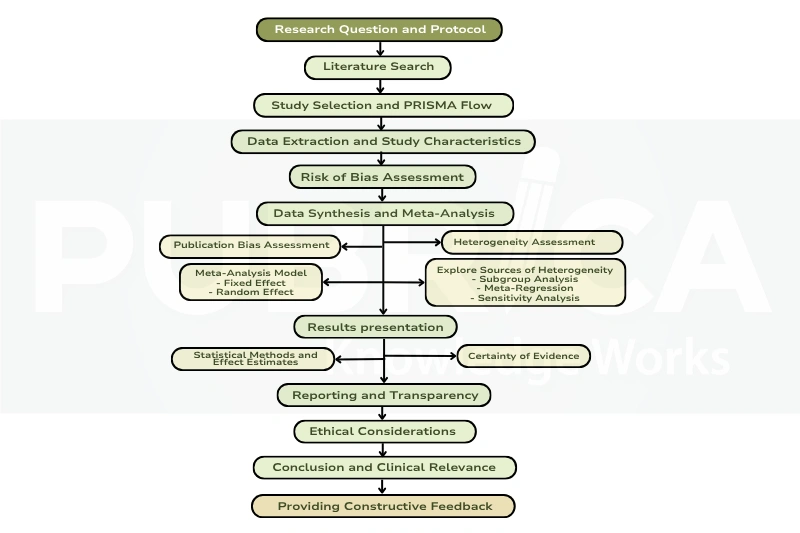
This generally entails the following:
- Defining the research question.
- Conducting an extensive literature search.
- Reviewing the titles and abstracts.
- Determining the eligibility of the studies.
- Extraction of information.
- Ascertaining the potential for bias.
- Performing meta-analysis.
This technique helps to reduce selection bias and increases the validity of the results.
5. Benefits of AI in Healthcare
There are many benefits that Artificial Intelligence in Healthcare brings to the healthcare industry:
- Accurate diagnostics thanks to pattern recognition.
- Detection of diseases at early stages using prediction methods.
- Tailored treatment suggestions.
- Automated processes in the clinic.
- Decrease in the expenses related to healthcare delivery due to increased efficiency.
- Improved AI in healthcare outcomes across multiple medical specialities.
6. Challenges and Limitations
Although AI demonstrates promising performance, several challenges remain.
Challenge | Impact on Healthcare |
Data Quality | Poor-quality data reduces model accuracy |
Algorithm Bias | Unequal performance across patient populations |
Limited Explainability | Difficulty interpreting AI predictions |
Privacy and Security | Risks associated with sensitive patient data |
Regulatory Compliance | Need for clinical validation and approval |
Integration Issues | Challenges in incorporating AI into existing healthcare systems |
Addressing these challenges is essential for the safe and effective implementation of AI technologies.
7. Quality Assessment in AI Systematic Reviews
There is a need to conduct quality assessment of included studies through recognised evaluation tools. These tools improve the quality of systematic review artificial intelligence research and strengthen the reliability of meta-analysis AI in medicine.[5]
Quality assessment models are:
- PRISMA 2020
- PROSPERO Registration
- QUADAS-2
- ROBINS-I
- GRADE Framework
These are important in enhancing transparency and credibility of the systematic review process.
8. Future Directions of Artificial Intelligence in Healthcare
Innovations that are coming up in the future will continue to enhance the functionality of Artificial Intelligence in Healthcare and expand AI in healthcare clinical applications.[6]
Some of them are:
- Explainable Artificial Intelligence (XAI)
- Federated Learning for sharing of data securely
- Precision medicine through AI
- Use of digital twin technology for customised care
- Real-time clinical decision support
- Integration with wearable and IoMT devices
All these innovations would improve patient care and ensure ethical use of AI.
Connect with us to explore how we can support you in maintaining academic integrity and enhancing the visibility of your research across the world!
Conclusion
Artificial Intelligence in Healthcare has emerged as a revolutionary tool in modern healthcare, bringing significant improvements in diagnosis, AI treatment planning, disease prediction, and clinical decision-making. Systematic review artificial intelligence studies and meta-analysis AI in medicine have demonstrated the ability of AI to improve healthcare quality and AI in healthcare outcomes when implemented appropriately. However, issues such as data quality, transparency, and ethics must be carefully addressed to ensure that AI in healthcare clinical applications remain safe, reliable, and effective for future healthcare delivery.
Artificial Intelligence in Healthcare: A Systematic Review and Meta-analysis. OurPubrica consultants are here to guide you. [Get Expert Publishing Support] or [Schedule a Free Consultation]
Frequently Asked Questions (FAQs)
Artificial intelligence (AI) in healthcare refers to the use of technologies such as machine learning, deep learning, natural language processing, and computer vision to analyze medical data, support clinical decision-making, improve diagnosis, and enhance patient care.
Systematic reviews and meta-analyses combine evidence from multiple studies to evaluate the accuracy, effectiveness, and reliability of AI systems, helping healthcare professionals make evidence-based decisions.
AI is used in medical imaging, oncology, cardiology, drug discovery, electronic health records, public health surveillance, disease prediction, and clinical decision support to improve healthcare outcomes.
AI improves diagnostic accuracy, enables early disease detection, supports personalized treatment, automates clinical workflows, reduces healthcare costs, and enhances patient monitoring through wearable technologies.
Key challenges include poor data quality, algorithm bias, limited explainability of AI models, patient privacy and security concerns, regulatory compliance requirements, and integration with existing healthcare systems.
The future of AI in healthcare includes Explainable AI (XAI), federated learning, AI-driven precision medicine, digital twin technology, real-time clinical decision support, and integration with wearable and Internet of Medical Things (IoMT) devices to deliver safer and more personalized care.
References
- Younis, H. A., Eisa, T. A. E., Nasser, M., Sahib, T. M., Noor, A. A., Alyasiri, O. M., Salisu, S., Hayder, I. M., & Younis, H. A. (2024). A Systematic Review and Meta-Analysis of Artificial Intelligence Tools in Medicine and Healthcare: Applications, Considerations, Limitations, Motivation and Challenges. Diagnostics (Basel, Switzerland), 14(1), 109. https://doi.org/10.3390/diagnostics14010109
- Bajwa, J., Munir, U., Nori, A., & Williams, B. (2021). Artificial intelligence in healthcare: transforming the practice of medicine. Future healthcare journal, 8(2), e188–e194. https://doi.org/10.7861/fhj.2021-0095
- Paul, P., Shyam, A., & Jos, S. (2025). Are Systematic Reviews and Meta-analysis on the Verge of Extinction with the Advent of Artificial intelligence?. Journal of orthopaedic case reports, 15(4), 1–3. https://doi.org/10.13107/jocr.2025.v15.i04.5420
- Salari, N., Shohaimi, S., Kiaei, A., Hosseinian-Far, A., Mansouri, K., Ahmadi, A., & Mohammadi, M. (2023). Executive protocol designed for new review study called: systematic review and artificial intelligence network meta-analysis (RAIN) with the first application for COVID-19. Biology methods & protocols, 8(1), bpac038. https://doi.org/10.1093/biomethods/bpac038
- Jayakumar, S., Sounderajah, V., Normahani, P., Harling, L., Markar, S. R., Ashrafian, H., & Darzi, A. (2022). Quality assessment standards in artificial intelligence diagnostic accuracy systematic reviews: a meta-research study. NPJ digital medicine, 5(1), 11. https://doi.org/10.1038/s41746-021-00544-y
- Fahim, Y. A., Hasani, I. W., Kabba, S., & Ragab, W. M. (2025). Artificial intelligence in healthcare and medicine: clinical applications, therapeutic advances, and future perspectives. European journal of medical research, 30(1), 848. https://doi.org/10.1186/s40001-025-03196-w