Evidence Gap Map for Infectious Disease Research: From Literature to Public Health Priorities
A literature search finds studies; it does not show where research is concentrated or thin. This is how our evidence synthesis team builds an evidence gap map for an infectious disease question, using Qatar as the worked setting.
On this page
Quick answer
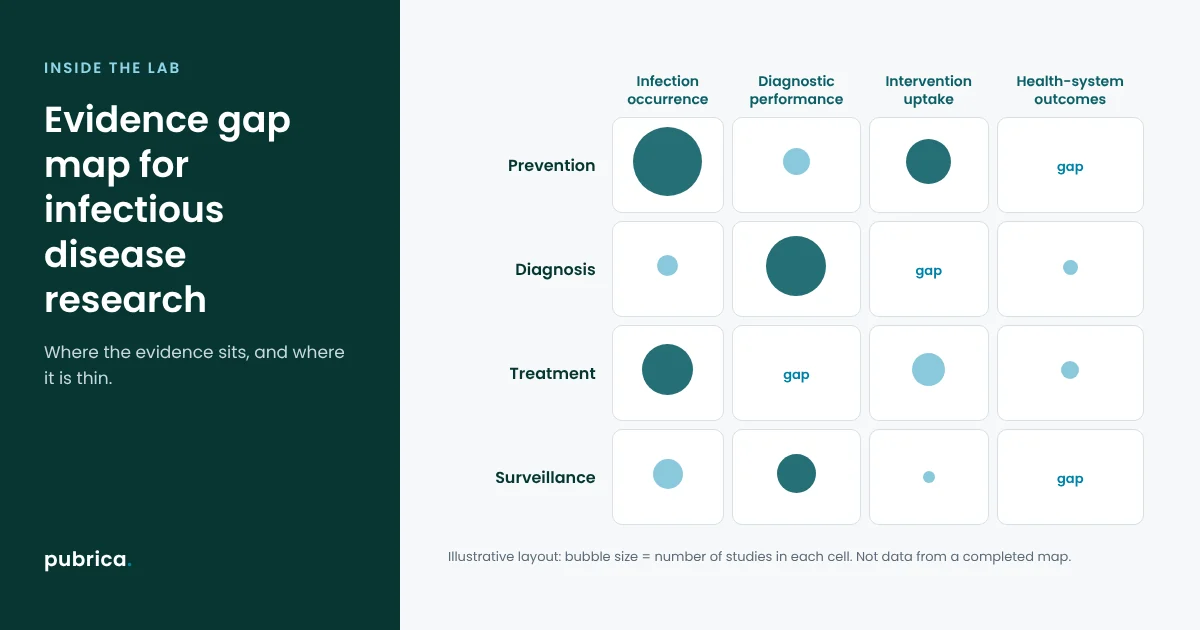
- An evidence gap map (EGM) sorts studies into a matrix, usually interventions against outcomes, so users can see where evidence exists and where it is sparse [1, 2].
- It shows where evidence is, not whether an intervention works; that needs a systematic review or meta-analysis.
- A credible map needs a defined scope, a documented systematic search, consistent eligibility criteria and a pre-agreed mapping framework.
- An empty cell is a question to investigate, not proof of a research priority.
01Why infectious disease research needs an evidence map
Public health decisions draw on evidence about prevention, diagnosis, surveillance and treatment. A search can return thousands of records without showing how they relate: studies may cluster on one intervention or population while other outcomes go unstudied. Evidence mapping organises those findings into categories so the distribution of evidence becomes visible [1, 3].
An evidence map does not answer a single focused question the way a systematic review does. It gives a broad overview of the relevant literature, which makes it a useful first step in evidence synthesis [1, 2].
| Method | Question it answers | Typical output |
|---|---|---|
| Evidence gap map | Where is the evidence, and where is it thin? | Interactive matrix of studies by category |
| Systematic review | What does the evidence say on one focused question? | Appraised narrative or tabulated synthesis |
| Meta-analysis | What is the pooled effect across compatible studies? | Pooled estimate with confidence interval |
02What the mapping framework should capture
The mapping framework decides how studies are organised. Its categories should follow the research question and the needs of the people who will use the map. Methodological guidance recommends defining scope and classification carefully, with stakeholder input and refinement before full coding [1, 4].
| Mapping dimension | Possible categories | What it shows |
|---|---|---|
| Disease control approach | Prevention, diagnosis, treatment, surveillance | Where research effort is concentrated |
| Population | General population, healthcare workers, higher-risk groups | Which groups have been studied |
| Study setting | Community, healthcare facilities, other defined settings | Which settings the evidence covers |
| Outcomes | Infection occurrence, diagnostic performance, intervention uptake | Which outcomes are measured |
| Study characteristics | Design, publication period, geographical location | Filters for exploring the map |
These categories are a starting point to adapt, not results from a completed map for Qatar.
03How the mapping process works, step by step
A reproducible process makes the map represent the evidence within its stated scope [1, 4, 5].
- Frame the question. Define the disease area, population, themes, outcomes and geographical boundaries.
- Run a systematic search. Choose databases and grey-literature sources, and document every search string. See our guide to a comprehensive literature search.
- Apply eligibility criteria. Screen records consistently, ideally with two reviewers, to decide which studies enter the map.
- Classify the evidence. Extract study characteristics and code each record against the framework. Evidence classification is where most disagreements surface.
- Present and interpret. Show the distribution of evidence and state the limits of the collection.
Register a protocol before mapping starts, and pilot the framework on a sample of records with stakeholders [4, 5]. Like a scoping review, the final report should describe the evidence actually found, not the evidence expected.
04From map to research priorities: reading gaps carefully
A map helps teams find clusters of studies, spot categories with few eligible studies, and judge whether a focused review or new primary research is warranted. Funders and policymakers use the same view to direct research prioritisation [1, 4, 6].
A sparse category is not automatically a priority. The gap may come from search limits, the eligibility criteria, publication patterns or the framework itself. Equally, a crowded cell does not mean the evidence is reliable. Judging certainty or effectiveness still needs critical appraisal and further synthesis [2, 3].
05What an evidence gap map could contribute in Qatar
In Qatar, a map would suit one clearly defined infectious disease or public health policy question, for example how research on prevention, diagnostic strategies or surveillance is distributed across selected populations and settings. The WHO Country Cooperation Strategy for Qatar 2024–2030 sets out national health priorities that can shape the question [7].
Conclusions about local evidence need a documented search and systematic screening first. International studies may help, but their applicability should be assessed, not assumed. Until the map is complete, possible gaps remain research questions rather than findings.
Questions
What is an evidence gap map?
An evidence gap map is a visual matrix that sorts studies on a topic by categories such as intervention and outcome. It shows where evidence is concentrated and where it is missing, without pooling results.
How is an evidence gap map different from a systematic review?
A systematic review appraises and synthesises studies to answer one focused question. An evidence gap map covers a broader area and describes where evidence exists, which often identifies the questions a later systematic review should answer.
Does a gap in the map mean more research is needed?
Not necessarily. Gaps can reflect search limits, eligibility criteria or how the framework was built. Treat each gap as a question to check before naming it a research priority.
References
- White H, Albers B, Gaarder M, et al. Guidance for producing a Campbell evidence and gap map. Campbell Systematic Reviews. 2020;16(4):e1125. https://doi.org/10.1002/cl2.1125
- Miake-Lye IM, Hempel S, Shanman R, Shekelle PG. What is an evidence map? A systematic review of published evidence maps and their definitions, methods, and products. Systematic Reviews. 2016;5:28. https://doi.org/10.1186/s13643-016-0204-x
- Schmucker C, Motschall E, Antes G, Meerpohl JJ. Methods of evidence mapping: a systematic review. Bundesgesundheitsblatt Gesundheitsforschung Gesundheitsschutz. 2013;56(10):1390–1397. https://doi.org/10.1007/s00103-013-1818-y
- Fredlund M, Rogers M, Orr N, et al. What are the methodological characteristics of evidence and gap maps? A systematic review and evidence and gap map. Cochrane Evidence Synthesis and Methods. 2024;2(8):e12096. https://doi.org/10.1002/cesm.12096
- Campbell F, Wong R, Llewellyn JL, et al. Methods used in the development, production and updating of evidence and gap maps: a scoping review protocol. Campbell Systematic Reviews. 2024;20(2):e1402. https://doi.org/10.1002/cl2.1402
- World Health Organization. Research prioritization for pandemic and epidemic intelligence: technical brief. Geneva: WHO; 2024. https://www.who.int/publications/i/item/9789240094529
- World Health Organization, Regional Office for the Eastern Mediterranean. Country cooperation strategy for WHO and Qatar, 2024–2030. WHO; 2025. https://www.who.int/publications/i/item/9789292745448