NICE Technology Appraisal: What the Health Technology Evaluations Manual Requires from the Systematic Review Behind a Submission
In NICE technology appraisals from 2000 to 2019, 65% of submitted evidence was rated poor or unacceptable. Most criticism targets planning, reporting and data quality. Here is what the NICE HTE manual asks of the systematic review, and how to build one an external assessment group can check.

On this page
- Quick answer
- Why systematic reviews in NICE submissions fail
- The manual and how it has changed
- The pre-defined protocol
- Search, screening and the cover statement
- Risk of bias, effect modifiers and meta-analysis
- Appraisal route and the external assessment group
- Archive the review and answer criticism from the record
- Questions
- References
Quick answer
- The NICE HTE manual requires a systematic review done to a pre-defined protocol (sections 3.3.4 and 3.4.4) [2].
- Screening needs two reviewers with a reported dispute procedure; every included study must be critically appraised for risk of bias.
- Effect modifiers are fixed before analysis; meta-analysis needs enough valid data and a heterogeneity assessment.
- Report with PRISMA 2020 and keep a full audit trail for the external assessment group [4].
01Why systematic reviews in NICE submissions fail
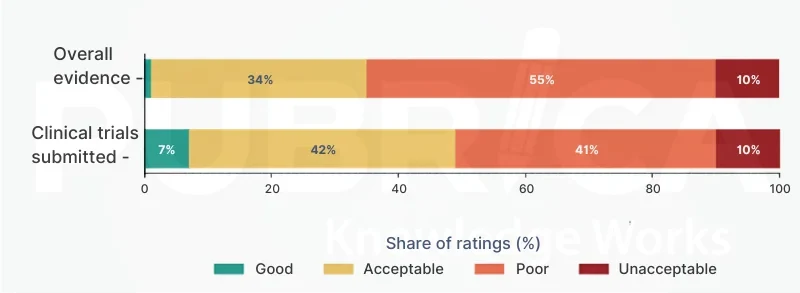
Osipenko and colleagues scored the evidence in 409 NICE technology appraisals published from 2000 to 2019. Overall data quality was rated poor in 55%, unacceptable in 10%, acceptable in 34% and good in 1%. They also flagged unclear methods for systematic reviews and indirect comparisons, which 68% of single technology appraisals used [1].
In a company submission, a review that cannot be traced to a protocol may be discounted, and closing the evidence gaps later can mean extra analysis or a resubmission. An early internal audit is a cost-saving step, not an academic exercise.
02The manual and how it has changed
The manual sets out how NICE judges clinical effectiveness and value when it recommends technologies for NHS use, the gateway to NHS reimbursement. The NICE health technology evaluations manual was first published on 31 January 2022 and has been updated since [2]. Angelis and colleagues traced the 2022 revision through consultation: it reinforced a comprehensive evidence base, clarified when non-randomised studies can be used, and accepted more uncertainty where evidence is hard to generate, such as in children, rare diseases and innovative technologies [3].
Section numbers can change between versions. Open the manual’s update information and confirm the numbers cited here before drafting.
03The pre-defined protocol
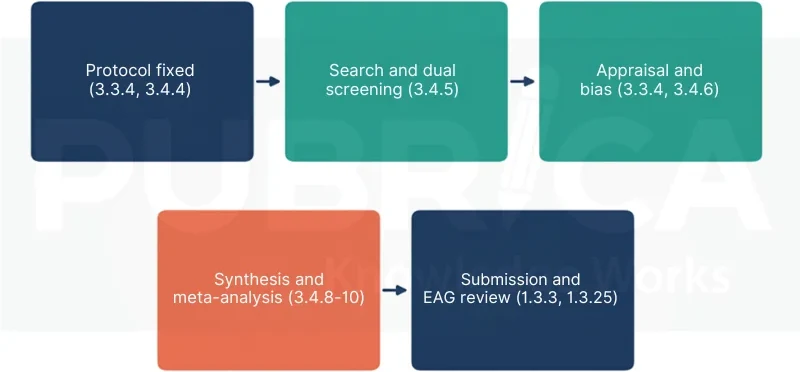
Section 3.3.4 requires a systematic review using a pre-defined protocol, with explicit, valid and replicable methods; section 3.4.4 says to follow a previously prepared protocol [2]. Fix the question, population, comparators, outcomes, databases, search dates, eligibility criteria and appraisal methods before screening. A protocol written after the results are known cannot meet that standard, and its dates usually show it.
The protocol also protects the company: an unfavourable result cannot be blamed on shifting eligibility rules. Our note on PRISMA reporting shows how to document it.
04Search, screening and the cover statement
The statement that accompanies the review should answer four questions before the evaluator asks: which sources were searched, when, by whom, and how disagreements were resolved. The manual expects companies to identify all relevant evidence, including studies known to them, and section 3.4.5 requires at least two reviewers to assess retrieved records [2]. Record these details at the time of the search, not afterwards.
PRISMA 2020, a 27-item checklist covering identification, screening, appraisal and synthesis, gives the reporting structure [4].
05Risk of bias, effect modifiers and meta-analysis
Section 3.4.6 requires every included study to be critically appraised; section 3.4.7 requires effect modifiers such as patient characteristics, setting and study year to be identified before analysis, which limits selective subgroup reporting. Meta-analysis is appropriate only with enough relevant, valid data (3.4.8), and pooled results need a heterogeneity assessment and sensitivity analyses (3.4.10) [2]. The Cochrane Handbook sets out established risk of bias methods [5].
| Requirement | Manual section | Evidence to keep |
|---|---|---|
| Pre-defined protocol | 3.3.4, 3.4.4 | Dated protocol and amendment log |
| Two reviewers at screening; disputes reported | 3.4.5 | Screening log and dispute procedure |
| Every included study critically appraised | 3.4.6 | Appraisal records, published and unpublished |
| Effect modifiers identified before analysis | 3.4.7 | Pre-analysis specification |
| Meta-analysis only with enough valid data | 3.4.8 | Data-sufficiency statement |
| Heterogeneity and sensitivity analyses | 3.4.10 | Analysis output and exclusion results |
| Risk of bias identified and appraised | 3.3.4 | Risk-of-bias tables |
06Appraisal route and the external assessment group
The route decides who checks the review [2].
| Appraisal route | Company duty | External assessment group (EAG) role |
|---|---|---|
| Single technology appraisal | Provide a systematic review of clinical and cost evidence | Reports on the company’s evidence and submission |
| Multiple technology appraisal | Identify all relevant evidence, including studies known to the company | Independently synthesises the published evidence |
In a multiple technology appraisal the EAG synthesises published evidence itself, so the company review should be detailed enough for an independent reviewer to follow its selection. Confirm the route early, then scope the search to the evidence that route will use.
07Archive the review and answer criticism from the record
Treat the evidence review as a permanent part of the HTA submission. Keep the protocol version, dated search logs, screening decisions, extraction forms and final report in one archive, indexed against the PRISMA 2020 checklist [4]. When the EAG challenges the search or appraisal, point to the protocol, search string and screening log rather than a new argument. Osipenko and colleagues acknowledged their own quality scoring was subjective [1], a reminder that many criticisms are judgements the record can answer. Where it cannot, say so and add a sensitivity analysis.
Questions
What does NICE require from a systematic review in a technology appraisal?
A review done to a pre-defined protocol, with comprehensive searches, two-reviewer screening, critical appraisal of every included study and reproducible methods, aligned with the current HTE manual.
How many reviewers should screen studies for a NICE submission?
At least two, with a reported procedure for resolving disagreements (section 3.4.5 of the manual at the time of writing). Check the current version before drafting.
Does PRISMA 2020 meet NICE requirements?
PRISMA 2020 supports transparent reporting, but it does not replace NICE’s methodological requirements on protocol, appraisal and synthesis.
References
- Osipenko L, Ul-Hasan SA, Winberg D, et al. Assessment of quality of data submitted for NICE technology appraisals over two decades. BMJ Open. 2024;14(2):e074341. https://doi.org/10.1136/bmjopen-2023-074341
- National Institute for Health and Care Excellence. NICE health technology evaluations: the manual (PMG36). London: NICE; 2022, updated. https://www.nice.org.uk/process/pmg36
- Angelis A, Harker M, Cairns J, et al. The evolving nature of health technology assessment: a critical appraisal of NICE’s new methods manual. Value in Health. 2023;26(10). https://doi.org/10.1016/j.jval.2023.05.015
- Page MJ, McKenzie JE, Bossuyt PM, et al. The PRISMA 2020 statement: an updated guideline for reporting systematic reviews. BMJ. 2021;372:n71. https://doi.org/10.1136/bmj.n71
- Higgins JPT, Thomas J, Chandler J, et al., eds. Cochrane Handbook for Systematic Reviews of Interventions. 2nd ed. Wiley; 2019. https://doi.org/10.1002/9781119536604