Academic Poster Presentations: A Complete Guide for Students and Researchers
High-Impact Journals
Interesting topics
Academic Poster Presentations: A Complete Guide for Students and Researchers
Academic Poster Presentations are an effective means of conveying the results of research work in a clear, visual, and attractive form. This method is commonly used in conferences, seminars, symposiums, and even in universities to demonstrate research work that is being done by researchers. In contrast to conventional research papers, Research poster presentation formats provide information about the main elements of a study using text, graphics, charts, and other means.
The use of a well-prepared academic poster can help one convey not only the importance of the research itself but also encourage cooperation and discussion. Scientific poster presentation skills are of great value for students and scientists, making an academic poster design guide useful for beginners and experienced researchers alike. [1]
1. What is an Academic Poster Presentation?
An Academic Poster Presentation is a pictorial presentation of research that includes the aims, methods, outcomes, and conclusions of the study. It allows the researcher to communicate complex information simply by engaging with the audience. A well-designed research poster presentation often follows a structured research poster template to ensure clarity and consistency. [2]
In contrast to oral presentations, poster presentations allow one-on-one communication between the participant and the presenter.
2. Essential Components of an Academic Poster
Poster Section | Purpose |
Title | Clearly states the research topic |
Introduction | Provides background and research problem |
Objectives | Defines the study aims |
Methodology | Explains research methods and data collection |
Results | Presents key findings using charts or graphs |
Discussion | Interprets the findings |
Conclusion | Summarises major outcomes |
References | Lists key scholarly sources |
Acknowledgements | Recognises contributors and funding support |
3. Designing an Effective Academic Poster
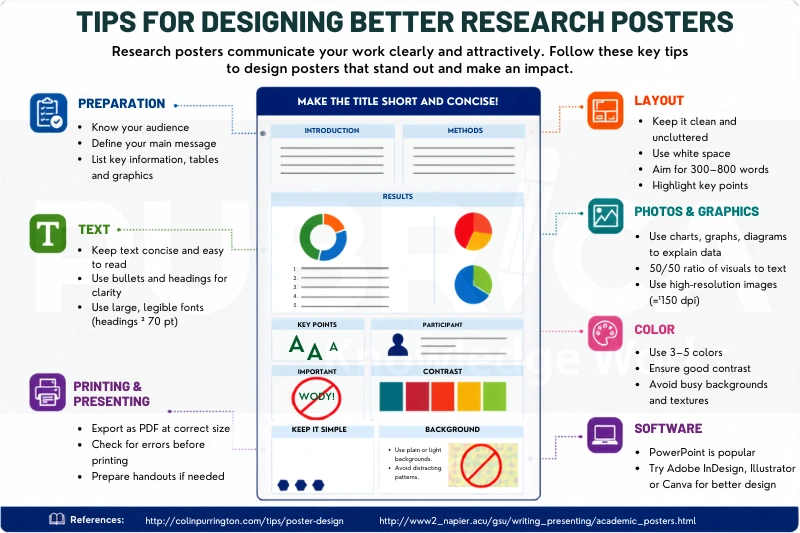
Having an attractive poster enhances readability and engagement by the audience. The researchers need to have equilibrium between the text and graphics used. An effective academic poster design guide also recommends selecting appropriate academic poster colour schemes and maintaining the best font size for academic poster readability. [3]
Best Practices
- The use of brief texts rather than long paragraphs
- Charts, graphs, and images to support research outcomes
- Having a clear visual hierarchy of heading and subheadings
- Use of readable fonts with proper colour contrast
- Emphasize key findings through visual aids.
4. Common Mistakes to Avoid
Several design and presentation errors can reduce the effectiveness of an academic poster.
Common Mistake | Recommended Solution |
Too much text | Use concise summaries and visuals |
Small font size | Maintain readable font sizes (24–36 pt for body text) |
Poor organisation | Arrange sections in logical order |
Low-quality graphics | Use high-resolution figures and charts |
Excessive colours | Follow a simple, professional colour scheme |
5. Presentation Tips for Students and Researchers
A good Scientific poster presentation is visually appealing. Researchers need to be able to present the results of their work competently. Learning poster presentation Q&A tips can also help presenters confidently answer audience questions. [4]
Presentation Hints
- Create a short 2–3-minute summary of the research.
- Highlight important results without going into details.
- Talk to the visitors through discussions and questions.
- Use eye contact and speak confidently.
- Opportunity for collaboration and publication through Research poster presentation
6. Benefits of Academic Poster Presentations
There are many benefits that can be gained from academic poster presentations.
- Enhancement of scientific communication skills.
- Promotion of visibility of research work in the academic world.
- Networking with other scientists and experts in the industry.
- Gain constructive criticism to improve future research work.
- Opportunity for collaboration and publication.
Connect with us to explore how we can support you in maintaining academic integrity and enhancing the visibility of your research across the world!
Conclusion
Academic Poster Presentations serve a vital function in the effective communication of research results and interaction with the scientific community. An academic poster is a tool that can combine the use of clear text, visual representations, and proper structuring. By following an academic poster design guide, using an effective research poster template, selecting appropriate academic poster colour schemes, and maintaining the best font size for academic poster, researchers can maximize the impact of their Scientific poster presentation. Applying effective poster presentation Q&A tips further enhances audience engagement and contributes to successful academic presentations.
Academic Poster Presentations: A Complete Guide for Students and Researchers. OurPubrica consultants are here to guide you. [Get Expert Publishing Support] or [Schedule a Free Consultation]
Frequently Asked Questions (FAQs)
An academic poster presentation is a visual method of presenting research findings using text, images, charts, and graphs. It summarises the research objectives, methodology, results, and conclusions in an easy-to-understand format while allowing direct interaction between the presenter and the audience.
To design an effective poster:
Including too much text.
Prepare a clear 2–3-minute summary of your research, explain the key findings confidently, maintain eye contact, encourage questions and discussion, and be ready to answer questions about your methodology and study limitations.
References
- Miller J. E. (2007). Preparing and presenting effective research posters. Health services research, 42(1 Pt 1), 311–328. https://doi.org/10.1111/j.1475-6773.2006.00588.x
- Gundogan, B., Koshy, K., Kurar, L., & Whitehurst, K. (2016). How to make an academic poster. Annals of medicine and surgery (2012), 11, 69–71. https://doi.org/10.1016/j.amsu.2016.09.001
- Bentsen, L., & Østergaard, D. E. (2026). What Makes a Good Poster? Evaluating #BetterPoster and Classic Formats at a Scientific Cancer Conference. Journal of cancer education : the official journal of the American Association for Cancer Education, 41(1), 49–54. https://doi.org/10.1007/s13187-025-02622-1
- Naegle K. M. (2021). Ten simple rules for effective presentation slides. PLoS computational biology, 17(12), e1009554. https://doi.org/10.1371/journal.pcbi.1009554