Systematic Reviews and Meta-Analyses: Methodological Approach and
Writing Framework
High-Impact Journals
Interesting topics
Systematic Reviews and Meta-Analyses: Methodological Approach and Writing Framework
Systematic reviews and meta-analyses are considered the gold standard of scientific research, since they summarise the results of many studies in an objective, transparent, and repeatable way. A systematic review is a type of research which summarizes all available relevant studies that answer a specific research question. At the same time, meta-analysis is the next step, when researchers statistically pool the results to calculate a pooled effect size.
The writing process of a systematic review with meta-analysis involves numerous stages and requires following some specific guidelines. For instance, one should use the PRISMA (Preferred Reporting Items for Systematic Reviews and Meta-Analyses) approach. The process starts with the formulation of a research question and continues with the development of the protocol, literature search, study selection, data extraction, and analysis of results. [1]
1. Formulating a Focused Research Question
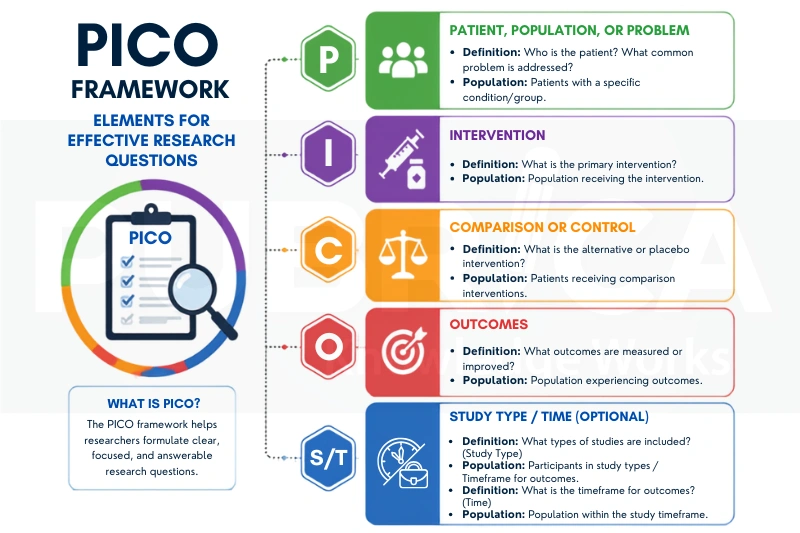
A good systematic review starts with the formulation of an appropriate research question. The most common approach to doing so is using the PICO format. In this context, the PICO framework for Population, Intervention, Comparison and Outcome. A clear research question helps ensure that all other elements are appropriately focused. [2]
2. Developing a Review Protocol
It is important to first develop a clear protocol defining the objectives, inclusion/exclusion criteria, search strategy, data extraction procedures, and statistical analyses before embarking on the process of review. It is also important to register this protocol on websites such as PROSPERO.
3. Literature Search Strategy
Conducting an extensive literature review search is important to get all pertinent studies. Important sources include PubMed/MEDLINE, Scopus, Web of Science, Embase, and the Cochrane Library. The search method must be based on keyword use, use of controlled vocabulary and Boolean operators to be comprehensive and to minimise chances of not finding eligible studies. This ensures that there is no publication bias in the review. [3]
4. Study Selection Process
Stage of Review Process | Description | Outcome |
Identification | Records identified through database searching (PubMed, Scopus, Web of Science, etc.) | Total records retrieved |
Duplicate Removal | Removal of repeated studies across databases | Unique records remaining |
Title Screening | Screening based on title relevance to research question | Records excluded |
Abstract Screening | Assessment of abstracts based on inclusion/exclusion criteria | Eligible records for full-text review |
Full-Text Assessment | Detailed evaluation of complete articles | Studies excluded with reasons |
Final Inclusion | Studies meeting all eligibility criteria | Studies included in qualitative synthesis/meta-analysis |
5. Quality Assessment and Risk of Bias
Assessment of methodological quality is an important process involved in judging the strength of evidence. Some of the tools that are widely used include Cochrane’s Risk of Bias Tool, Newcastle-Ottawa Scale (NOS) and ROBINS-I, depending on the research designs. Bias is usually assessed in areas such as selection bias, performance bias, detection bias, and reporting bias among others.
6. Meta-Analysis and Statistical Synthesis
The process of meta-analysis includes the statistical combination of data from several different research works to compute an overall effect size. These statistics can include odds ratio, risk ratio, hazard ratio, mean difference, and standardised mean difference. For different degrees of heterogeneity, the use of a fixed-effect or random-effects model would apply.
Heterogeneity can be estimated through different statistics, including the Q test. If the degree of heterogeneity is high, then it might be possible to conduct subgroup analysis or sensitivity analysis to find out reasons for this variability. [4]
7. Interpretation of Findings
The interpretation of the results must be done carefully and accurately. It should include a summary of the number of studies used and their features; effect estimates; risk of bias; and heterogeneity analysis. It is critical to prevent any overinterpretation and recognise possible weaknesses in the conclusion.
8. Common Methodological Challenges
There are various issues that systematic reviews and meta-analyses may encounter which may potentially impact on the quality of the synthesised evidence. Issues such as publication bias may cause overestimation of effect size estimates, while a poor search strategy may cause some relevant articles to be missed. Data extraction errors, high heterogeneity, and risk of bias across the studies are other issues that should be taken into consideration.
Connect with us to explore how we can support you in maintaining academic integrity and enhancing the visibility of your research across the world!
Conclusion
An appropriately conducted systematic review and meta-analysis adopt a scientific approach to the review process, starting from formulating a specific research question up until the synthesis and interpretation of results. The use of PRISMA guidelines, a thorough literature search, proper quality evaluation, and statistical analysis are some of the basics needed to achieve scientific credibility. If well performed, such an investigation provides scientifically sound evidence to guide decision-making and future research.
Systematic Reviews and Meta-Analyses: Methodological Approach and Writing Framework. OurPubrica consultants are here to guide you. [Get Expert Publishing Support] or [Schedule a Free Consultation]
Frequently Asked Questions (FAQs)
A systematic review is a structured research method that collects, evaluates, and summarises all relevant studies addressing a specific research question using a transparent and reproducible approach.
A meta-analysis is a statistical technique used within a systematic review to combine data from multiple studies and generate a pooled estimate of the overall effect.
They provide high-level evidence by summarising multiple studies, reducing bias, and helping in clinical decision-making, policy development, and future research planning.
PRISMA (Preferred Reporting Items for Systematic Reviews and Meta-Analyses) is a guideline that ensures transparency and completeness in reporting systematic reviews and meta-analyses
PICO stands for Population, Intervention, Comparison, and Outcome. It is used to develop a clear and focused research question for systematic reviews.
Common databases include PubMed/MEDLINE, Scopus, Web of Science, Embase, and the Cochrane Library.
Study selection ensures that only relevant studies meeting predefined inclusion and exclusion criteria are included for analysis.
References
- Calderon Martinez, E., Ghattas Hasbun, P. E., Salolin Vargas, V. P., García-González, O. Y., Fermin Madera, M. D., Rueda Capistrán, D. E., Campos Carmona, T., Sanchez Cruz, C., & Teran Hooper, C. (2025). A comprehensive guide to conduct a systematic review and meta-analysis in medical research. Medicine, 104(33), e41868. https://doi.org/10.1097/MD.0000000000041868
- Ratan, S. K., Anand, T., & Ratan, J. (2019). Formulation of Research Question – Stepwise Approach. Journal of Indian Association of Pediatric Surgeons, 24(1), 15–20. https://doi.org/10.4103/jiaps.JIAPS_76_18
- Gionfriddo, M. R., McClendon, C., Nolfi, D. A., Kalarchian, M. A., & Covvey, J. R. (2024). Back to the basics: Guidance for designing good literature searches. Research in social & administrative pharmacy : RSAP, 20(4), 463–468. https://doi.org/10.1016/j.sapharm.2024.01.009
- Wang, X. M., Zhang, X. R., Li, Z. H., Zhong, W. F., Yang, P., & Mao, C. (2021). A brief introduction of meta-analyses in clinical practice and research. The journal of gene medicine, 23(5), e3312. https://doi.org/10.1002/jgm.3312