Internal Medicine Systematic Reviews and Meta-Analyses: A Practical Guide for Hospitalists and Internists
High-Impact Journals
- Why Evidence Synthesis Matters in Internal Medicine
- What Makes Internal Medicine Reviews Different?
- Designing a High-Quality Search Strategy
- Screening, Data Extraction, and Risk-of-Bias Assessment
- Meta-Analysis: Combining Evidence Appropriately
- Interpreting Heterogeneity and Clinical Relevance
- GRADE and Certainty of Evidence
- Current Trends: Living Reviews, Automation, and Rapid Evidence Synthesis
- Editing Reviews for Hospitalists and Internists
- Future Directions of Internal Medicine Evidence Synthesis
- Conclusion
Interesting topics
Internal Medicine Systematic Reviews and Meta-Analyses: A Practical Guide for Hospitalists and Internists
Systematic reviews and meta-analyses are important components of evidence-based practice in internal medicine because they synthesise findings from multiple studies to address clinically relevant questions. This guide will give insight into how the hospitalist and internist can master the art of posing questions clinically, searching for and selecting relevant information, critically appraising bias and evidence, and interpreting results. Some key concepts such as heterogeneity, publication bias, and certainty of evidence will be discussed during this process. [1]
1. Why Evidence Synthesis Matters in Internal Medicine
Internal medicine is supported by a rapidly evolving evidence base spanning cardiovascular disease, infectious disease, respiratory disease, diabetes, kidney disease, and multimorbidity. Hospitalists and internists must evaluate a large and continually expanding body of clinical literature to support evidence-based decisions. Systematic reviews and meta-analyses can be used to synthesize evidence obtained from multiple sources. [2]
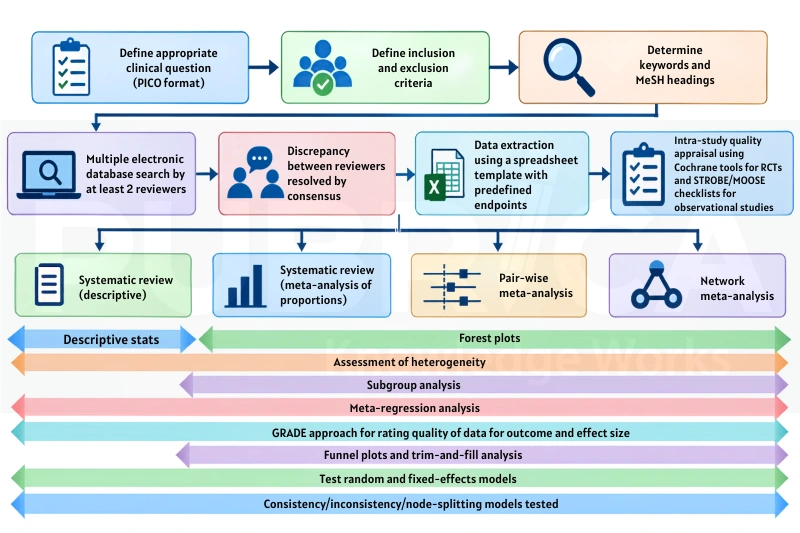
From the clinician’s perspective, conducting a systematic review involves more than literature searching and effect-size synthesis. Key methodological considerations include the clinical question, eligibility criteria, a reproducible search strategy, risk-of-bias assessment, data extraction, and evidence synthesis. PRISMA 2020 is a reporting guideline designed to improve the transparency and completeness of systematic review reporting. It helps authors clearly describe the rationale for the review, how studies were identified and selected, how data were analysed and synthesised, and what the review found. It does not prescribe how every methodological decision should be made; authors should therefore consult appropriate systematic-review methodology guidance, such as the Cochrane Handbook, where applicable.
2. What Makes Internal Medicine Reviews Different?
Internal medicine literature reviews typically consider different populations of patients, different comorbidities, different treatments, and different outcomes. Hospital-based research may also include observational studies, randomized controlled trials, diagnostic studies, prognostic studies, and real-world evidence. [3]
Consequently, the reviewer should make sure that a question raised is indeed an unanswered one and not an arbitrary collection of all the available literature.
The use of PICO (Population, Intervention, Comparison, and Outcome) methodology can be helpful in formulating the boundaries of an intervention-based review. This is an important part of systematic review methodology steps, as it helps define the review question and establish appropriate eligibility criteria.
3. Designing a High-Quality Search Strategy
A comprehensive and reproducible search strategy should translate the review question into structured concept blocks and database-specific search strategies. For an intervention-focused review, this may involve defining the PICO elements, mapping concepts to controlled terminology such as MeSH or Emtree, adding relevant free-text synonyms, and combining concepts with Boolean and, where supported, proximity operators. Search syntax, field codes, truncation and other database-specific features should then be adapted to each database.
Important aspects of the search strategy are as follows:
- Concept blocks with the use of controlled terminology (e.g. MeSH, Emtree) and free text synonyms
- Boolean operators, along with proximity operators where available
- Search syntax, fields, truncations, and search capabilities unique to the database
- Citation searching and grey literature or trial registries as needed
- Systematic removal of duplicates from the results obtained
- Detailed search strategies and search dates for each database
- Reasons for applying language and date restrictions, etc.
It must be possible to independently reproduce the search methodology described in the report.
4. Screening, Data Extraction, and Risk-of-Bias Assessment
After conducting the literature search, duplicates need to be removed, and the studies must be screened based on predefined inclusion criteria.
The standard process consists of the following stages:
Deduplication → dual title/abstract screening → full text acquisition → dual full text eligibility screening → disagreement resolution → state reasons for exclusion → show PRISMA flowchart.
Data extraction needs to be conducted using a standardized form, which should contain information about study characteristics, participants, interventions and comparators, duration, outcomes, measures of effect, and harms. Risk of bias evaluation should be done using a validated tool, and where applicable, it should be conducted independently, and any disagreements should be resolved by consensus or adjudication.
The above-described stages can ensure transparency, reproducibility, and appropriateness of study selection, data extraction, and evaluation for further analysis. [4]
5. Meta-Analysis: Combining Evidence Appropriately
Meta-analysis should be undertaken when the included studies are sufficiently comparable for a pooled estimate to answer a clinically meaningful question. This assessment should consider clinical, methodological, and statistical heterogeneity rather than relying on statistical similarity alone. Studies do not need to be identical, but they should address a sufficiently coherent clinical question for the pooled estimate to be interpretable.
- Clinical heterogeneity: Differing populations, interventions, comparators, outcomes, or clinical setting which could impact on the applicability of the summary estimate.
- Methodological heterogeneity: Differing study designs, inclusion and exclusion criteria, outcome definitions, follow-up period, and risk of bias which could influence the magnitude of the effects being estimated.
- Statistical heterogeneity: Variation in effect size estimates between studies beyond what would be due to sampling variability, evaluated using suitable statistics.
Thus, the decision about the suitability of combining studies must consider whether the studies are answering a coherent question and whether their pooled estimate is interpretable.
Common effect measures include:
| Outcome Type | Common Effect Measure |
|---|---|
| Dichotomous outcomes | Risk ratio, odds ratio |
| Continuous outcomes | Mean difference, standardized mean difference |
| Time-to-event outcomes | Hazard ratio |
| Diagnostic outcomes | Sensitivity, specificity |
Heterogeneity should also be assessed rather than assuming that all studies estimate the same underlying effect.
6. Interpreting Heterogeneity and Clinical Relevance
Statistical significance does not, by itself, establish clinical importance. Interpretation should also consider the magnitude and precision of the effect, baseline risk, patient characteristics, heterogeneity, and whether the study population and setting are applicable to the clinical question. When reviewing articles in internal medicine, the following need to be considered: Heterogeneity, effect size, confidence intervals, baseline risk, patient characteristics, and any differences from the study setting. [5]
The causes of heterogeneity include:
- Variances in patient population and disease severity.
- Variances in treatment regimens and comparisons.
- Variances in outcome definitions.
- Differences in follow-up periods.
- Study methodology variances.
Heterogeneity should be assessed before interpreting a pooled estimate. Forest-plot inspection, I² and τ² can help quantify or characterise statistical heterogeneity, but these measures should be interpreted alongside differences in populations, interventions, outcomes, study designs and risk of bias. Where clinically and methodologically appropriate, subgroup analyses, sensitivity analyses or meta-regression may help explore potential sources of heterogeneity.
Need help presenting your meta-analysis results? Pubrica’s forest plot design service can help you present pooled estimates, confidence intervals, and study-level results in a clear, publication-ready format.
7. GRADE and Certainty of Evidence
Any well-conducted meta-analysis needs not just to convey the summary statistic, but also the degree to which health-care providers can rely on that evidence. The GRADE approach assesses the certainty of evidence for each important outcome and helps communicate how much confidence readers can place in the estimated effect. Certainty can be affected by factors such as risk of bias, inconsistency, indirectness, imprecision, and publication bias. The resulting assessment can be presented in a Summary of Findings table to support transparent interpretation. The Cochrane Handbook includes this guidance. [6]
8. Current Trends: Living Reviews, Automation, and Rapid Evidence Synthesis
One of the recent developments is associated with the emergence of living systematic reviews (LSRs). Unlike traditional systematic reviews, LSRs regularly monitor new evidence and constantly update their results when new studies emerge. Living systematic reviews require methods for documenting ongoing searches, evidence updates, and changes to the review. Appropriate reporting guidance can help authors communicate these updates transparently.
Recently performed methodological research reveals the tendency towards popularity of living systematic reviews and yet some variations in frequency and triggers of updates, methods and mechanisms of updating and dissemination.
The other promising trend in the field is automation. Computational tools can increasingly support routine tasks such as deduplication and study screening. However, automation does not eliminate the need for methodological judgment: reviewers still need to define eligibility criteria, assess study relevance and risk of bias, resolve disagreements, and determine whether the evidence is appropriate for synthesis. [7]
9. Editing Reviews for Hospitalists and Internists
Clinical editing should assess more than language and presentation. It should examine whether the review question is appropriately framed, methods are reported clearly, statistical findings are interpreted correctly, conclusions remain within the evidence, and clinically relevant limitations are communicated to the intended audience.
Any review written from the clinical point of view should be able to differentiate between statistical and clinical significance, as well as state the limitations of the study. This is particularly useful when preparing a hospitalist research writing guide, where evidence must be translated into clinically meaningful information.
10. Future Direction of Internal Medicine Evidence Synthesis
The future of evidence synthesis in internal medicine is likely to involve more living review approaches, computational support for review workflows, and improved dissemination of evidence in formats that clinicians can interpret efficiently. [2]
Hospitalists and internists do not need to perform every statistical calculation themselves, but they should be able to assess whether the meta-analysis used appropriate methods, understand the implications of uncertainty and heterogeneity, and determine whether the conclusions are clinically applicable, know whether the methodology used was correct, comprehend the effects of uncertainty and heterogeneity on the pooled value, and understand the clinical applicability of the conclusions. They need an evidence synthesis that is clearly defined and replicable to enable them to know what is known, what confidence level is involved in the evidence and where the significant gaps are. Clear reporting according to PRISMA guidelines for reviews can support this transparency and reproducibility.
Get expert support from Pubrica for addressing reviewer comments, preparing point-by-point rebuttals, and strengthening manuscripts for journal resubmission. Prepare your revised manuscript with confidence.
Conclusion
Systematic reviews and meta-analyses help clinicians synthesise an expanding body of evidence while maintaining methodological transparency and making uncertainty explicit. A rigorous systematic review depends on a focused question, reproducible searching, appropriate study selection, structured data extraction, risk-of-bias assessment, suitable statistical methods, and clinically appropriate interpretation.. In current times there are many trends that are developing in this area such as living systematic reviews, automated processes and better reporting criteria. Hospitalists and internists need to ensure that statistics are clinically interpreted.
A structured evidence-based medicine review process therefore helps connect rigorous evidence synthesis with practical clinical decision-making while maintaining methodological transparency.
Planning an Internal Medicine Systematic Review or Meta-Analysis? Pubrica supports researchers across the evidence-synthesis workflow, from protocol development and reproducible search strategies to study screening, data extraction, risk-of-bias assessment, statistical synthesis, evidence interpretation and publication-ready reporting. [Start Your Review with Pubrica]
Frequently Asked Questions (FAQs)
They synthesize evidence from multiple studies to support evidence-based clinical decision-making.
Start with a focused clinical question, often using the PICO framework, followed by clearly defined eligibility criteria and a reproducible search strategy.
Researchers should assess clinical and methodological comparability, risk of bias, appropriate effect measures, outcome definitions, and heterogeneity before deciding whether a pooled analysis is appropriate.
The GRADE approach can be used to assess how confident clinicians can be in the evidence and its conclusions.
Living systematic reviews, automation, rapid evidence synthesis, and improved reporting are increasingly shaping the future of internal medicine research.
References
- Calderon Martinez, E., Ghattas Hasbun, P. E., Salolin Vargas, V. P., García-González, O. Y., Fermin Madera, M. D., Rueda Capistrán, D. E., Campos Carmona, T., Sanchez Cruz, C., & Teran Hooper, C. (2025). A comprehensive guide to conduct a systematic review and meta-analysis in medical research. Medicine, 104(33), e41868. https://doi.org/10.1097/MD.00
- Sutton, A. J., Cooper, N. J., & Jones, D. R. (2009). Evidence synthesis as the key to more coherent and efficient research. BMC medical research methodology, 9, 29. https://doi.org/10.1186/1471-2288-9-29
- McMahon, L. F., Jr, & Chopra, V. (2017). General Medicine and Hospital Medicine: The Janus of Internal Medicine. Journal of general internal medicine, 32(11), 1168–1169. https://doi.org/10.1007/s11606-017-4182-z
- De Cassai, A., Boscolo, A., Zarantonello, F., Pettenuzzo, T., Sella, N., Geraldini, F., Munari, M., & Navalesi, P. (2023). Enhancing study quality assessment: an in-depth review of risk of bias tools for meta-analysis-a comprehensive guide for anesthesiologists. Journal of anesthesia, analgesia and critical care, 3(1), 44. https://doi.org/10.1186/s44158-023-00129-z
- West SL, Gartlehner G, Mansfield AJ, et al. Comparative Effectiveness Review Methods: Clinical Heterogeneity [Internet]. Rockville (MD): Agency for Healthcare Research and Quality (US); 2010 Sep. 4, Discussion. Available from: https://www.ncbi.nlm.nih.gov/books
- Gartlehner, G., Nussbaumer-Streit, B., Devane, D., Kahwati, L., Viswanathan, M., King, V. J., Qaseem, A., Akl, E., Schuenemann, H. J., & Cochrane Rapid Reviews Methods Group (2024). Rapid reviews methods series: Guidance on assessing the certainty of evidence. BMJ evidence-based medicine, 29(1), 50–54. https://doi.org/10.1136/bmjebm-2022-112111
- Ghosh, A., & Choudhury, S. (2025). Understanding different types of review articles: A primer for early career researchers. Indian journal of psychiatry, 67(5), 535–541. https://doi.org/10.4103/indianjpsych