AI in Nursing Research Methodology: How AI Is Changing Reviews, Analysis and Research Ethics
AI tools now help nursing researchers screen literature, analyse data and code interviews. Recent reviews show real gains and real risks. Here is where AI in nursing research methodology helps, where it fails, and how to use it without weakening your study.
On this page
Quick answer
- Artificial intelligence in nursing research mainly supports literature screening, data analysis and qualitative content analysis [1, 5].
- AI can cut repetitive work, but it does not make a study faster, more accurate or more trustworthy by default.
- The main risks are inaccurate outputs, research bias, weak reproducibility and data privacy breaches.
- Human oversight stays non-negotiable: verify every output, document AI use and follow ethics and reporting rules.
01Literature reviews and evidence synthesis
AI-assisted tools can organise references, flag potentially relevant studies, summarise papers and support preliminary screening, which helps when a search returns thousands of records.
The same tools can omit key findings, misread methods or produce claims the source does not support. Verify every reference, apply predefined inclusion and exclusion criteria, and keep a record of search and screening decisions. AI should assist systematic searching and critical appraisal, not replace them [1, 5].
02Data analysis: machine learning in nursing
Machine learning supports pattern detection, classification and prediction in complex datasets, for example relationships between patient characteristics, care processes and outcomes.
The method must still fit the question. A predictive model is not the right tool for a study designed to explore experiences or estimate an association. Check data quality, sample suitability, missing data, model performance and validation before interpreting results, and report enough detail for readers to follow how you reached your conclusions [1, 5]. Our note on machine learning accuracy in research covers validation in more depth.
03AI in qualitative research and content analysis
Qualitative researchers use AI, often built on natural language processing, for transcription, organising text, preliminary coding and spotting recurring patterns in interviews or open-ended responses. A 2025 methodological review examined AI support for content analysis in nursing research specifically [2].
These tools cannot be assumed to grasp what participants mean. Context, culture, contradiction and nuance need human interpretation. Compare AI codes with the raw data, document how themes developed, and explain your analytical role, as reporting guidelines such as COREQ expect.
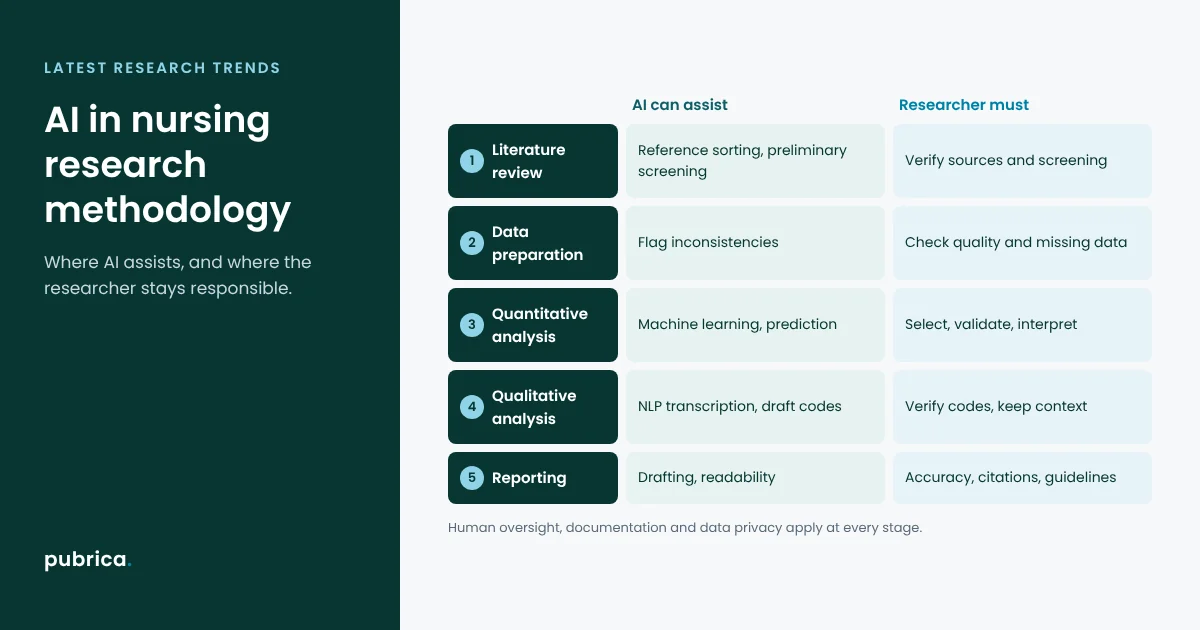
| Research activity | Potential AI contribution | Researcher responsibility |
|---|---|---|
| Literature review | Organising references, supporting preliminary screening | Verify sources and screening decisions |
| Data preparation | Flagging inconsistencies, organising datasets | Check data quality and missing values |
| Quantitative analysis | Pattern detection and predictive modelling (machine learning) | Select, validate and interpret methods |
| Qualitative analysis | Transcription and preliminary coding (natural language processing) | Verify codes and preserve context |
| Reporting | Organising drafts, improving readability | Confirm accuracy, citations and reporting compliance |
04Methodological challenges: bias, privacy and oversight
- Accuracy, research bias and reproducibility. AI outputs can contain errors or inherit bias from their data. If a dataset under-represents a population, findings for that group are less reliable. Record the tools, settings, procedures and verification steps so others can see which decisions were the team’s [1, 5].
- Ethics and data privacy. Transcripts and patient records are confidential. Before using an external tool, check consent, ethics approval, data protection law and the platform’s data handling. Do not upload identifiable data unless the use is authorised and safeguarded [3, 6].
- Human oversight and integrity. Responsibility stays with the researcher. Check AI-generated references, summaries and codes against reliable sources, never present them as verified findings, and disclose AI use as your institution and journal require.
05Five steps to use AI responsibly in a PhD study
- Define the objective first. Choose the design and methodology for the research question before choosing a tool.
- Choose tools deliberately. Weigh capability, limits, data-protection safeguards and fit for the task.
- Verify outputs. Check references, claims, codes and results against original sources or data.
- Document AI use. Record tools and procedures, including how outputs were checked and used.
- Follow ethics and reporting rules. Apply institutional policy and the relevant guideline from the EQUATOR Network [4].
Used this way, AI-assisted healthcare research keeps its methodological rigour: AI complements sound design and critical thinking rather than replacing them [1, 2, 5]. See also our guide to ethical AI in research writing.
Questions
How is AI used in nursing research?
Mostly for literature screening, data preparation and analysis, and qualitative coding. Reviews published in 2025 describe these uses alongside concerns about accuracy, bias and ethics.
Can AI analyse qualitative interview data?
It can transcribe, organise and suggest preliminary codes. Interpretation must stay with the researcher, who should check AI codes against the transcripts and document how themes were built.
Do I need to disclose AI use in my thesis or paper?
Usually yes. Follow your university’s policy and the target journal’s instructions, and describe which tools you used, for what, and how outputs were verified.
References
- Ruksakulpiwat S, Phianhasin L, Benjasirisan C, et al. Artificial intelligence in nursing research: a systematic review of applications, benefits, and challenges. International Nursing Review. 2025;72(3):e70080. https://doi.org/10.1111/inr.70080
- Maj A, Makowska M, Sacharczuk K. The content analysis used in nursing research and the possibility of including artificial intelligence support: a methodological review. Applied Nursing Research. 2025;82:151919. https://doi.org/10.1016/j.apnr.2025.151919
- World Health Organization. Ethics and governance of artificial intelligence for health: WHO guidance. Geneva: WHO; 2021. https://www.who.int/publications/i/item/9789240029200
- EQUATOR Network. Reporting guidelines for health research. https://www.equator-network.org/
- Yasin MY, Al-Hamad A, Metersky K, Kehyayan V. Incorporation of artificial intelligence into nursing research: a scoping review. International Nursing Review. 2025;72(1):e13013. https://doi.org/10.1111/inr.13013
- Mohammed SAAQ, Osman YMM, Ibrahim AM, Shaban M. Ethical and regulatory considerations in the use of AI and machine learning in nursing: a systematic review. International Nursing Review. 2025;72(1):e70010. https://doi.org/10.1111/inr.70010