Role of Machine Learning in Enhancing Data Analysis Accuracy in Research
High-Impact Journals
- Machine Learning in Research Data Analysis
- Understanding Machine Learning in Research
- Improving Data Analysis Accuracy
- Applications Across Research Disciplines
- Machine Learning Workflow in Research
- Role of Machine Learning in Big Data Analysis
- Ethical Considerations in Machine Learning Research
- Future Trends in Machine Learning and Research
- Conclusion
Interesting topics
Role of Machine Learning in Enhancing Data Analysis Accuracy in Research
The contemporary world is characterized by data-intensive research activities that involve the production of vast amounts of data across various scientific fields. While conventional statistical techniques are still relevant and important in the field of research, they are not well adapted to handle massive volumes of data and uncover complex data structures. The use of machine learning for data analysis, which is a subset of Artificial Intelligence (AI), has become common in enhancing the efficiency of research data analysis through more accurate, fast, and precise research outputs.
Machine learning is revolutionising the way data is collected, analysed, interpreted, and verified in many fields, including healthcare and biomedical sciences, social sciences, and business management, among others. Its capacity to establish relationships and minimise human biases makes machine learning in research an essential aspect of research methodologies. [1]
Machine Learning in Research Data Analysis
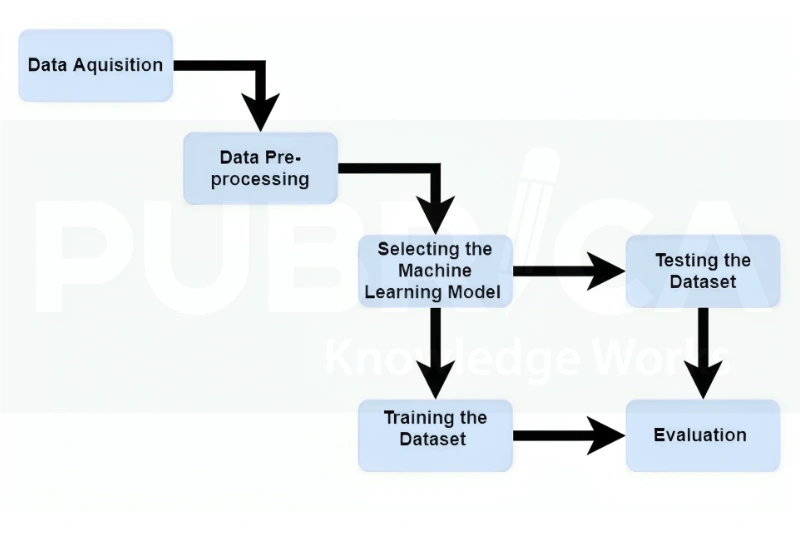
Machine learning workflow for research data analysis and decision-making.
1. Understanding Machine Learning in Research
Machine learning is defined as the use of computer algorithms that can find patterns in the data and improving their performance with time. As opposed to the other analytical techniques, ML models can change according to new data. [2]
The three main types of machine learning algorithms for data analysis are:
- Supervised Learning – Utilises labelled data sets for making predictions.
- Unsupervised Learning – Reveals underlying patterns in data sets without labelling.
- Reinforcement Learning – Involves learning through interactions.
Scientists apply these methods for analysing data sets and making predictions.
2. Improving Data Analysis Accuracy
One of the core benefits associated with machine learning models in research is the enhanced accuracy in analysis. Whereas traditional techniques depend on pre-assumptions, machine learning algorithms help in recognising nonlinear interactions among the data. [3]
Key Enhancements for Improved Accuracy
- Detection of underlying patterns in the data
- Less possibility of human error during analysis
- Automatic detection of abnormalities
- Better predictive modelling
- Efficient classification and clustering
In medical studies, for instance, the use of machine learning tools will allow the analysis of thousands of patients’ data to determine potential disease risk factors.
3. Applications Across Research Disciplines
AI in research data analysis has become increasingly valuable across multiple research domains.
| Research Field | Machine Learning Application | Research Benefit |
| Healthcare | Disease prediction and diagnosis | Improved clinical decisions |
| Pharmaceutical Research | Drug discovery and development | Faster identification of therapeutic compounds |
| Social Sciences | Behavioural pattern analysis | Better understanding of social trends |
| Environmental Science | Climate modelling | Enhanced forecasting accuracy |
| Business Research | Customer behaviour prediction | Improved strategic decision-making |
The versatility of machine learning allows researchers to address increasingly complex scientific questions.
4. Machine Learning Workflow in Research
Steps to achieve success in implementing machine learning are well defined in the following systematic order. [4]
Workflow
- Data Acquisition: Collecting raw data from sources like databases, sensors, surveys, or APIs.
- Data Preprocessing: Cleaning and preparing data by handling missing values, removing noise, and formatting it for use.
- Feature Selection: Choosing the most important variables (features) that help improve model performance.
- Model Design: Selecting and structuring the machine learning or statistical model to solve the problem.
- Training & Validation: Training the model on data and checking its performance using validation data to avoid overfitting.
- Performance Analysis: Evaluating how well the model works using metrics like accuracy, precision, recall, or error rate.
- Result Interpretation: Understanding and explaining the model’s outputs in a meaningful and practical way.
Such an approach guarantees robustness, reliability, and scientific validity of the study’s results.
Machine Learning Research Workflow
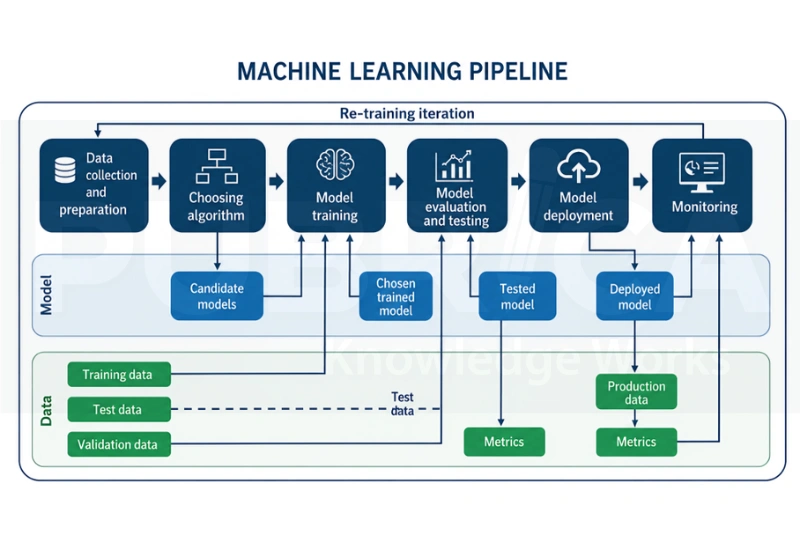
Typical machine learning workflow used in research studies.
5. Role of Machine Learning in Big Data Analysis
Modern research tends to utilise big data, which is collected using different sensors, electronic devices, e-healthcare, and other sources. There can be difficulties with analysing such big data sets due to traditional analytical methods used by researchers.
However, there are numerous benefits of using machine learning in scientific research:
- Efficient big data analysis
- Timely analytics
- Fast feature extraction
- Scalability to a research environment
Using machine learning algorithms in genomic studies, scientists manage to analyse millions of genetic features and find possible correlations with different diseases.
6. Ethical Considerations in Machine Learning Research
With greater use of machine learning in research, issues of ethics demand consideration.
Some of these issues are:
- Privacy of participants
- The ethical use of sensitive data
- Ethical decisions about the use of algorithms
- Bias minimization in the training datasets.
7. Future Trends in Machine Learning and Research
Machine learning continues to evolve rapidly. Emerging technologies are expected to further improve research accuracy and efficiency. [4]
Emerging Trend | Potential Impact |
Explainable AI (XAI) | Improved transparency of models |
Deep Learning | Enhanced pattern recognition |
Automated Machine Learning (AutoML) | Reduced technical barriers |
Federated Learning | Improved data privacy |
AI-Assisted Research Platforms | Faster research workflows |
These innovations are expected to transform research methodologies across academic and industrial sectors.
Connect with us to explore how we can support you in maintaining academic integrity and enhancing the visibility of your research across the world!
Conclusion
However, through its ability to work with massive amounts of data, reveal hidden patterns within the data, increase predictive capabilities, and automate analysis, machine learning for data analysis has become a revolutionary tool in today’s scientific world, increasing the accuracy of analysing the data. Although issues with data quality and ethics have arisen, continued improvements in technology are expected to solve such problems.
As researchers adopt data-driven techniques more frequently, machine learning in research will continue to become even more important as they develop accurate conclusions from experiments. Those scientists who can incorporate machine learning models in research methods into their research will be well-equipped to conduct accurate studies.
Role of Machine Learning in Enhancing Data Analysis Accuracy in Research. OurPubrica consultants are here to guide you. [Get Expert Publishing Support] or [Schedule a Free Consultation]
Frequently Asked Questions (FAQs)
Machine learning in research refers to the use of computer algorithms that automatically learn patterns from data and improve performance over time. It is widely used to enhance machine learning for data analysis in various scientific fields.
Machine learning is used to process large datasets, identify hidden patterns, and make predictions. It improves AI in research data analysis by enabling faster, more accurate, and scalable data interpretation.
The three main types are supervised learning, unsupervised learning, and reinforcement learning. These are key machine learning algorithms for data analysis used for prediction, clustering, and decision-making tasks.
Machine learning is important because it improves accuracy, reduces human error, and handles large-scale datasets efficiently. It strengthens machine learning in scientific research by supporting better predictions and deeper insights.
References
- Weissler, E. H., Naumann, T., Andersson, T., Ranganath, R., Elemento, O., Luo, Y., Freitag, D. F., Benoit, J., Hughes, M. C., Khan, F., Slater, P., Shameer, K., Roe, M., Hutchison, E., Kollins, S. H., Broedl, U., Meng, Z., Wong, J. L., Curtis, L., Huang, E., … Ghassemi, M. (2021). The role of machine learning in clinical research: transforming the future of evidence generation. Trials, 22(1), 537. https://doi.org/10.1186/s13063-021-05489-x
- Badillo, S., Banfai, B., Birzele, F., Davydov, I. I., Hutchinson, L., Kam-Thong, T., Siebourg-Polster, J., Steiert, B., & Zhang, J. D. (2020). An Introduction to Machine Learning. Clinical pharmacology and therapeutics, 107(4), 871–885. https://doi.org/10.1002/cpt.1796
- Sarker I. H. (2021). Data Science and Analytics: An Overview from Data-Driven Smart Computing, Decision-Making and Applications Perspective. SN computer science, 2(5), 377. https://doi.org/10.1007/s42979-021-00765-8
- Cho, H., She, J., De Marchi, D., El-Zaatari, H., Barnes, E. L., Kahkoska, A. R., Kosorok, M. R., & Virkud, A. V. (2024). Machine Learning and Health Science Research: Tutorial. Journal of medical Internet research, 26, e50890. https://doi.org/10.2196/50890