Artificial Intelligence in Clinical Medicine: Diagnostic Accuracy, Bias, and Clinical Evidence
High-Impact Journals
- Artificial Intelligence in Clinical Practice
- Diagnostic Accuracy of AI Systems
- Sources of Bias in Clinical AI
- Evaluating the Quality of Evidence for Clinical AI
- Clinical Applications of Artificial Intelligence
- Challenges Limiting AI Adoption in Clinical Practice
- Best Practices for Implementing AI in Healthcare
- Future Directions of AI in Clinical Medicine
- Conclusion
Interesting topics
Artificial Intelligence in Clinical Medicine: Diagnostic Accuracy, Bias, and Clinical Evidence
Artificial Intelligence (AI) has already become an indispensable tool in modern clinical diagnostics that enables improved diagnosis, prediction, medical image analysis, and patient-oriented medicine. Modern AI systems are employed in radiology, pathology, cardiology, oncology, ophthalmology, and even general practice to help healthcare practitioners make better-informed clinical decisions. Analysing huge sets of clinical information, electronic health records, and medical images helps AI to detect patterns that may not be easily detected by conventional diagnostic means.
However, despite numerous achievements in this sphere, there are still issues associated with the reliability, transparency, potential bias, and the quality of evidence supporting clinical use of AI-based instruments. Issues such as AI bias in medicine, lack of generalizability, low-quality training data, and lack of proper external validation can impact diagnostic accuracy and patient safety. Thus, it is important to assess AI systems prior to employing them for clinical purposes. The current paper focuses on the role of artificial intelligence in healthcare, diagnostic accuracy of such technologies, bias in AI, and evidence quality assessment for clinical application of AI. [1]
1. Artificial Intelligence in Clinical Practice
The definition of artificial intelligence includes computational systems that can learn from data and perform functions that generally require human intelligence. Applications of artificial intelligence in healthcare include the following technologies: [2]
- Machine Learning (ML)
- Deep Learning (DL)
- Natural Language Processing (NLP)
- Computer Vision
- Clinical Decision Support Systems (CDSS)
The above technologies assist physicians by analysing healthcare data, both structured and unstructured. Clinical decision support AI systems help healthcare professionals interpret complex information and improve clinical decision-making.
2. Diagnostic Accuracy of AI Systems
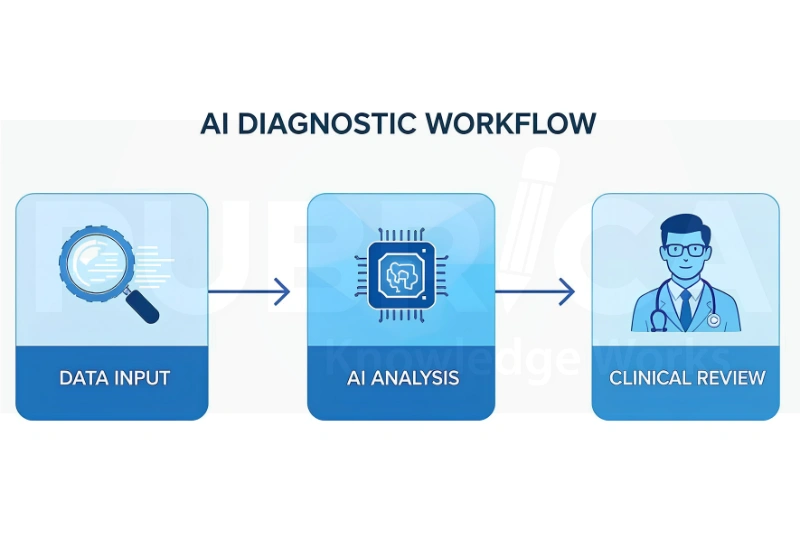
Accuracy in diagnosis refers to the capability of AI in distinguishing sick patients from healthy individuals. Many research studies have demonstrated that AI performs comparably with skilled practitioners for certain types of diagnoses. An AI diagnostic accuracy review evaluates the performance, reliability, and clinical usefulness of AI-based diagnostic systems. [3]
Factors Influencing Diagnostic Accuracy
Factor | Influence on AI Performance |
Data Quality | High-quality datasets improve prediction accuracy |
Sample Size | Larger datasets enhance model generalisation |
Feature Selection | Relevant variables improve model precision |
External Validation | Confirms reliability across different populations |
Clinical Integration | Human-AI collaboration improves decision-making |
AI has shown promising results in detecting diabetic retinopathy, breast cancer, lung nodules, skin lesions, and cardiovascular abnormalities. However, performance often declines when models are applied to populations different from those used during training. Proper machine learning clinical validation is necessary to confirm reliability and clinical applicability.
3. Sources of Bias in Clinical AI
Bias is one of the biggest obstacles affecting the safe adoption of AI technologies in healthcare. AI bias in medicine can influence diagnostic performance, treatment decisions, and healthcare equality. [4]
Some examples of bias include:
- Selection Bias – The training dataset does not represent the target population.
- Sampling Bias – Unequal representation of demographics.
- Measurement Bias – Inequalities in the data capture process from the clinics.
- Algorithmic Bias – Poor predictions on different patient populations.
- Confirmation Bias – Clinicians’ reliance on recommendations made by the AI.
Bias can lead to health inequalities and unfairness in the AI-based decision-making process in healthcare.
4. Evaluating Evidence Quality
The effectiveness of AI should be supported by high-quality scientific evidence before widespread clinical implementation. [5]
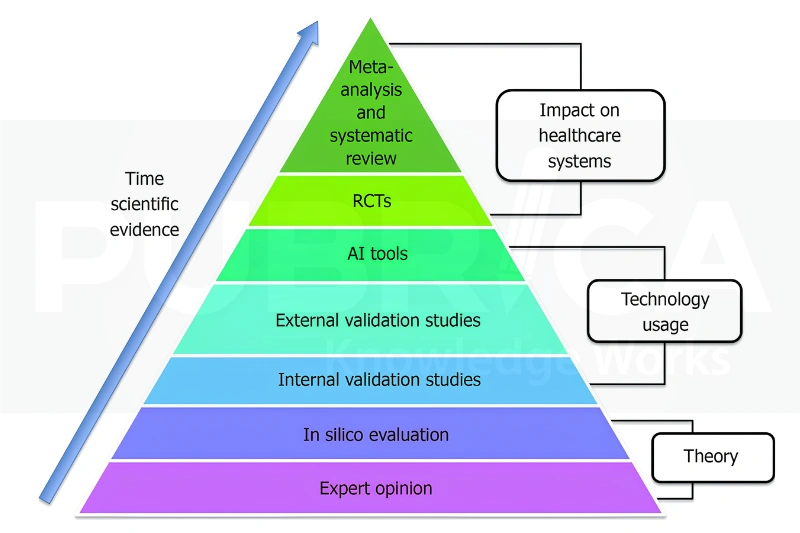
Evaluations by researchers are usually based on:
- Study design
- Data quality
- External validation
- Bias risk assessment
- Real-world applicability
- Replicability
Systematic reviews and prospective clinical validations offer better evidence than retrospective analyses. Machine learning clinical validation studies help establish confidence in AI-based healthcare applications.
5. Clinical Applications of AI
AI applications continue to expand across multiple medical specialities.
Clinical Specialty | AI Application | Clinical Benefit |
Radiology | Image interpretation | Earlier disease detection |
Pathology | Digital pathology | Improved diagnostic consistency |
Cardiology | ECG interpretation | Early cardiac risk prediction |
Oncology | Tumour classification | Precision medicine |
Ophthalmology | Retinal image analysis | Diabetic retinopathy screening |
Emergency Medicine | Patient triage | Faster clinical decision-making |
These applications demonstrate the potential of AI in clinical practice to improve healthcare efficiency while supporting clinician expertise.
6. Challenges Limiting Clinical Adoption
Despite the positive results observed, there exist certain obstacles that hinder the everyday implementation of AI.
- Lack of Generalizability: Models created based on data provided by one hospital might work differently when applied to another hospital or population.
- Explainability: Deep learning models can be considered black-box models where it is hard for a clinician to understand how the prediction was made.
- Data Privacy: AI systems need to gain access to personal information, which means that they need to follow GDPR, HIPAA, and institutional regulations.
- Regulation: The clinical tool needs to pass certain testing before getting approved by the relevant authorities.
7. Essential Considerations for Clinical AI Implementation
For AI to be successfully integrated in clinical practice, there need to be some ethical and technical requirements. [6]
Some of those recommended include:
- Using a wide and diverse set of data.
- Conducting independent validation studies.
- Conducting continuous monitoring of algorithm performance.
- Being transparent about the process of creating the models.
- Integrating AI into clinical decision-making process but not replacing clinicians.
- Using existing frameworks for reporting such as TRIPOD-AI, CONSORT-AI, SPIRIT-AI and STARD-AI.
These approaches improve trust, reproducibility, and patient safety while strengthening clinical decision support AI implementation.
8. The Evolving Role of AI in Future Clinical Practice
The future of artificial intelligence in healthcare will focus on:
- Explainable Artificial Intelligence (XAI)
- Federated learning to provide privacy-preserving healthcare
- Real-time decision support in clinical settings
- Electronic health records
- Multimodal AI that integrates imaging, lab, genomic and clinical information
Such developments will be able to contribute to personalised medicine and better diagnostics.
Connect with us to explore how we can support you in maintaining academic integrity and enhancing the visibility of your research across the world!
Conclusion
AI is changing the way clinical practice works through improved diagnosis, faster identification of diseases, and evidence-based decision-making. However, for successful incorporation of AI technology in medicine, issues such as AI bias in medicine, high-quality evidence, validation of AI models across different cohorts, and transparency during clinical use must be addressed.
AI in clinical practice should support healthcare professionals rather than replace them. Continuous machine learning clinical validation, evidence-based evaluation, and collaboration among clinicians, researchers, and technology developers will be necessary to ensure the safety and effectiveness of AI in medicine.
Artificial Intelligence in Clinical Medicine: Diagnostic Accuracy, Bias, and Clinical Evidence. OurPubrica consultants are here to guide you. [Get Expert Publishing Support] or [Schedule a Free Consultation]
Frequently Asked Questions (FAQs)
Artificial intelligence in clinical practice refers to computer systems that use machine learning, deep learning, and other advanced techniques to assist healthcare professionals with disease diagnosis, treatment planning, medical imaging, and clinical decision-making.
AI diagnostic accuracy is evaluated using performance measures such as sensitivity, specificity, accuracy, positive predictive value, negative predictive value, and area under the receiver operating characteristic (ROC) curve. External validation on independent patient populations is also essential.
Common sources of bias include selection bias, sampling bias, measurement bias, algorithmic bias, and confirmation bias. These biases can reduce model fairness, limit generalizability, and contribute to healthcare disparities.
High-quality evidence demonstrates that an AI system is accurate, reliable, safe, and effective across different clinical settings. Prospective studies, external validation, and systematic reviews provide stronger evidence than retrospective analyses alone.
Key challenges include limited generalizability across populations, lack of model explainability, concerns about patient privacy, regulatory requirements, integration into clinical workflows, and maintaining clinician trust.
Several reporting guidelines improve the transparency and quality of AI research, including TRIPOD-AI for prediction models, CONSORT-AI for randomized clinical trials, SPIRIT-AI for clinical trial protocols, and STARD-AI for diagnostic accuracy studies.
References
- Chari, N., Ahmed Abdelmageed, A. A., Subhedar, D., Sabra, M., Ali, O., Ali, S., Waqas, R., & Ali, R. (2026). Artificial Intelligence in Clinical Decision-Making: A Systematic Review of Diagnostic Accuracy, Predictive Performance, and Clinical Outcomes. Cureus, 18(6), e111796. https://doi.org/10.7759/cureus.111796
- Thomas, K. S., Edpuganti, S., Puthooran, D. M., Thomas, A., Joy, A., & Latheef, S. (2025). Artificial intelligence in modern clinical practice (Review). Medicine international, 6(1), 5. https://doi.org/10.3892/mi.2025.289
- Takita, H., Kabata, D., Walston, S. L., Tatekawa, H., Saito, K., Tsujimoto, Y., Miki, Y., & Ueda, D. (2025). A systematic review and meta-analysis of diagnostic performance comparison between generative AI and physicians. NPJ digital medicine, 8(1), 175. https://doi.org/10.1038/s41746-025-01543-z
- Adedinsewo, D., & Al-Khatib, S. M. (2024). Understanding AI bias in clinical practice. Heart rhythm, 21(10), e262–e264. https://doi.org/10.1016/j.hrthm.2024.
- Atkins, D., Best, D., Briss, P. A., Eccles, M., Falck-Ytter, Y., Flottorp, S., Guyatt, G. H., Harbour, R. T., Haugh, M. C., Henry, D., Hill, S., Jaeschke, R., Leng, G., Liberati, A., Magrini, N., Mason, J., Middleton, P., Mrukowicz, J., O’Connell, D., Oxman, A. D., … GRADE Working Group (2004). Grading quality of evidence and strength of recommendations. BMJ (Clinical research ed.), 328(7454), 1490. https://doi.org/10.1136/bmj.328.7454
- Harishbhai Tilala, M., Kumar Chenchala, P., Choppadandi, A., Kaur, J., Naguri, S., Saoji, R., & Devaguptapu, B. (2024). Ethical Considerations in the Use of Artificial Intelligence and Machine Learning in Health Care: A Comprehensive Review. Cureus, 16(6), e62443. https://doi.org/10.7759/cureus.62443