Oncology Manuscripts & Trial Reporting: CONSORT, RECIST & High-Impact Journal Submission
High-Impact Journals
- Why Reporting Quality Matters in Oncology Research
- CONSORT for Randomised Oncology Trials
- RECIST 1.1 for Tumour Response Assessment
- Integrating CONSORT and RECIST into the Manuscript
- Statistical and Clinical Reporting in Oncology Trials
- Current Trends in Oncology Manuscript Reporting
- Preparing for High-Impact Journal Submission
- Common Reporting and Submission Errors
- Practical Oncology Manuscript Checklist
- Conclusion
Interesting topics
Oncology Manuscripts & Trial Reporting: CONSORT, RECIST & High-Impact Journal Submission
The field of oncology has seen an increase in the need for transparent reporting so that healthcare professionals, scientists, reviewers, and policymakers may be able to critically appraise their results. Despite the technical robustness of the study, it may pose some challenges during peer review if not well reported regarding the method, flow of participants, assessment of tumor response, statistics, and trial registration. Oncology manuscript writing service can support authors in presenting these methodological and reporting elements clearly.
For randomized oncology studies, CONSORT is the guideline to guide transparent reporting, and CONSORT 2025 promotes open and transparent reporting of randomised cancer trials, including the following aspects:
- Trial registration and registration information.
- Access to the protocol and statistical analysis plan.
- Sharing of patient-level data, code, and materials.
- Conflicts of interest.
- Patient and public involvement.
- Harms identification and reporting.
- Analysis population and deviations from the planned analyses.
- Missing data and their treatment.
- Intervention administration (as planned, deviations, compliance).
The RECIST 1.1 adds to CONSORT 2025 by establishing the criteria for tumor response evaluation in solid tumors, while ICMJE guidelines promote trial registration, transparency, data and conflict of interest disclosure. [1]
1. Why Reporting Quality Matters in Oncology Research
Clinical trials in oncology frequently have complicated endpoints, several experimental arms, long-term measurements, and clinically significant safety endpoints. Reporting in such cases must show: [2]
- Participant recruitment and randomisation methods
- Definition and measurement of the endpoints
- Measurements of tumour response
- Methods of statistical analysis
- Whether or not the conclusions made are based on the results obtained
Such a reporting structure will make results more reproducible and help distinguish statistical significance from clinical importance. Clinical trial manuscript editing can help ensure that these reporting elements are presented consistently.
2. CONSORT for Randomized Oncology Trials
CONSORT guidelines are especially helpful in reporting randomized controlled trials. They help writers incorporate vital information relating to trial design, allocation of subjects, intervention, outcome measures, and results.
In the reporting of a good oncology RCT, one needs to explain:
- Eligibility and recruiting
- Randomization and allocation methods
- Intervention and control arms
- Primary and secondary outcome measures
- Flow of participants and withdrawals
- Analyses and adverse effects
CONSORT flow diagram is especially important in that it explains how participants move from eligibility evaluation, allocation, follow-up, to analyses. Proper oncology journal submission preparation should ensure that the CONSORT information is complete and consistent throughout the manuscript.
3. RECIST for Tumour Response Assessment
Response Evaluation Criteria in Solid Tumours (RECIST) provides standardised criteria for evaluating treatment response in patients with solid tumours. [3]
RECIST-Based Tumour Response Assessment
RECIST 1.1 commonly categorises tumour response as:
- Complete response (CR):Disappearance of all target lesions; pathological lymph nodes should regress to <10 mm in short axis.
- Partial response (PR):At least a 30% decrease in the sum of diameters of target lesions from baseline.
- Progressive disease (PD):At least a 20% increase in the sum of diameters from the smallest value recorded (nadir), with an absolute increase of at least 5 mm, or the appearance of new lesions.
- Stable disease (SD):Neither sufficient shrinkage for PR nor sufficient increase for PD.
The explanation of how the image analysis was performed, the response criteria used, and the response-related end points selected must be clear in an oncology paper.
Note: It is not enough to mention RECIST criteria in the methods section of your manuscript. The manuscript must show how these criteria were used in assessing outcomes.
4. Integrating CONSORT and RECIST into the Manuscript
CONSORT and RECIST address different reporting needs.
| Framework | Primary Purpose | Manuscript Application |
|---|---|---|
| CONSORT | Transparent reporting of randomised trials | Trial design, allocation, participants and outcomes |
| RECIST | Standardised tumour-response assessment | Imaging and treatment-response outcomes |
| ICMJE Recommendations | Medical manuscript preparation and publication | Manuscript structure and submission |
| Journal Guidelines | Publication-specific requirements | Formatting, word limits and submission files |
This integration allows the manuscript to explain how the trial was conducted and how oncology outcomes were measured.
5. Statistical and Clinical Reporting in Oncology Trials
There should be sufficient statistical information provided in such a way that the reader can comprehend the methodology employed as well as the accuracy of the results. The use of statistical methods needs to be presented in a manner that readers can grasp the methods used as well as the reliability of the findings. The authors should:
- State appropriate uncertainty statistics such as confidence intervals, rather than using only P values.
- Clearly differentiate between pre-planned (confirmatory) analysis and exploratory analysis.
Provide sufficient description of the statistical methods, population for analysis, and management of missing data. [4]
In clinical trials within oncology, reporting can entail:
- Overall survival (OS)
- Progression-free survival (PFS)
- Objective response rate (ORR)
- Hazard ratios and confidence intervals
- Adverse events
- Subgroup analysis
6. What Changed in Oncology Trial Reporting by 2026?
In terms of oncology trial reporting by 2026:
- CONSORT 2025: Focuses on openness of science, data/code/material sharing, adverse events reporting, missing data handling, and patient/public participation (PPI).
- ICMJE 2026: Reiterates the existing guidelines on authorship, conflict of interest disclosures, AI usage and disclosure, data access policy, and publications.
- Prospective trial registration: All trials should be registered before recruitment of patients.
- Oncology-specific reporting: Reports should clearly specify the tumour response criteria, clinical outcome measures, safety measures, and statistical analyses.
7. Preparing for High-Impact Journal Submission
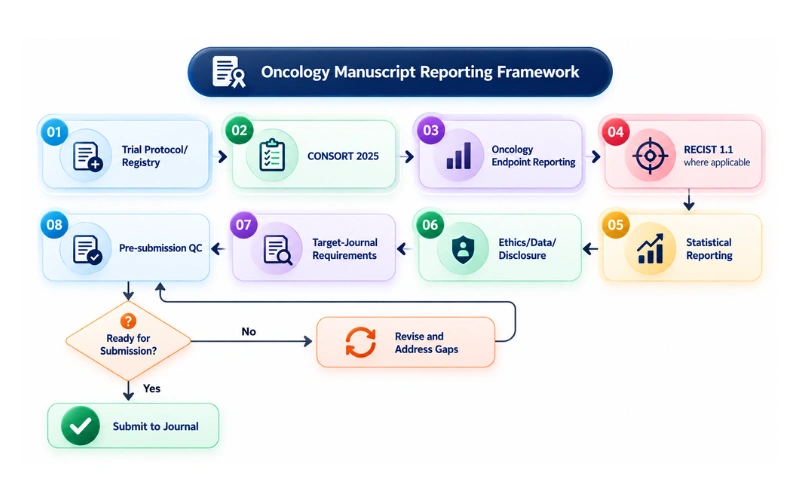
High-impact journals typically require manuscripts to demonstrate both scientific rigor and completeness of reporting. [5]
Before submitting the manuscript, authors need to check the following:
- The manuscript conforms to the instructions of the journal being targeted.
- The appropriate guideline for reporting has been followed.
- Trial registration information has been provided, wherever necessary.
- The abstract, Methods, Results, tables, and figures are consistent with each other.
- Ethical approval, funding, conflict of interest, and data availability statements have been adequately addressed.
ICMJE advocates the traditional IMRAD structure for original research studies. Oncology journal submission requirements should therefore be reviewed carefully before final submission.
8. Common Reporting and Submission Errors
Some common mistakes are:
- Lack of complete CONSORT statement compliance
- Limited description of randomization process
- Definitions of tumour response not consistent
- Lack of trial registry details
- Overreliance on P values without reporting effect estimates and uncertainty
- Inconsistency in figures between abstract, tables, and main body of paper
- Failure to comply with journal-specific formatting guidelines
- Lack of declaration of funding/funding sources or conflicts of interest
Avoiding these mistakes will help you avoid any unnecessary editorial queries. Professional clinical trial manuscript editing can help identify inconsistencies before submission.
9. Practical Oncology Manuscript Checklist
☐ Trial Registration: Prospective registration and registration identifier reported.
☐ Protocol & SAP: Accessibility of the protocol and statistical analysis plan stated.
☐ Participant Flow: Allocation, follow-up, exclusions, and analysed participants clearly reported.
☐ Analysis Population: Analysis populations clearly defined and deviations explained.
☐ Missing Data: Extent of missing data and handling methods reported.
☐ Intervention Delivery: Actual interventions received, adherence, deviations, and discontinuations reported.
☐ Tumour Response: RECIST 1.1 or other appropriate response criteria identified and applied.
☐ Response Assessment: Lesion selection, measurement methods, assessment schedule, and response evaluation described.
☐ Clinical Endpoints: Primary and secondary oncology endpoints clearly defined and reported.
☐ Harms & Safety: Adverse events and relevant harms systematically assessed and reported.
☐ Statistics: Effect estimates, confidence intervals or other measures of uncertainty, and P values reported appropriately.
☐ Data & Code Sharing: Data, statistical code, and study-material availability stated where applicable.
☐ Patient/Public Involvement: Patient and public involvement reported where applicable.
☐ Ethics & Consent: Ethics approval, informed consent, and participant protections addressed.
☐ Funding & COI: Funding, sponsor role, and conflicts of interest disclosed.
☐ AI Disclosure: Use of AI reported where required or applicable.
☐ Tables & Figures: Consistent with the main text and accurately present the results.
☐ Journal Compliance: Current journal instructions and relevant reporting
ICMJE specifically recommends that tables and figures be limited to information needed to explain the study and support interpretation, while supplementary material can contain additional technical details where appropriate.
Connect with us to explore how we can support you in maintaining academic integrity and enhancing the visibility of your research across the world!
Conclusion
High-quality cancer reporting cannot just depend on statistical significance. Authors need to make sure that their methodological approach, tumour response evaluation and statistics are clearly reported. The guidelines that help to report randomised trials and not how to design and conduct them are given by CONSORT 2025, whereas RECIST 1.1 helps to report tumour response in solid tumours. These principles are particularly important when preparing a cancer research manuscript writing project for high-impact journal submission.
Preparing an Oncology Clinical-Trial Manuscript? Pubrica can support researchers with manuscript development and editing, CONSORT 2025 reporting review, RECIST 1.1 presentation, statistical reporting review and journal-submission preparation while maintaining researcher ownership and author responsibility.
Frequently Asked Questions (FAQs)
CONSORT guidelines help researchers report randomized oncology clinical trials clearly and transparently. They cover important aspects such as participant recruitment, randomization, interventions, outcomes, participant flow, statistical analysis, and adverse events. Following CONSORT can improve the completeness and credibility of an oncology manuscript.
Authors should clearly explain how RECIST 1.1 criteria were applied to assess tumor response. The manuscript should describe the imaging methods, target and non-target lesions, assessment schedule, response categories, and relevant endpoints such as objective response rate. Simply stating that RECIST was used is not sufficient; the application of the criteria should be clearly documented.
Before high-impact journal submission, check that the manuscript follows the relevant reporting guidelines and the target journal’s instructions. Ensure that the Methods, Results, tables, figures, and abstract are consistent, and include appropriate information on trial registration, ethics approval, funding, conflicts of interest, and data availability. Clinical trial manuscript editing can also help identify reporting gaps and inconsistencies.
Common mistakes include incomplete CONSORT reporting, inadequate descriptions of randomization, unclear RECIST-based tumor-response assessment, missing trial registration information, overreliance on P values, inconsistent data between tables and the main text, and failure to follow journal-specific requirements. Careful oncology manuscript writing and pre-submission review can help minimize these problems.
References
- Toews, I., Binder, N., Wolff, R. F., Toprak, G., von Elm, E., & Meerpohl, J. J. (2017). Guidance in author instructions of hematology and oncology journals: A cross sectional and longitudinal study. PloS one, 12(4), e0176489. https://doi.org/10.1371/journal.pone.0176489
- MacCarthy, A., Kirtley, S., de Beyer, J. A., Altman, D. G., & Simera, I. (2018). Reporting guidelines for oncology research: helping to maximise the impact of your research. British journal of cancer, 118(5), 619–628. https://doi.org/10.1038/bjc.2017.407
- Schwartz, L. H., Litière, S., de Vries, E., Ford, R., Gwyther, S., Mandrekar, S., Shankar, L., Bogaerts, J., Chen, A., Dancey, J., Hayes, W., Hodi, F. S., Hoekstra, O. S., Huang, E. P., Lin, N., Liu, Y., Therasse, P., Wolchok, J. D., & Seymour, L. (2016). RECIST 1.1-Update and clarification: From the RECIST committee. European journal of cancer (Oxford, England : 1990), 62, 132–137. https://doi.org/10.1016/j.ejca.2016.03.081
- Piantadosi, S., Saijo, N., & Tamura, T. (1993). Guidelines for analysis and reporting of clinical trials in oncology. Japanese journal of cancer research : Gann, 84(9), 929–937. https://doi.org/10.1111/j.1349-7006.1993.tb00180.x
- Jirge P. R. (2017). Preparing and Publishing a Scientific Manuscript. Journal of human reproductive sciences, 10(1), 3–9. https://doi.org/10.4103/jhrs.JHRS_36_17