Integrative Review Explained: A Comprehensive Guide to Synthesising Diverse Research Evidence
High-Impact Journals
Interesting topics
Integrative Review Explained: A Comprehensive Guide to Synthesising Diverse Research Evidence
About the increase in the amount and variety of the scientific literature, there is a need for approaches that will enable the synthesis of evidence from various traditions of knowledge. Integrative review represents a new approach that enables scholars to undertake a review of evidence by combining research studies based on quantitative, qualitative, mixed, and theoretical designs into one approach. This process supports evidence synthesis and facilitates knowledge integration across multiple disciplines. Integrative reviews are different from other systematic reviews, where usually only one research design is considered at once. The application of integrative reviews is common in the areas of health care, nursing, education, public health, and social sciences. [1]
1. What Is an Integrative Review?
Integrative review is an evidence synthesis technique that involves gathering, analysing, and synthesising results created by different paradigms of research. An integrative review is one of the broadest forms of review techniques because it includes different forms of evidence and promotes knowledge integration across diverse research traditions. [2]
- Quantitative research designs
- Qualitative research designs
- Mixed research designs
- Theoretical articles
- Methods research articles
The primary purpose of performing an integrative review is not just summarization of existing research results, but also conceptual framework development, theory generation, and a deeper understanding of complex phenomena.
2. Why Researchers Use Integrative Reviews
An integrative review plays a significant role in both the development of knowledge and evidence synthesis.
- Considers all elements of complex topics.
- Serves to identify gaps in existing knowledge and supports research gap identification.
- Promotes development of theoretical and conceptual frameworks.
- Makes evidence-based decision-making possible.
- Does not depend on a particular research approach.
The application of the integrative review approach helps to answer questions from various disciplines that cannot be answered using only one method. In the field of public health and medicine, it becomes highly valuable due to the multiple types of evidence used and its support for interdisciplinary research.
3. Key Characteristics of Integrative Reviews
| Feature | Description | Benefit |
| Evidence Diversity | Includes multiple study designs | Broader perspective |
| Flexible Methodology | Accommodates diverse methods | Inclusive synthesis |
| Conceptual Integration | Combines findings into themes | Theory development |
| Knowledge Generation | Identifies trends and gaps | Future research guidance |
| Interdisciplinary Scope | Draws evidence from various fields | Enhanced applicability |
These characteristics make integrative reviews highly adaptable across disciplines.
4. Methodological Frameworks for Integrative Reviews
Several frameworks can be used to ensure that an integrative review is conducted in an effective and rigorous manner. [4]
Common Frameworks: Whittemore and Knafl Framework
- Identifying the Problem
- Literature Search
- Data Evaluation
- Data Synthesis
- Reporting
- Torraco Framework: Focused more on conceptual framework development and theory building.
- PRISMA Guidelines: Even though initially created for systematic reviews, the PRISMA guidelines help improve transparency in conducting integrative reviews.
5. Step-by-Step Process to Conduct an Integrative Review
Conducting an integrative review involves a structured and systematic process. [5]
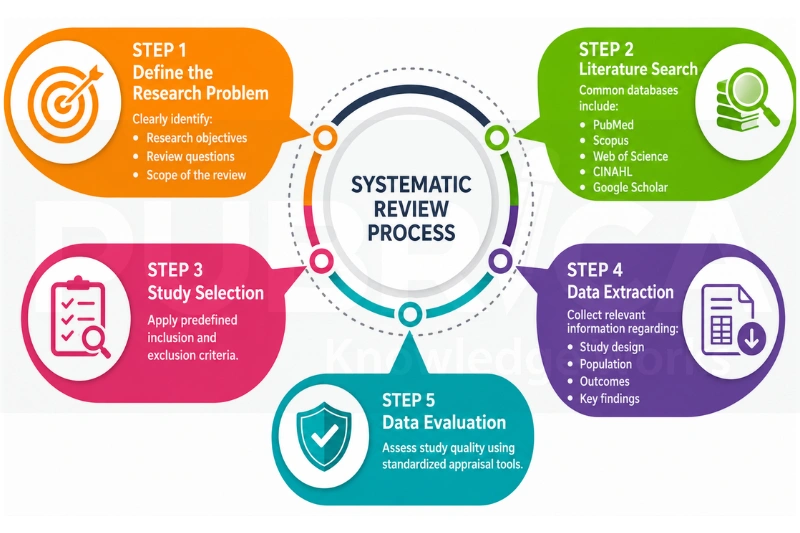
A systematic process ensures transparency and minimises bias throughout the review while improving research gap identification and evidence integration.
6. Data Evaluation and Quality Assessment
The evaluation of quality is important for the purpose of establishing the validity of the results of reviews.
Quality Assessment Instruments
- CASP Checklists
- Tool for JBI Critical Appraisal
- Mix Methods Appraisal Tool (MMAT) for mixed-methods research
- ROBINS-I
- Cochrane Risk of Bias Tool
It entails assessing the methodology, relevance, validity, and possible biases. Elimination and/or inclusion with appropriate weight of poor-quality studies enhances the validity of the synthesised information and the results.
7. Data Analysis and Synthesis
Data synthesis is the most important phase in the integrative review.
Analysis Methods
- Thematic Analysis: Finds recurring themes across various sources.
- Constant Comparative Analysis: Makes comparisons between results using various methods.
- Concept Mapping: Constructs a visual picture of concept relationships and supports conceptual framework development.
Main Issues for Analysis
- What are the patterns in the data?
- In what ways does the data overlap or diverge?
- What are the relationships among concepts?
- What are the gaps in the literature?
Data synthesis helps to derive themes, frameworks, and theory out of data from individual studies, promoting knowledge integration and advancing interdisciplinary research.
Connect with us to explore how we can support you in maintaining academic integrity and enhancing the visibility of your research across the world!
Conclusion
There is no doubt that the method of the integrative review provides an excellent approach to evidence synthesis of different types of information and creation of an elaborate picture of the research topic. This type of review uses not only quantitative or qualitative research but also incorporates mixed-methods research and combines all possible types of information including theories. The contribution of the integrative review approach to research gap identification, conceptual framework development, and knowledge integration can be considered its advantage over other types of reviews. Furthermore, its value in supporting interdisciplinary research makes it an increasingly important methodology across a wide range of academic disciplines.
Integrative Review Explained: A Comprehensive Guide to Synthesising Diverse Research Evidence. OurPubrica consultants are here to guide you. [Get Expert Publishing Support] or [Schedule a Free Consultation]
Frequently Asked Questions (FAQs)
An integrative review is a form of evidence synthesis that combines findings from quantitative, qualitative, mixed-methods research, and theoretical studies to provide a comprehensive understanding of a research topic.
Unlike a systematic review, which often focuses on a single type of research design, an integrative review incorporates multiple forms of evidence. This broader approach supports knowledge integration and offers a more holistic perspective on complex issues.
Integrative reviews bring together evidence from different disciplines, making them particularly valuable for interdisciplinary research. They help researchers explore complex topics, identify connections across fields, and develop comprehensive conceptual frameworks.
Common methods include thematic analysis, constant comparative analysis, and concept mapping. These techniques help researchers identify patterns, relationships, and research gaps while supporting conceptual framework development.
An integrative review examines a wide range of evidence sources, allowing researchers to detect inconsistencies, underexplored areas, and emerging trends. This process of research gap identification helps guide future studies and contributes to evidence-based knowledge development.
References
- Whittemore, R., & Knafl, K. (2005). The integrative review: updated methodology. Journal of Advanced Nursing, 52(5), 546–553. https://doi.org/10.1111/j.1365-2648.2005.03621.x
- Souza, M. T., Silva, M. D., & Carvalho, R.d (2010). Integrative review: what is it? How to do it?. Einstein (Sao Paulo, Brazil), 8(1), 102–106. https://doi.org/10.1590/S1679-45082010RW1134
- Snyder, H. (2019). Literature review as a research methodology: An overview and guidelines. Journal of Business Research, 104, 333–339. https://doi.org/10.1016/j.jbusres.2019
- Reviews and Evidence Syntheses: Integrative review. (2025, March 24). Utoledo.edu. https://libguides.utoledo.edu/es/
- Adelphi University Libraries. (2021, November 19). Systematic reviews/evidence synthesis. Adelphi.edu. https://libguides.adelphi.edu