Publishing With Impact: How Authors Should Select the Right Journal
- Home
- Academy
- journal selection
- Publishing With Impact: How Authors Should Select the Right Journal
High-Impact Journals
Interesting topics
Publishing With Impact: How Authors Should Select the Right Journal
The process of publication of scientific articles is among the most significant stages of an academic life. At the same time, there are many difficulties, such as choosing the proper journal due to the increase in scientific research and journals. The main aim of each scientist is to have his/her work published in a certain journal as part of an effective publication strategy tips and scholarly publishing strategy. Nevertheless, scientists should not only be concerned about publication but also try to maximise the influence of their article on the academic community and the outside world, ensuring strong research visibility improvement and publishing with impact. In this paper, we will discuss some issues related to journal selection for publication and offer a practical journal selection guide. [1]
1. Understanding the Scope and Focus of the Journal
An author must understand what the focus or speciality of a journal is. In other words, you should find out what areas a journal specialises in to ensure proper manuscript journal matching. Therefore, submitting a paper to the journal that specialises in the same area you do is one of the most significant aspects for choose right journal decisions. [2]
Important Things to Know:
- Subject Specialisation: Is your work compatible with the specialisation of a journal? Each journal focuses on certain subjects, such as neuroscience, economics, linguistics, etc.
- Interdisciplinary Nature of a Journal: Are your research results interdisciplinary? Some journals are interested in interdisciplinary issues that might help them appeal to more audiences. Thus, if you conduct interdisciplinary research and want to submit an article to a particular journal, make sure that the journal is not against the idea.
Remember to read a journal’s mission statement and the articles they have recently published to see if it is suitable for your academic research publication.
2. Audience and Readership
A particular journal is designed for a certain set of audiences, and your publication could succeed only when you reach the right target audience through it. Will your research cater to the needs of the general academic audience, or will it cater to a niche field? Although a journal targeting a broader readership will help you maximise your exposure and support publishing with impact, it may fail to cover your specialised field. At the same time, if you choose a specialised journal, you might face problems of reaching out to a broader audience. [3]
Considerations to Remember:
Readership Targeted | Global Readership or Regional Readership |
Who are the readers of the journal? What is their demographic? What kind of content would satisfy the expectations of the audience? Try matching up with your target readership.
| You will come across some journals that address local issues and some that address international issues. Will you try reaching out to the local community, or do you intend to go global through indexed journals list and international platforms? |
3. Reputation and Impact Factor
The reputation of the journal can be said to be one of the key criteria that the author considers when choosing a place to publish his research work. The choice of the journal’s reputation will affect your article’s credibility and perhaps even your career. One of the main characteristics used to estimate the reputation of the journal is the journal impact factor (IF). This indicator shows how often the articles published in the journal are quoted during the specified period. [4]
For example, journals from relatively new fields or journals focusing on narrow themes usually don’t have a high impact factor, but their contribution to the research process can be invaluable for academic research publication.
Important Criteria:
- Impact Factor: If you want to make yourself known and establish yourself in the academic world, then you need to try to submit your work to prestigious and high-impact-factor journals. But do not forget that the importance of the IF depends on many other factors.
- Prestige of the journal: There are such journals that cannot boast a high impact factor but still play a role in scholarly publishing strategy.
These criteria allow reviewers to make structured judgments rather than relying on subjective impressions.
4. Peer Review Process
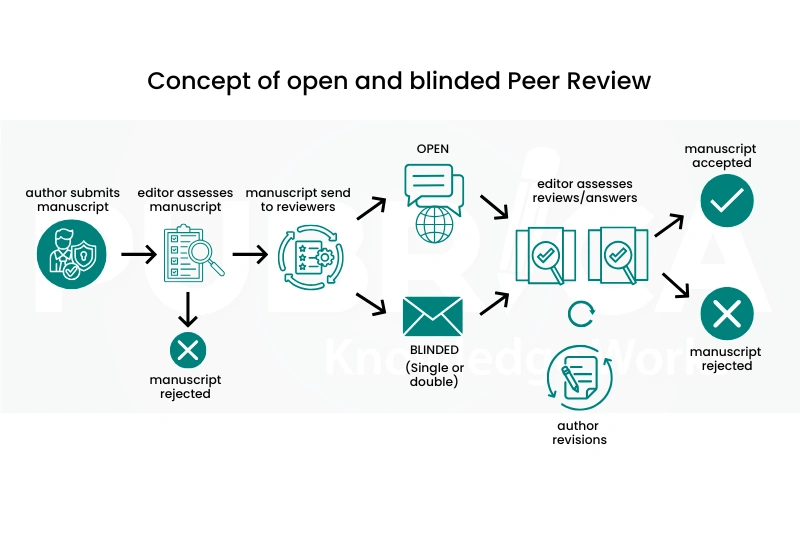
Peer review is one of the pillars of the scientific publication process and a core feature of peer review journals. Peer review is a process of evaluating and improving the quality of science that is reported by scientists. It should guarantee that what will be published is of good scientific merit and adds to the development of knowledge. Authors should familiarise themselves with the peer review process of the journals under consideration before research paper submission. [5]
Considerations
- Blind or Single Blind Review: In a blind review, neither the reviewer nor the authors know about each other’s identities, whereas in a single-blind review, the reviewer knows who is authoring the article. Both types have their advantages and disadvantages.
- Review Speed: Some of the journals conduct faster peer review processes, which is important for time-sensitive research paper submission.
- Revision and Resubmission Policy: Some journals require a revision of an article and resubmission of the paper before publication. Others prefer fast acceptance of the papers upon submission.
5. Accessibility and Open Access
However, with the advent of digital publications, the question of accessibility has taken centre stage. Open-access journals are gaining popularity because they allow research papers to be available free of charge to all people interested. [6]
Key Issues to Consider:
Open Access Journals vs. Subscription Journals | While open-access journals are considered preferable because of higher visibility of your research and more opportunities for reaching a broader audience, there might be some publication fees associated. On the other hand, subscription-based journals may not be easily accessible but have a more traditional readership within scholarly publishing strategy. |
Institutional Repositories | If you decide to submit a manuscript to a subscription-based journal, find out what institutional access is available and if there is any opportunity to archive the article yourself to improve research visibility improvement. |
Consider issues regarding open access while selecting a journal.
6. Journal Guidelines and Formatting Requirements
Each journal has its own guidelines for submission of the articles, and failing to follow these guidelines might lead to rejection of the paper. Therefore, it is necessary to study the submission guidelines of the journals you want to submit your article to make sure that it follows all the rules.
Important Factors:
- Manuscript Format: You need to be familiar with the formatting guidelines of the journal regarding the number of words, references, headings, etc.
- Additional Materials: Some journals demand additional materials accompanying the article, such as data sets, figures, multimedia files, etc.
- Article Type: Depending on each journal, different types of articles can be accepted, including original research articles, reviews, case studies, etc.
Connect with us to explore how we can support you in maintaining academic integrity and enhancing the visibility of your research across the world!
Conclusion
The decision to choose an appropriate journal where you want to publish your research is very important and plays a huge role in making sure that your work will be visible and achieve publishing with impact. The following aspects can guide authors in journal selection for publication, including scope, targeted audience, reputation, peer reviewing process, accessibility, and journal criteria.
Research involves many processes and stages; thus, the right publication will ensure that your work will have an academic impact on the scientific world and improve research visibility improvement. Whether you are an experienced or novice author, you need to consider these factors when deciding on a suitable journal to publish in, following a strong scholarly publishing strategy.
Publishing with Impact: How Authors Should Select the Right Journal. OurPubrica consultants are here to guide you. [Get Expert Publishing Support] or [Schedule a Free Consultation]
References
- Tullu, M. S., & Karande, S. (2018). Success in Publishing: Selecting an Appropriate Journal and Braving the Peer-review Process. Journal of postgraduate medicine, 64(1), 1–4. https://doi.org/10.4103/jpgm.JPGM
- Rogers, J. R., Mills, H., Grossman, L. V., Goldstein, A., & Weng, C. (2020). Understanding the nature and scope of clinical research commentaries in PubMed. Journal of the American Medical Informatics Association : JAMIA, 27(3), 449–456. https://doi.org/10.1093/jamia/ocz20
- Pignard-Cheynel, N., & Amigo, L. (2023). (Re)connecting with audiences. An overview of audience-inclusion initiatives in European French-speaking local news media. Journalism (London, England), 24(12), 2612–2631. https://doi.org/10.1177/1464884923117
- Pignard-Cheynel, N., & Amigo, L. (2023). (Re)connecting with audiences. An overview of audience-inclusion initiatives in European French-speaking local news media. Journalism (London, England), 24(12), 2612–2631. https://doi.org/10.1177/1464884923117
- Tumin, D., & Tobias, J. D. (2019). The peer review process. Saudi journal of anaesthesia, 13(Suppl 1), S52–S58. https://doi.org/10.4103/sja.SJA_544
- Fleming, J. I., Wilson, S. E., Hart, S. A., Therrien, W. J., & Cook, B. G. (2021). Open Accessibility in Education Research: Enhancing the Credibility, Equity, Impact, and Efficiency of Research. Educational psychologist, 56(2), 110–121. https://doi.org/10.1080/00461520.2021