Two Lists, One Manuscript: A Data-Driven Journal Selection Model for Polish Researchers (2026–2027)

Polish researchers choosing where to publish now work with two lists that do not always agree. The first is the national list maintained by the Ministry of Science and Higher Education, which assigns points that feed into evaluation and funding. The second is the international indexing record, principally Scopus and Web of Science, which shapes what a journal is called and how visible it is. A manuscript that fits one list well can fit the other poorly. This article offers a practical way to reconcile them.

1. The Two Lists Problem

A journal can be strong on the international index and still score low on the national list, or the reverse. Points on the national list depend on how a journal is classified under the ministry’s rules, not only on its citation profile. Researchers who check only one list risk submitting to a venue that earns few points, or to one that the national list does not recognise at all. The problem is larger when a manuscript must satisfy both an evaluation office and a readership.

Consider how the problem plays out in practice. A researcher in a Polish university may have a finished manuscript in clinical epidemiology, a list of five candidate journals drawn from an AI finder, and a deadline set by the faculty evaluation cycle. Without a structured comparison, the choice tends to reflect the most familiar name or the first search result. A two-lists approach replaces that guesswork with two recorded checks made on the same day.[3]

2. What the May 2026 Changes Mean

The ministry announced new rules for compiling its lists on 13 May 2026. Points that journals held under the old system no longer apply, and every entity is assessed under the new rules (Ministry of Science and Higher Education, 2026). Journals indexed in Scopus or Web of Science enter the draft list automatically and receive between 40 and 200 points, depending on their ranking position. Indexed journals without calculated indicators now receive 40 points, up from 20. Journals in other databases depend on expert nomination (Ministry of Science and Higher Education, 2026).

Important timing distinction: the regulation governing preparation of the new list entered into force on 27 May 2026, but that did not mean the new journal list was already final or in force. The Ministry stated on 2 June 2026 that the new list was to be prepared and published by the end of 2026 and signed in early 2027; the database snapshot for its preparation was set for 1 July 2026. Researchers should therefore verify the currently applicable list and the relevant evaluation rules rather than treating the regulation’s effective date as the publication date of the new list [4, 5].

The Commission for Research Evaluation can lower a journal’s score or remove it for unethical publishing practices (Ministry of Science and Higher Education, 2026). This makes the national list a living record, not a fixed reference. A decision made on last year’s points may no longer hold.

For practical screening, do not interpret “indexed in Scopus or Web of Science” as a guarantee of a particular point value or immediate final-list status. The regulation specifies eligible indexing categories and the process for preparing the list; verify the journal’s exact title, ISSN/e-ISSN, relevant index coverage and the applicable official list record before relying on a points allocation [4, 5].


Element of the 2026 rules

What it means for selection

Automatic inclusion (Scopus, Web of Science)

Check the bibliometric ranking position; this sets the point band

Indexed, no indicators

Now 40 points; no longer 20

Other databases

Depends on expert nomination; treat as uncertain until confirmed

Removal for unethical practice

Monitor the list before each submission decision

3. Why AI Journal Finders Mislead

Automated journal finders are useful for scope matching, but they are built on indexing metadata and text similarity. They generally do not know the current national points, and they cannot judge whether a journal’s status has changed. A suggestion that looks highly relevant may carry a score the researcher cannot use for evaluation, or a status that has changed since the tool last updated. Researchers should treat finder output as a shortlist to verify, not as a decision. The difficulty of telling legitimate and questionable journals apart is well documented, and features that look reassuring can be misleading.

4. The Quota and Acceptance-Date Trap

Because old points no longer carry over, the score a journal held when a researcher submitted may differ from the score on the list in force when an evaluation counts the publication. Researchers should not assume a journal’s band is fixed for the whole cycle. The safest practice is to record the list version and the score on the date of submission and acceptance, and to recheck before any evaluation deadline. The exact transitional treatment should be confirmed in the regulation itself, which this article does not reproduce.

5. Special Issues: Evidence, Not Opinion

Special issues are a common source of doubt. Some are legitimate and well edited, while others are not. A recurring problem is that no single agreed definition of predatory publishing exists, which makes blanket judgements risky [1]. The defensible approach is to judge each special issue against observable evidence: the editorial board’s named members and their affiliations, the peer-review process as described, the editorial independence of the guest editors, and whether the journal is indexed in the database that the ministry uses.

6. Hijacked and Delisted Journal Check

Hijacked journals imitate a legitimate title, often with a similar name and website, to collect submissions. Checking them requires comparing the journal’s website against its record in the official index and confirming the ISSN and publisher. Blacklists and whitelists used to flag questionable journals overlap only partly and weigh criteria differently. Whitelist criteria were easier to verify, and both types paid little attention to the quality of peer review [2]. A check should therefore rely on verifiable features and on the official index, not on a single external list.

7. The PJSI Matrix

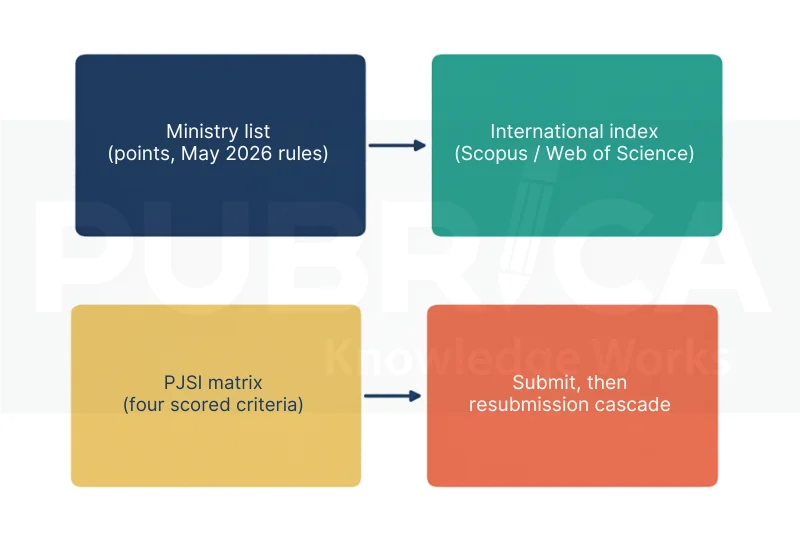
This article proposes the PJSI matrix (Polish Journal Selection Index) as a structured way to compare candidate journals. It scores each journal from 1 to 5 on four criteria, combines them with weights, and produces a ranked shortlist. The weights below are illustrative and should be set by each research unit. The four criteria are the ministry points band, integrity status, scope fit and expected time to decision.


Criterion (weight)

Score 5

Score 3

Score 1

Ministry points (40%)

200 points

100 points

40 points

Integrity status (25%)

Indexed, no concerns, verified ISSN

Minor unresolved query

Hijack or delisting concern

Scope fit (20%)

Core topic of recent papers

Adjacent topic

Weak or unclear fit

Time to decision (15%)

Under 8 weeks

8–16 weeks

Over 6 months


The matrix is deliberately simple. Its value lies in forcing each criterion to be recorded before a decision, so that a high-points journal with an integrity concern cannot win on points alone. The weighting is a policy choice, and it should be documented.

Integrity safeguard: treat a confirmed hijacked-journal identity, a verified delisting relevant to the planned submission, or credible evidence of serious publishing misconduct as a stop-and-verify condition, not merely as a low score that can be offset by points, scope fit or speed. Pause submission until the journal’s identity and current status have been checked against primary records. If the concern remains unresolved, exclude the journal from the active shortlist and document the reason.
Scopus journals Poland

Figure 1. Author-prepared illustration of the proposed two-lists model.

Scoring should be done from primary records wherever possible. For the points band, use the current list and save a dated copy. For integrity, check the journal’s site against the official index and note the ISSN and publisher. For fit, compare the candidate with the three most recent papers in the field that the journal published. For time to decision, use the journal’s stated median, and if none is published, ask the editorial office directly. A score without a source should be recorded as unverified rather than estimated.

To make the points scale reproducible, use the ministry point bands actually shown in the current official record: 200 points = score 5; 140 points = score 4; 100 points = score 3; 70 points = score 2; and 40 points = score 1. If the applicable list uses a different band or a journal’s status is not yet confirmed, record the item as unverified and document the source rather than forcing it into this illustrative scale. For the time-to-decision criterion, define the intermediate bands before scoring: score 5 for under 8 weeks, score 4 for 8 to under 12 weeks, score 3 for 12 to 16 weeks, score 2 for over 16 weeks to 6 months, and score 1 for over 6 months. These cut-offs are proposed operating rules for this matrix, not official ministry criteria.

8. Worked Example

The three journals below are hypothetical and are used only to show the arithmetic. Scores are weighted using the matrix in Section 7. Journal A has the highest points band, but it’s time to decision is long. Journal B balances fit and timing. Journal C scores well on fit and timing but carries an integrity flag, which drags its total down.

The integrity flag in this illustration is a warning that requires verification, not a finding that the hypothetical journal is definitively unsafe. In real use, a confirmed hijack or serious unresolved integrity concern overrides the numerical ranking: do not recommend the journal solely because its weighted total is competitive.


Journal (hypothetical)

Points (×0.40)

Integrity (×0.25)

Fit (×0.20)

Time (×0.15)

Total

A: 200 points

5 → 2.00

5 → 1.25

3 → 0.60

2 → 0.30

4.15

B: 100 points

3 → 1.20

4 → 1.00

5 → 1.00

4 → 0.60

3.80

C: 40 points, flagged

1 → 0.40

2 → 0.50

5 → 1.00

5 → 0.75

2.65


Figure 2. Author-prepared illustration using hypothetical journals.

Journal B is the rational first choice in this example, even though Journal A has the highest points band. The difference illustrates the value of a matrix: it prevents a single attractive criterion from deciding the matter.

9. The Resubmission Cascade

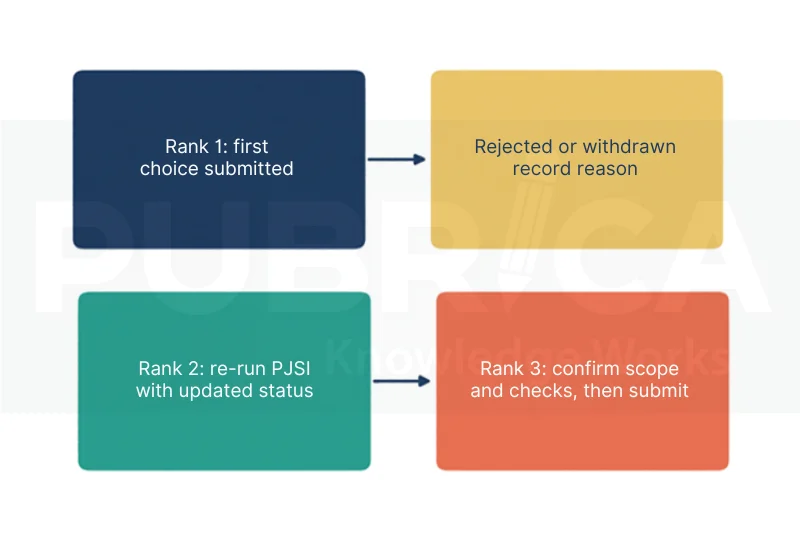
A ranked shortlist turns rejection into a planned step. If the first-choice declines, the researcher records the reason, re-runs the matrix with the updated status of each candidate, and moves to the next journal. This avoids the common pattern of restarting the search from scratch, which wastes months and can lead to a lower-quality venue chosen under time pressure.
Scopus journals Poland

Figure 3. Author-prepared illustration of the resubmission cascade.

The approach also helps with accountability. A dated record of the scores, sources and weights show an evaluation committee how a journal was chosen, and it protects the researcher if a journal later changes status.

Conclusion

Polish researchers can no longer choose a journal from one list alone. The May 2026 rules make the national list dynamic and tie points to international indexing, while the integrity of individual journals still requires case-by-case checking. Adopt the PJSI matrix for your next submission, record every score and its date, and build a ranked shortlist before the first submission goes out. Start with your current manuscript and your list of candidate journals this week.

Choose the Right Journal with Pubrica: Selecting the right journal involves more than checking journal points and indexing. Researchers must also consider scope, publication ethics, and manuscript quality.

Pubrica helps researchers: with journal selection, manuscript editing, journal credibility checks, and submission preparation to support informed publishing decisions. Prepare your manuscript for successful submission with expert support. [Explore Pubrica’s Publication Support Services]

Get expert support from Pubrica for addressing reviewer comments, preparing point-by-point rebuttals, and strengthening manuscripts for journal resubmission. Prepare your revised manuscript with confidence.

Frequently Asked Question

How can Polish researchers verify a journal's current ministry points for 2026–2027?

Researchers should consult the applicable official Polish Ministry of Science and Higher Education journal list and verify the journal’s exact title, ISSN or e-ISSN, and assigned point value. They should also check the relevant evaluation regulations to determine which list version and publication-date rules apply to their assessment. Save a dated copy of the official record for documentation. Do not rely solely on journal websites, third-party rankings, or AI-generated recommendations.

Not necessarily. International indexing and national evaluation points are separate measures. Researchers should verify the journal’s inclusion and point value in the applicable official Polish list, alongside its current indexing status in Scopus or Web of Science. Indexing status alone should not be treated as proof of a specific point allocation or eligibility under every evaluation rule.

The proposed Polish Journal Selection Index (PJSI) matrix compares candidate journals using four weighted criteria: ministry points (40%), publication integrity (25%), scope fit (20%), and expected time to decision (15%). Each criterion receives a score from 1 to 5, and the weighted scores are added to calculate a total out of 5. The resulting ranking supports transparent comparison, but it is a proposed decision-making framework rather than an official Polish government ranking or an independently validated journal-quality measure.

Researchers should verify the journal’s ISSN, publisher, official website, editorial board, peer-review policies, and indexing records. They should check the relevant Scopus or Web of Science source records and confirm whether the journal remains covered, including any documented discontinuation or delisting. Unsolicited publication invitations, unverifiable editorial identities, misleading indexing claims, and unrealistic acceptance promises warrant further investigation. No single checklist or blacklist is conclusive; decisions should be based on multiple verifiable sources and current records.

References

  1. Grudniewicz, A., Moher, D., Cobey, K. D., Bryson, G. L., Cukier, S., Allen, K., et al. (2019). Predatory journals: No definition, no defence. Nature, 576, 210–212. https://doi.org/10.1038/d41586-019-03759-y
  2. Strinzel, M., Severin, A., Milzow, K., & Egger, M. (2019). Blacklists and whitelists to tackle predatory publishing: A cross-sectional comparison and thematic analysis. mBio, 10(3), Article e00411-19. https://doi.org/10.1128/mBio.00411-19


  1. Kulczycki, E., & Rozkosz, E. A. (2017). Does an expert-based evaluation allow us to go beyond the Impact Factor? Experiences from building a ranking of national journals in Poland. Scientometrics, 111(1), 417–442. https://doi.org/10.1007/s11192-017-2261-x