Systematic Review of Artificial Intelligence Applications in Healthcare
High-Impact Journals
Interesting topics
Systematic Review of Artificial Intelligence Applications in Healthcare
The technology known as Artificial Intelligence in Healthcare is now considered to be one of the most innovative and revolutionary tools in modern-day healthcare. AI is defined as a computer system able to complete those tasks which generally would require human intellect such as learning, making conclusions, decision making, and recognizing patterns. During the last decade, thanks to developments in Machine Learning in Healthcare, deep learning (DL), natural language processing (NLP), and computer vision, healthcare services have greatly benefited in terms of accuracy and speed.[1]
Healthcare providers more and more use AI technology to facilitate Clinical Decision Support, decrease the number of mistakes, increase efficiency, and improve patient outcomes. At the same time, questions about data protection, ethics, transparency of algorithms, and other regulatory aspects are still the biggest issues. This Systematic Review AI highlights the current state of Healthcare Artificial Intelligence in terms of its application, benefits, limitations, and future perspectives.
1. Methodology
A systematic literature review was carried out by searching for scientific articles from peer-reviewed journals published from 2019 to 2025. Relevant search engines like PubMed, Scopus, Web of Science, IEEE Xplore, and Google Scholar were explored through the following keywords:
- Artificial Intelligence
- Machine Learning
- Deep Learning
- Healthcare
- Clinical Decision Support
- Medical Imaging
Inclusion Criteria
- English language articles
- Research articles and systematic reviews
- Studies focusing on AI application in healthcare
Exclusion Criteria
- Editorials
- Conference abstracts
- Duplicate studies
- Non-healthcare AI applications
After searching the existing literature, the relevant literature was critically analyzed for the identification of AI applications, benefits, challenges, and future prospects.
2. Applications of Artificial Intelligence in Healthcare
There is tremendous potential of artificial intelligence in several aspects of healthcare.[2]
Diagnostic Imaging: AI in Medical Imaging help the radiologists to detect various illnesses like cancer, stroke, pneumonia, and diabetic retinopathy using automatic image interpretation techniques. Deep learning systems provide diagnosis at an accuracy level equivalent to that of trained professionals.
Clinical Decision Support Systems: Clinical Decision Support systems analyze patients’ data including test results, imaging and clinical history to suggest effective treatment choices without making medical mistakes.
Drug Discovery: Developing a drug using conventional processes takes more than 10 years and huge amounts of money. AI helps identify targets, screen molecules, predict their toxicity, and optimize clinical trials.
Personalized Medicine: Personalized Medicine AI combines genomic, clinical, and lifestyle data to provide individualized treatment by increasing effectiveness and decreasing adverse drug effects. [3]
Remote Patient Monitoring: Wearable gadgets fitted with AI systems continuously monitor heart rate, blood glucose, blood pressure, oxygen saturation and physical activities to detect any irregularities.
Robotic Surgery: AI-driven robotic surgery improves surgical accuracy through enhanced visualization and instruments control.[4]
3. Major Applications of AI in Healthcare
| Application | AI Technology | Clinical Benefit |
| Medical Imaging | Deep Learning | Improved diagnostic accuracy |
| Clinical Decision Support | Machine Learning | Evidence-based treatment decisions |
| Drug Discovery | Predictive Analytics | Faster drug development |
| Personalized Medicine | Genomic AI | Individualized therapies |
| Remote Monitoring | Wearable AI | Early disease detection |
| Robotic Surgery | Computer Vision | Increased surgical precision |
4. Benefits and Challenges of AI in Healthcare
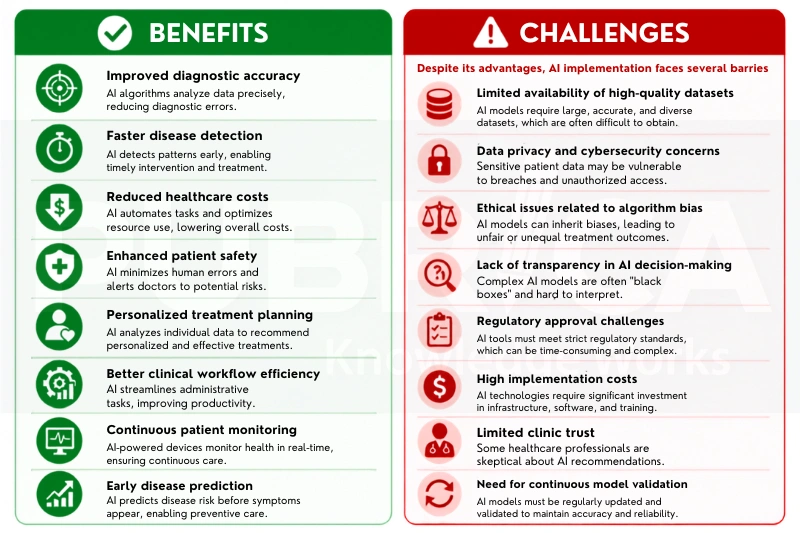
Healthcare organizations must develop robust governance frameworks to ensure responsible AI deployment while maintaining patient confidentiality and regulatory compliance.
5. Future Perspectives
However, the future of Artificial Intelligence in Healthcare looks very bright. Future technologies such as XAI, federated learning, generative AI, and digital twins are anticipated to make the process more transparent, secure, and personalized in terms of healthcare delivery. The integration of AI with EHRs, wearable technologies, and IoMT devices will help provide real-time analytics and precision medicine.
It is crucial for further research to develop an algorithm which would be equitable, transparent, and interpretable. In addition, regulatory guidelines need to be developed. It will be necessary to collaborate with clinicians, engineers, policymakers, and researchers.
Connect with us to explore how we can support you in maintaining academic integrity and enhancing the visibility of your research across the world!
Conclusion
Healthcare Artificial Intelligence is transforming the world of healthcare with its contributions in disease diagnostics, Clinical Decision Support, AI Drug Discovery, Personalized Medicine AI, robotic surgery, and remote patient monitoring. There is substantial scientific evidence indicating that artificial intelligence increases the accuracy of diagnosing diseases, reduces healthcare costs, ensures patient safety, and improves operational efficiency. Still, there are ethical questions, algorithm bias, data protection issues, regulatory problems, and the high cost of implementing the technology.
The future development of explainable AI, protected data exchange, and precision medicine is going to enhance AI-based healthcare systems. Overall, Artificial Intelligence in Healthcare represents a significant opportunity to transform healthcare delivery while improving patient outcomes worldwide.
Systematic Review of Artificial Intelligence Applications in Healthcare. OurPubrica consultants are here to guide you. [Get Expert Publishing Support] or [Schedule a Free Consultation]
Frequently Asked Questions (FAQs)
Artificial Intelligence (AI) in healthcare refers to computer systems that mimic human intelligence to perform tasks such as disease diagnosis, medical image analysis, clinical decision support, drug discovery, and patient monitoring.
The major applications include medical imaging, clinical decision support systems, drug discovery, personalized medicine, robotic surgery, remote patient monitoring, predictive analytics, and electronic health record analysis.
AI uses machine learning and deep learning algorithms to analyze medical images, laboratory results, and patient records, enabling faster and more accurate disease detection while reducing diagnostic errors.
Machine learning helps identify patterns in healthcare data, predict disease outcomes, support clinical decision-making, personalize treatments, and optimize healthcare operations.
AI accelerates drug discovery by identifying potential drug targets, predicting drug toxicity, screening chemical compounds, and optimizing clinical trials, reducing both development time and costs.
Key benefits include improved diagnostic accuracy, faster disease detection, personalized treatment planning, reduced healthcare costs, enhanced patient safety, efficient clinical workflows, and continuous patient monitoring.
AI implementation faces challenges such as data privacy concerns, cybersecurity risks, algorithm bias, limited high-quality datasets, regulatory compliance, high implementation costs, and lack of transparency.
No. AI is designed to support healthcare professionals by improving efficiency and decision-making. Human expertise remains essential for diagnosis, treatment planning, patient communication, and ethical decision-making.
The future of AI in healthcare includes explainable AI (XAI), generative AI, federated learning, digital twins, precision medicine, smart hospitals, and AI-integrated wearable devices that will enhance patient care and healthcare delivery.
References
- Bitkina, O. V., Park, J., & Kim, H. K. (2023). Application of artificial intelligence in medical technologies: A systematic review of main trends. Digital health, 9, 20552076231189331. https://doi.org/10.1177/20552076231189331
- Askin, S., Burkhalter, D., Calado, G., & El Dakrouni, S. (2023). Artificial Intelligence Applied to clinical trials: opportunities and challenges. Health and technology, 13(2), 203–213. https://doi.org/10.1007/s12553-023-00738-2
- Ali, A., Kausar, M. A., Anwar, S., Khan, F. H., Elagib, H. M., Shahien, M. M., & Alshabrmi, F. M. (2026). The expanding role of artificial intelligence in personalised medicine: from innovation to individualized care. Frontiers in medicine, 13, 1795879. https://doi.org/10.3389/fmed.2026.1795879
- Reddy, K., Gharde, P., Tayade, H., Patil, M., Reddy, L. S., & Surya, D. (2023). Advancements in Robotic Surgery: A Comprehensive Overview of Current Utilizations and Upcoming Frontiers. Cureus, 15(12), e50415. https://doi.org/10.7759/cureus.50415