






How to evaluate bias in meta-analysis within meta-epidemiological studies?
June 23, 2021
How to handle discrepancies while you collect data for systemic review
June 30, 2021How to write the rationale for research?
High-Impact Journals
Interesting topics
How to write the rationale for research?
The rationale for a research project justifies why the research was done. This shows that the research is important, relevant, and unique. Although the rationale is often confused with research questions or research problems, the rationale for research study proves the necessity of the research by pointing out the existing deficiencies in the body of knowledge. [1]
Developing a good rationale is very crucial not only when writing a research proposal but also when writing a thesis, journal article, or project report after conducting research.
1. Understanding the Rationale for a Study
The rationale for research helps to answer the following question: “Why this study?” The rationale provides a link between the identified problem and the goals of the research. [2]
- Before research: Helps to write a research proposal; explains why the researcher chose this research.
- After research: Helps to connect the research and results; demonstrates the importance of the selected topic.
The rationale ensures the originality, necessity, and significance of the research.
2. Key Elements of a Research Rationale
The research rationale is often included at the end of the introduction part, which includes: [3]
- Research background: Give some background on the previous research findings that have been made regarding the subject matter.
- Problem or Gap in the literature: What are the problems that are yet to be addressed? What are those gaps in knowledge regarding the issue you are dealing with?
- Rationale for research: Why do you need to address these gaps or resolve these problems? What difference does it make?
- Objectives and methodology of research: State briefly your research objectives and methodology.
3. Importance and Significance of the Study
The purpose of having an effective rationale can be seen as a way of showing that:
The study would have scientific or practical relevance. The research would be innovative and different from other studies that have been undertaken previously. There may be broader effects of the results and their applicability in future research, policies, industries, or society. This is why knowing how to write a rationale for research is essential. [4]
4. Objectives and Expected Outcomes
The rationale needs to explain the following:
- The problem of research: Explain the problem that your study tries to address.
- Hypotheses or predictions: Provide some rational predictions for your research, if needed.
- Contribution of research: Describe the contribution that you want your research to make.
- Scopes and limitations of research: Define the scopes of research and what falls outside its scope.
This is often included in a rationale for a research proposal or in a rationale for a project.
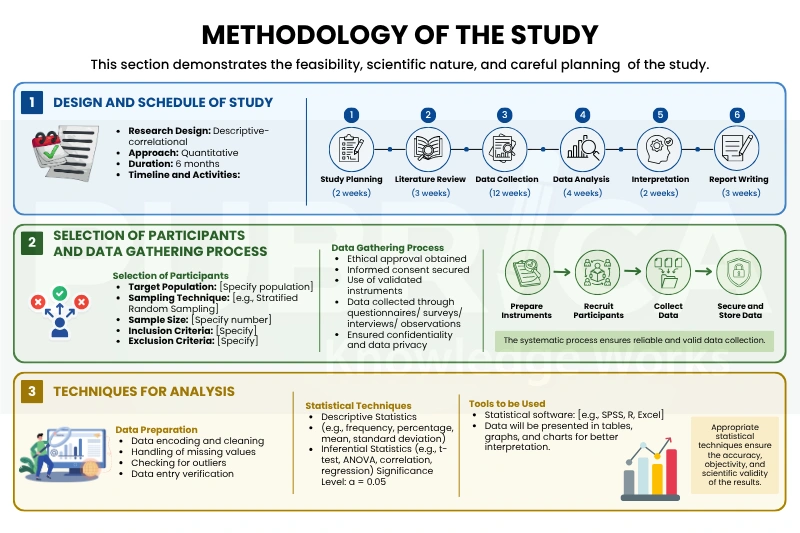
5. Methodology Overview
Describe your methodology concisely as follows: [5]
This makes a case for the feasibility, scientific nature, and planning involved in the study.
6. Ethical and Practical Considerations
Ethical considerations of the research project should also be noted: [6]
- Ethics approval: Mention whether there will be any involvement of humans or animals.
- Honesty and integrity: Ensure that the research methodology maintains academic integrity.
- Potential problems: Note possible hurdles and measures to deal with them.
This will enhance the validity of your research study rationale.
Connect with us to explore how we can support you in maintaining academic integrity and enhancing the visibility of your research across the world!
Conclusion
The rationale is crucial in academic research, highlighting the relevance, uniqueness, and necessity of your study. A well-written rationale for research study identifies the problem, gaps, methods, and contributions. Knowing how to write the rationale for research, using a rationale example, or understanding how to write a rationale for a research proposal or project ensures clarity and purpose. Clearly defining what is the rationale of a research study strengthens its feasibility, significance, and originality. Without a proper rationale, the research risks failure.
How to Write the Rationale for Research? Our Pubrica consultants are here to guide you. [Get Expert Publishing Support] or [Schedule a Free Consultation]
References
- Herek, G.M. (2010). Developing a Theoretical Framework and Rationale for a Research Proposal. In: Pequegnat, W., Stover, E., Boyce, C. (eds) How to Write a Successful Research Grant Application. Springer, Boston, MA. https://doi.org/10.1007/978-1-4419-1454-5_12
- Paparini, S., Green, J., Papoutsi, C. et al.Case study research for better evaluations of complex interventions: rationale and challenges. BMC Med 18, 301 (2020). https://doi.org/10.1186/s12916-020-01777-6
- Sutton, B. (1993). The rationale for qualitative research: A review of principles and theoretical foundations. The Library Quarterly, 63(4), 411–430. https://doi.org/10.1086/602619
- Institute of Medicine (US) Committee on Health Research and the Privacy of Health Information: The HIPAA Privacy Rule; Nass SJ, Levit LA, Gostin LO, editors. Beyond the HIPAA Privacy Rule: Enhancing Privacy, Improving Health Through Research. Washington (DC): National Academies Press (US); 2009. 3, The Value, Importance, and Oversight of Health Research. Available from: https://www.ncbi.nlm.nih.gov/
- Garg R. (2016). Methodology for research I. Indian journal of anaesthesia, 60(9), 640–645. https://doi.org/10.4103/0019-5049.190619
- Miteu G. D. (2024). Ethics in scientific research: a lens into its importance, history, and future. Annals of medicine and surgery (2012), 86(5), 2395–2398. https://doi.org/10.1097/MS9.000
