
- Services
- Discovery & Intelligence Services
- Publication Support Services
- Sample Work
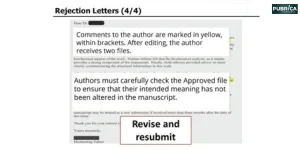
Publication Support Service
- Editing & Translation
-
Editing and Translation Services
- Sample Work

Editing and Translation Service
-
- Research Services
- Sample Work
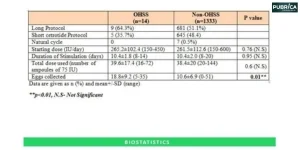
Research Services
- Physician Writing
- Sample Work

Physician Writing Service
- Statistical Analyses
- Sample Work
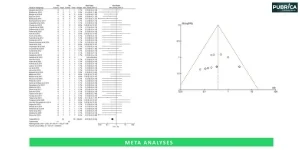
Statistical Analyses
- Data Collection
- AI and ML Services
- Sample Work

AI and ML Services
- Medical Writing
- Sample Work
Medical Writing
- Research Impact
- Sample Work
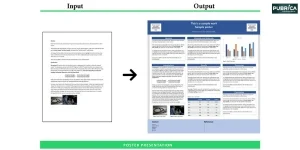
Research Impact
- Medical & Scientific Communication
- Sample Work
Medical & Scientific Communication
- Medico Legal Services
- Educational Content
- Academic Editorial Services
- Sample Work
Academic Editorial Services
- Educational Editorial Service
-
Education Editorial Services
- Sample Work
Education Editorial Services
-
- Industries
- Subjects
- About Us
- Academy
- Insights
- Contact Us
A Comprehensive and Analytical Study of Conjunctions: Classification, Functions, and Syntactic Usage
High-Impact Journals
Interesting topics
A Comprehensive and Analytical Study of Conjunctions: Classification, Functions, and Syntactic Usage
Table of Contents
1. Understanding Conjunctions
2. Classification of Conjunctions
3. Coordinating Conjunctions
4. Subordinating Conjunctions
5. Correlative Conjunctions
6. Functional Significance of Conjunctions
7. Syntactic Usage of Conjunctions
8. Conjunctions in Academic and Professional Writing
9. Conclusion
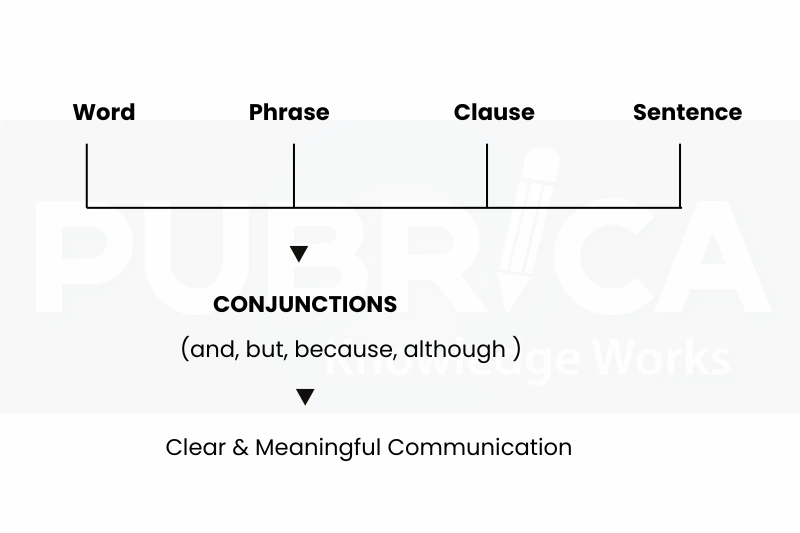
In language, there are different grammatical components used in creating meaningful communication, and conjunctions happen to be among the most important ones. Conjunction usage acts as connecting components of language, connecting words, phrases, clauses, and sentences to establish some logical connection between the ideas expressed. The absence of conjunctions in a language would make it difficult for communication to take place because there would be no coherent flow of ideas from one point to another. [1]
1. Understanding Conjunctions
Conjunctions are grammatical devices used to link linguistic elements in sentences. The main function of is to build connections between things and ensure syntactic cohesion. By means of conjunction usage, one can communicate addition, opposition, consequence, condition, and sequence logically and concisely.
Thus, for instance, in the sentence “
The researcher gathered data and analysed the results,” the coordinating conjunction and connects two actions. Likewise, in the sentence “Although the sample size was limited, the outcomes were highly important,” the subordinating conjunction although establishes an opposition between two notions.
2. Classification of Conjunctions
Types of conjunctions are generally classified into three major categories based on their grammatical functions and syntactic behaviour. [2]
| Type of Conjunction | Function | Examples |
| Coordinating Conjunctions | Join words, phrases, or clauses of equal importance | and, but, or, yet, so |
| Subordinating Conjunctions | Connect dependent clauses to independent clauses | because, although, since, while |
| Correlative Conjunctions | Work in pairs to connect parallel elements | either…or, neither…nor, both…and |
3. Coordinating Conjunctions
Coordinating conjunctions join grammatical elements that are equal in importance within a sentence structure. They are used in connecting ideas without making either one of them subordinate.
Example: The students finished their assignment and handed it in on time. (Follows FANBOYS rule).
3.1. Subordinating Conjunctions
Subordinating conjunctions form a relation between an independent and a dependent clause within a sentence. They are usually used to indicate causation, condition, time, and contrast.
Example: The experiment was conducted again as the first results were not conclusive.
3.2. Correlative Conjunctions
Correlative conjunctions work in pairs and relate equal grammatical elements together.
Example: Not only did the participants, but also the researchers, gain something from the experiment.
4. Functional Significance of Conjunctions
There are many uses of conjunctions, each of which makes them useful in communicating effectively in a language. The first use of conjunctions includes showing addition. There are some conjunctions, such as ‘and’ and ‘furthermore,’ which are employed to extend the idea by mentioning other information. [3]
A second use of conjunctions includes showing contrast. There are some conjunctions, such as ‘but,’ ‘although,’ and ‘however,’ that make contrasts between different concepts and situations clear.
Another use is causation. Subordinating conjunctions such as ‘because,’ ‘since,’ and ‘therefore’ are useful in explaining causes and consequences. Conditions and time sequence are also expressed using subordinating conjunctions such as ‘if,’ ‘unless’ ‘when,’ and ‘before.
5. Syntactic Usage of Conjunctions
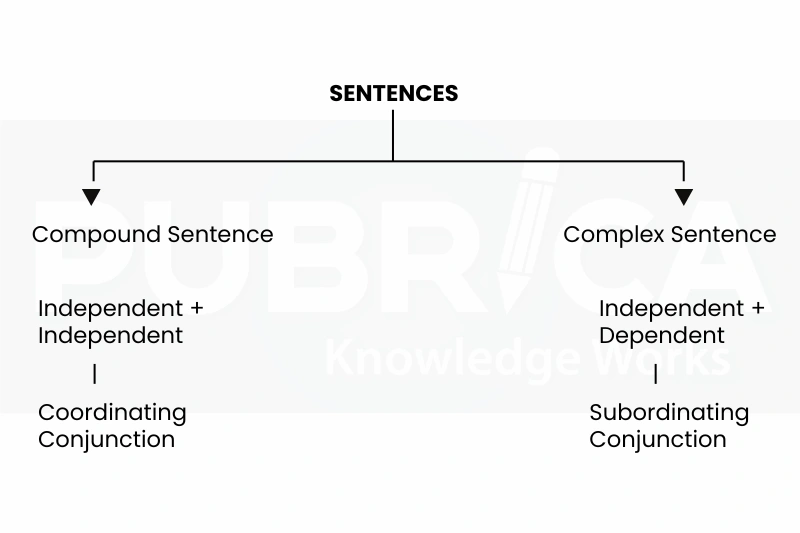
On the syntax level, conjunction usage is very important because it helps form both compound and complex sentences. Coordinating conjunctions are used to join two independent clauses in a compound sentence.
For example, the survey was conducted online, and the data were gathered in a week.
Subordinating conjunctions are used to introduce dependent clauses in complex sentences.
For example, although the information was correct, additional investigation had to be done. Using the correct conjunctions improves sentence diversity and eliminates repetition, while misuse may result in ambiguity and faulty sentences.
6. Conjunctions in Academic and Professional Writing
Conjunctions play an important role in academic writing. Many research papers, articles, and other academic works use conjunction usage to explain their arguments, findings, and conclusions. Proper use of conjunctions allows writers to lead the audience through the information provided. [1]
In business communication, it is also important to use conjunctions properly for organisational purposes. This will make the messages sent concise, coherent, and effective.
Connect with us to explore how we can support you in maintaining academic integrity and enhancing the visibility of your research across the world!
Conclusion
Conjunctions are basic elements of language that help establish links between ideas and form coherent discourse. With categorisation into coordinating, subordinating, and correlative conjunctions, the function of a conjunction becomes versatile. Besides its syntactical function of linking ideas, conjunction usage contributes to the complexities of sentence structure. Understanding types of conjunctions and their correct usage is essential for effective academic writing and professional communication.
A Comprehensive and Analytical Study of Conjunctions: Classification, Functions, and Syntactic Usage. Our Pubrica consultants are here to guide you. [Get Expert Publishing Support] or [Schedule a Free Consultation]
References
- Safari, M., & Mahdavirad, F. (2024). The evolving trajectory of conjunction use in the ELT research articles. Frontiers in research metrics and analytics, 9, 1337836. https://doi.org/10.3389/frma.2024.1337836
- Roland, D., Dick, F., & Elman, J. L. (2007). Frequency of Basic English Grammatical Structures: A Corpus Analysis. Journal of memory and language, 57(3), 348–379. https://doi.org/10.1016/j.jml.2007.03.002
- Bott, L., Frisson, S., & Murphy, G. L. (2009). Interpreting conjunctions. Quarterly journal of experimental psychology (2006), 62(4), 681–706. https://doi.org/10.1080/17470210802214866