
- Services
- Discovery & Intelligence Services
- Publication Support Services
- Sample Work

Publication Support Service
- Editing & Translation
-
Editing and Translation Services
- Sample Work

Editing and Translation Service
-
- Research Services
- Sample Work
Research Services
- Physician Writing
- Sample Work

Physician Writing Service
- Statistical Analyses
- Sample Work
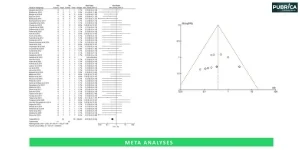
Statistical Analyses
- Data Collection
- AI and ML Services
- Sample Work
AI and ML Services
- Medical Writing
- Sample Work
Medical Writing
- Research Impact
- Sample Work

Research Impact
- Medical & Scientific Communication
- Sample Work
Medical & Scientific Communication
- Medico Legal Services
- Educational Content
- Academic Editorial Services
- Sample Work
Academic Editorial Services
- Educational Editorial Service
-
Education Editorial Services
- Sample Work
Education Editorial Services
-
- Industries
- Subjects
- About Us
- Academy
- Insights
- Contact Us
How to Choose the Right Data Collection Methods
- Home
- Academy
- Data Collection
- How to Choose the Right Data Collection Methods
High-Impact Journals
Interesting topics
How to Choose the Right Data Collection Methods
Table of Content
1. The Importance of Selecting the Right Data Collection Method
2. Key Considerations Before Choosing a Method
3. Research Objectives
4. Ethical Considerations
5. Popular Data Collection Techniques and Examples
6. Step-by-Step Guide to Selecting the Best Method
7. Best Practices for Reliable Data Collection
8. Conclusion
The collection of data collection methods forms the core of any research methodology worth its name. In fact, the approaches you adopt have a direct bearing on the validity and reliability of your findings. By choosing the appropriate method, you ensure that the information collected by you can be trusted and will also serve an actionable purpose. Additionally, selecting the right data collection tools helps in identifying patterns and trends accurately, allowing for meaningful analysis. It also minimises errors and biases that could distort your results. The choice of method influences how efficiently you can gather primary data and the ease with which participants can provide information. Finally, the correct approach ensures that your research is ethically sound and aligns with the overall objectives of your study, supporting principles of ethical research. [1]
1. The Importance of Selecting the Right Data Collection Method
Choosing the right technique for data collection methods is not only a technical issue; it can influence the success of the whole research methodology project. The advantages are:
- Accuracy and Validity: Guarantees that the measurements correspond to the phenomena under consideration.
- Suitability to the Research Problem: Allows addressing the research problem successfully.
- Reproducibility and Reliability: Minimises errors and enables replication by other scientists.
- Ethics: Promotes participant confidentiality and scientific integrity.
- Effective Resource Management: Helps save time and money.
Example: In research that aims at evaluating a new educational program, the use of a standardised test will guarantee objective measurement of the results using quantitative research or qualitative research techniques, depending on the objective.
2. Key Considerations Before Choosing a Data Collection Method
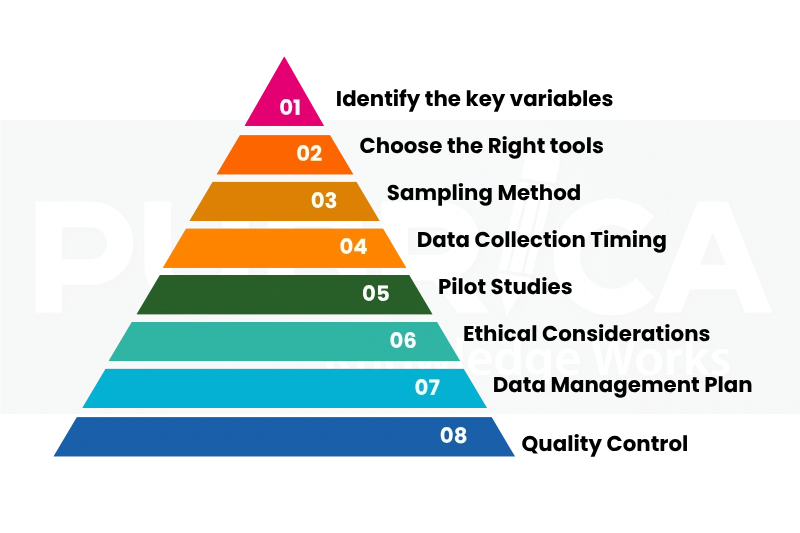
It is crucial to select a suitable approach for collecting data through proper planning. Several aspects must be considered by the researchers to ensure the appropriateness of the selected data collection methods for their studies:
3. Research Objectives
Specify precisely what you would like to measure or investigate. Knowledge of your research objective will aid in choosing the right research design or method of investigation.
- Are you researching behavioural, attitudinal or observable aspects?
- Is there a hypothesis that needs to be proven or a phenomenon that needs to be investigated?
Examples:
- Learning about the motivation of employees – interviews
- Measuring trends in sales – surveys
3.1. Type of Data Required
The type of data needed influences the choice of collection method. Data can be quantitative, qualitative, or mixed. [2]
Data Type | Methods | Purpose |
Quantitative | Surveys, Experiments | Statistical analysis, hypothesis testing |
Qualitative | Interviews, Focus Groups | Understanding perceptions, experiences |
Mixed Methods | Surveys + Interviews | Combines numeric data with personal insights |
3.2. Study Design
Research design assists in deciding upon the most suitable data collection methods.
- Descriptive Research: Observation and Survey
- Experiment Research: Laboratory and Field Experiment
- Exploratory Research: Interviews and Focus Group
- Explanatory Research: Mixed Methodology
3.3. Resources
Evaluate the availability of the resources to determine the feasibility of the plan for data collection tools.
- Financial constraints: Expenses involved in conducting surveys, obtaining software or even compensating participants
- Timeline of study: Available time frame for collecting and analysing data
- Access to participants: The accessibility of the participants
- Professionally trained staff: Skilled individuals for data collection and analysis
4. Ethical Considerations
Ethical considerations are essential in any ethical research. Make sure your data collection methods process considers ethical compliance.
- Get consent from the participants
- Maintain the privacy and confidentiality of the data
- Gain ethics clearance from the relevant boards/committees, where applicable
5. Popular Data Collection Techniques and Examples
Technique | Data Type | Example Use Case |
Surveys/Questionnaires | Quantitative | Customer satisfaction, employee engagement |
Interviews | Qualitative | Exploring patient experiences |
Focus Groups | Qualitative | Community feedback, product testing |
Observations | Qualitative | Classroom or workplace behaviour studies |
Experiments | Quantitative | Clinical trials, marketing experiments |
Document Analysis | Secondary | Policy review, historical research |
Online Data Collection | Mixed | Web surveys, virtual interviews |
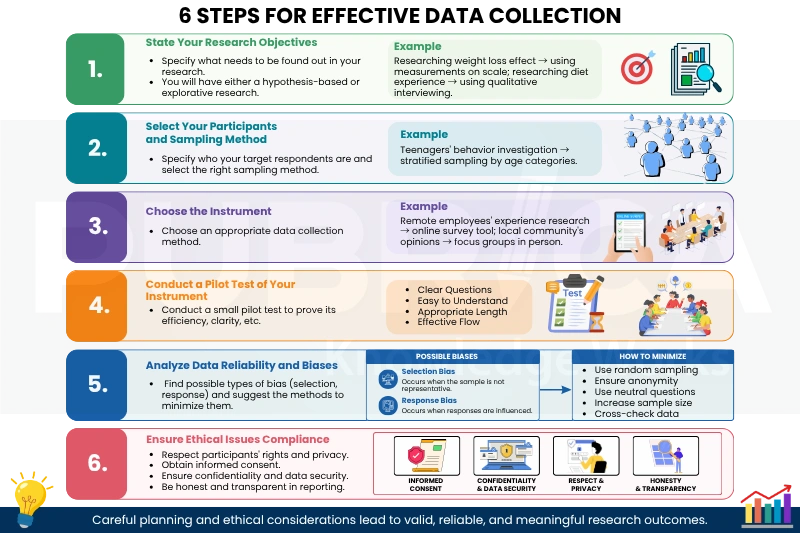
6. Step-by-Step Guide to Selecting the Best Method
Overwhelmed by options? Follow these steps to confidently select the best data collection methods for your research methodology project. [3]
7. Practices for Reliable Data Collection
- Use standardised instruments for measuring.
- Provide training to data collectors to ensure uniformity.
- Constantly monitor and audit the process.
- Record the procedures meticulously.
- Do ethical reviews continuously to safeguard the respondents’ rights.
Tip: Consistency and record-keeping play very important roles in collecting data.
Connect with us to explore how we can support you in maintaining academic integrity and enhancing the visibility of your research across the world!
Conclusion
The selection of an appropriate data collection method can be considered the most important process when conducting any kind of research methodology work. The researcher should make sure that the methodology chosen meets the purpose of the research, the nature of the data collection methods used, resource availability, and ethical research considerations, whether he wants to collect qualitative research, quantitative research, or mixed methods research.
How to Choose the Right Data Collection Methods. Our Pubrica consultants are here to guide you. [Get Expert Publishing Support] or [Schedule a Free Consultation]
References
- A guide to data collection methods: Choosing the right approach. (2025, January 26). Ref-n-Write: Scientific Research Paper Writing Software; Ref-n-Write. https://www.ref-n-write.com/
- Weyant, E. (2022). Research design: Qualitative, quantitative, and mixed methods approach, 5th edition: By John W. Creswell and J. David Creswell, Los Angeles, CA: SAGE, 2018, $38.34, 304pp., ISBN: 978-1506386706. Journal of Electronic Resources in Medical Libraries, 19(1–2), 54–55. https://doi.org/10.1080
- Taherdoost, H. (2016). Sampling methods in research methodology: How to choose a sampling technique for research. SSRN Electronic Journal. https://doi.org/10.2139/